|
|
 |
|
Calanoida ( Order ) |
|
|
|
Diaptomoidea ( Superfamily ) |
|
|
|
Acartiidae ( Family ) |
|
|
|
Acartia ( Genus ) |
|
|
|
Acanthacartia ( Sub-Genus ) |
|
|
| |
Acartia (Acanthacartia) steueri Smirnov, 1936 (F,M) | |
| | | | | | | Ref.: | | | Smirnov, 1936 (p.87, figs.F,M); Brodsky, 1950 (1967) (p.425, figs.F,M); Tanaka, 1965 (p.388, figs.F, M); Kos, 1984 (1985) (p.246, figs.F,M, Rem.); Nishida, 1985 (p.136, figs.F,M, Rem.); Chihara & Murano, 1997 (p.671, Pl.18,19: F,M); Okada & al., 2009 (p.70, Naupliar stages 1-6, figs.1-4, Table 2-4) | 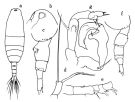 issued from : O. Tanaka in Publs Seto Mar. Biol. Lab., 1965, XII (5). [p.389, Fig.245]. Female: a, habitus (dorsal); b, forehead (left lateral side); c, last thoracic segment and urosome (left lateral side); d, P5; e, proximal portion of A1. Male: f, last thoracic segment and urosome (left lateral side); g, P5.
|
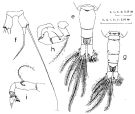 issued from : S. Nishida in Publ. Seto Mar. Biol. Lab., 1985, 30 (1/3). [p.135, Fig.6, e-i]. Female (from Kabira Bay, Ishigaki Is.): e, 5th thoracic segment and urosome (dorsal); f, P5. Male: g, 5th thoracic segment and urosome (dorsal); h, right P5; i, left P5. Nota: In the present specimens, the two ventral spinules on the 2nd abdominal segment described by Tanaka (1965) were present in some but absent in the others, and the presence of these spinules is variable within a local population.
|
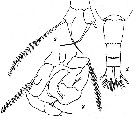 issued from : S. Smirnov in Zool. Anz., 1936, 114 (3-4). [p.88, Fig.1-3]. Female (from Belzow and Petrow Is.: off Vladivostok): 1, urosome (dorsal); 2, P5. Male: 3, P5.
|
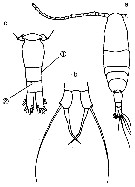 Issued from : M. Chihara & M. Murano in An Illustrated Guide to Marine Plankton in Japan, 1997. [p.676, Pl. 18, fig.9 a-c]. Female: a, habitus (dorsal); b, P5; c, last thoracic segment and urosome (dorsal). Nota: numbers show characteristics of this species to compare with A. fossae, A. tumida.
|
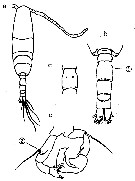 Issued from : M. Chihara & M. Murano in An Illustrated Guide to Marine Plankton in Japan, 1997. [p.677, Pl. 19, fig.9 a-d]. Male: a, habitus (dorsal); b, last thoracic segment and urosome (dorsal); c, 2nd urosomal segment; d, P5. Nota: numbers show characteristics of this species to compare with A. tumida, A. fossae.
|
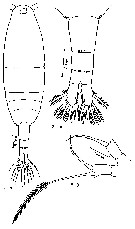 Issued from : M.S. Kos in Issled. Fauny Morei, 1984 (1985), 30 (38). [p.247, Fig.12]. Female (from South Sakhalin Islands): 1, habitus (dorsal); 2, abdomen (dorsal); 3, P5.
|
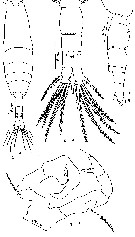 Issued from : M.S. Kos in Issled. Fauny Morei, 1984 (1985), 30 (38). [p.248, Fig.13]. Male (from South Sakhalin Islands): 1, habitus (dorsal); 2, abdomen (dorsal); 3, same (lateral view); 4, P5.
| | | | | Compl. Ref.: | | | Uye, 1980 (p.1); Uye, 1980 (p.1, development); 1980 a (p.11, isochronal development); 1981 (p.255, egg production); Ueda & al., 1983 (p.165, Table 1, 2, 4, swarms); Ueda, 1985 (p.125); Yoo, 1991 (tab.1); Yoo & al., 1991 (p.263); Madhupratap & al., 1996 (p.77, Table 2: resting eggs); Marcus, 1996 (p.143); Ban S, Burns C. & al., 1997 (p.287, Table1, 2, feeding, reproduction); Mauchline, 1998 (tab. 40, 45, 47, 48, 51); Shimode & Shirayama, 2004 (tab.2); Kurihara & al., 2004 a (p.721, Rem.: CO2 effects); Kang HK & Kang YJ., 2005 (p.327, production); Youn & Choi, 2007 (p.222: Table1, egg production); Ohtsuka & al., 2008 (p.115, Table 5); Kang J.-H., 2011 (p.219, occurrences, inter-annual variability vs t° & Sal., Chl.a, Rem.: p.428); Seo & al., 2013 (p.448, Table 1, occurrence); Barton & al., 2013 (p.522, Table 1: metabolism, diapause feeding mode, biogeo); Ohtsuka & Nishida, 2017 (p.565, 578, Table 22.1, Rem.) | | | | NZ: | 3 | | |
|
Distribution map of Acartia (Acanthacartia) steueri by geographical zones
|
| | | | | | 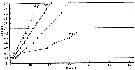 issued from : S.-I. Uye in Bull. Plankton Soc. Japan, 1980, 27 (1). [p.14, Fig.4]. issued from : S.-I. Uye in Bull. Plankton Soc. Japan, 1980, 27 (1). [p.14, Fig.4].
Post-embryonic development of Acartia steueri at 13.1, 16.8, 20.3 and 23.0°C, cultered with excess food.
Nota: Isochronal development may be more advantageous than onoisochronal development for some species to ensure high reproductive potential of the population by reducing the mortality during copepodite stages. |
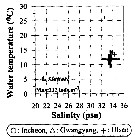 Issued from : J.-H. Kang in Ocean Sci. J., 2011, 46 (4). [p.228, Fig.5] Issued from : J.-H. Kang in Ocean Sci. J., 2011, 46 (4). [p.228, Fig.5]
Abundance-temperature-salinity diagram of A. steueri observed in the seaports from Korea during 3 years (2007-2009). |
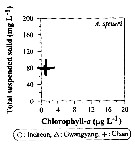 Issued from : J.-H. Kang in Ocean Sci. J., 2011, 46 (4). [p.229, Fig.6] Issued from : J.-H. Kang in Ocean Sci. J., 2011, 46 (4). [p.229, Fig.6]
Abundance-total suspended solid-chlorophyll-a diagram of A. steueri observed in the seaports from Korea during 3 years (2007-2009). |
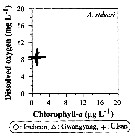 Issued from : J.-H. Kang in Ocean Sci. J., 2011, 46 (4). [p.230, Fig.7] Issued from : J.-H. Kang in Ocean Sci. J., 2011, 46 (4). [p.230, Fig.7]
Abundance-dissolved oxygen-chlorophyll-a diagram of A. steueri observed in the seaports from Korea during 3 years (2007-2009). |
 Issued from : S. Ban, C. Burns, J. Castel, Y. Chaudron & al. in Mar. Ecol. Prog. Ser., 1997, 157. [p.289, Table 1]. Issued from : S. Ban, C. Burns, J. Castel, Y. Chaudron & al. in Mar. Ecol. Prog. Ser., 1997, 157. [p.289, Table 1].
Synopsis of feeding/reproduction experiments. A total of 17 diatom and 16 copepod species, representative of a variety of worldwide temperate and subarctic environments (E: estuarine, C: coastal ocean), were screened.
Data for fecundity and hatching success are average values measured at the start and end of the inciubations in a minimum of 3 replicate batches, showing the variation in time of the effects of diatoms on copepod reproduction.
Level of significance of the diatom effect between treatments and controls (e.g. non-diatom diets) in categories I to III was p < 0.01. No.. rank (for comparison with Table 2, p.290).
For the signification of the categories I to IV (fecundity vs. Hatching success vs. Duration of experiment days-1): See Calanus finmarchicus .
List of the 12 marine or estuarine species studied (fresh water excluded. CR): Acartia clausi, A. grani, A. steueri, A. tonsa, Calanus finmarchicus, C. helgolandicus, C. pacificus, Centropages hamatus, C. typicus, Eurytemora affinis, Temora longicornis, T. stylifera. |
 Issued from : S. Ban, C. Burns, J. Castel, Y. Chaudron & al. in Mar. Ecol. Prog. Ser., 1997, 157. [p.290, Table 2]. Issued from : S. Ban, C. Burns, J. Castel, Y. Chaudron & al. in Mar. Ecol. Prog. Ser., 1997, 157. [p.290, Table 2].
Combinations of copepod and non-diatom diets in controls in concentrations ranging from 104 to 105 cells ml-1. Data for fecundity and hatching success are average values measured at the start and end of incubation in a minimum of 3 replicate batches.
In the Category I. |
| | | | Loc: | | | Kuril Is., China Seas (Yellow Sea), Okinawa (Kabira Bay), S & E Korea, Ilkwang Bay, Ulsan Harbour, Japan Sea (off Vladivostok), S Sakhalin Is., Japan (Ishigaki Is., Manazuru Port, Tanabe Bay, Onagawa Bay, N Kyushu, ? Okkirai Bay: Honshu) | | | | N: | 23 ? | | | | Lg.: | | | (22) F: 1,7-1,5; M: 1,3-1,2; (119) F: 1,6-1,38; M: 1,25-1,13; (287) F: 1,674-1,449; M: 1,306-1,208; (866) F: 1,1-1,6; M: 0,9-1,3; {F: 1,10-1,70; M: 0,90-1,306} | | | | Rem.: | coastal.
After Ueda & al., 1983 (p.167, Table 2 & p.169: Table 4) at Tanabe Bay (A), Shijiki Bay (B, 1978) and (C, 1980): (1)-Shape and diameter of swarm, (2)-depth (m), (3)- swarming position, (4)-number of samples examined, (5)-Mean % of adults, (6)- Mean % of females among adults.
A: (1)- irregular balls (10-50 cm); (2)- 3-10 m; (3)- over rocky shore; (4)- 1; (5)- 43.1; (6)- 55.9.
B: (1)- not determined; (2)- 3-5 m; (3)-throughout entire sea grass beds; (4)-8; (5)- 99.2 (97.5-100.0); (6)- 91.2 (83.3-100.0).
C: (1)- irregular balls (30-60 cm); (2)- 14 m; (3)- over sandy flat bottom; (4)- 1; (5)-50.0; (6)- 37.0.
Ohrsuka & Nishida (2017, p.578) consider this species as a cold-water species on the japanese coasts infuenced by Oyashio waters. | | | Last update : 26/10/2020 | |
|
|
 Any use of this site for a publication will be mentioned with the following reference : Any use of this site for a publication will be mentioned with the following reference :
Razouls C., Desreumaux N., Kouwenberg J. and de Bovée F., 2005-2024. - Biodiversity of Marine Planktonic Copepods (morphology, geographical distribution and biological data). Sorbonne University, CNRS. Available at http://copepodes.obs-banyuls.fr/en [Accessed April 23, 2024] © copyright 2005-2024 Sorbonne University, CNRS
|
|
|
|




 steueri - Plate 1 of morphological figures',750,500);)
 steueri - Plate 2 of morphological figures',750,500);)
 steueri - Plate 3 of morphological figures',750,500);)
 steueri - Plate 4 of morphological figures',750,500);)
 steueri - Plate 5 of morphological figures',750,500);)
 steueri - Plate 6 of morphological figures',750,500);)
 steueri - Plate 7 of morphological figures',750,500);)

 steueri - Distribution map 2',750,500);)
 steueri - Distribution map 3',750,500);)
 steueri - Distribution map 4',750,500);)
 steueri - Distribution map 5',750,500);)
 steueri - Distribution map 6',750,500);)
 steueri - Distribution map 7',750,500);)








 steueri - Plate 1 of morphological figures)
 steueri - Plate 2 of morphological figures)
 steueri - Plate 3 of morphological figures)
 steueri - Plate 4 of morphological figures)
 steueri - Plate 5 of morphological figures)
 steueri - Plate 6 of morphological figures)
 steueri - Plate 7 of morphological figures)
 steueri - Distribution map 2)
 steueri - Distribution map 3)
 steueri - Distribution map 4)
 steueri - Distribution map 5)
 steueri - Distribution map 6)
 steueri - Distribution map 7)