|
|
 |
|
Monstrilloida ( Order ) |
|
|
|
Monstrillidae ( Family ) |
|
|
|
Cymbasoma ( Genus ) |
|
|
| |
Cymbasoma striatum (Isaac, 1974) (F) | |
| | | | | | | Syn.: | Thaumaleus striatus Isaac, 1974 (p.135, Descr.F, figs.F); 1975 (p.3, 9, fig.F); Grygier, 1995 a (p.76) | | | | Ref.: | | | Suarez-Morales, 2000 d (p.140, figs.F); 2002 (p.95: tab.1); Suarez-Morales & Morales-Ramirez, 2003 (p.210: Table 2, p.212: Rem.); Suarez-Morales, 2011 (p.9, as C. striatus); Grygier & Suarez-Morales (p.499: Rem.) | 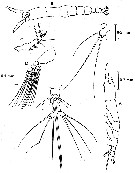 issued from : M.J. Isaac in J. mar. biol. Ass. U.K., 1974, 54. [p.135, Fig.7]. As Thaumaleus striatus. Female (from N of Land's End): A-B, habitus (lateral and dorsal, respectively); C, right A1 (ventral); D, P3; E, last thoracic segment and abdomen (ventral); F, P5. B same scale as A; C, E same scale as D.
|
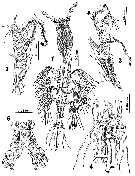 issued from : E. Suarez-Morales in Beaufortia, 2000,50 (7). [p.141, Figs.1-5]. Female (holotype): 1, habitus (dorsal); 2, left A1 (dorsal); 3, right A1 (dorsal); 4, P5 and genital area (ventral); 5, anal somite and caudal rami (dorsal). Nota: Cephalothorax accounting for 55 % of total body length. Forehead with medial protuberance formed by several bumps with irregular arrangment. Pair of short sensilla inserted widely apart from each other. Anterior part of cephalothorax with a wide fringe of fine cuticular striations running around the body, and covering almost half the length of cephalothorax. Nauplius eye present, well developed, ocelli large, slightly pigmented on inner half, rounded, separate to each other by a distance equal to 80 % of an eye diameter. A1 4-segmented; ratio of length of segments 9.5:33.4:16.5:40.6 = 100; A1 relatively short, slightly longer than 21 % of total body length. P5 represented by a single lobe, elongated, separated at base; lobe armed with 3 long, lightly plumose setae (2 outer subequal in length and breadth, innermost much shorter; outer setae reach about halfway of anal somite. Urosome consisting of 5th pedigerous somite, genital double-somite, and 1 free abdominal somite, ratio of length 38.5:34.6:26.9 = 100. Genital double-somite bearing pair of long ovigerous spines, basally separated, inserted on middle of ventral surface, representing about 34 % of total body length. Caudal rami subquadrate, 1.2 times longer than wide, bearing 3 terminal setae subequal in length and breadth.
|
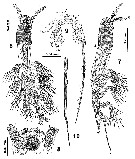 issued from : E. Suarez-Morales in Beaufortia, 2000,50 (7). [p.142, Figs.6-10]. Female: 6, habitus (dorsal); 7, idem (lateral); 8, cephalic area (ventral); 9, P3; 10, distal part of ovigerous spines. Nota: Oral papilla lying midventrally 0.18 of way back along cephalothorax.
|
 issued from : E. Suarez-Morales in Beaufortia, 2000,50 (7). [p.143]. Female: Armature of swimming legs P1 to P4. Roman numeral = spine; arabic numeral = seta.
|
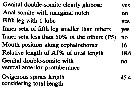 Issued from : Suarez-Morales in Mitt. Mus. Nat.kd. Berl., Zool. Reihe, 2002, 78. [p.95, Table 1]. Comparison of main taxonomic features in species of Cymbasoma with a cephalothorax relative length equal or over 60%, females only: C. striatus (Isaac, 1975). Mouth position way back anterior part of forehead in percentage of the cephalothorax length. Compare with C. bowmani, C. boxshalli, C. longispinosum, C. morii, C. nicolettae, C. quintanarooense, C. thompsoni, C. tumorifrons, C. sp. (from Brazil), C. chelemense.
|
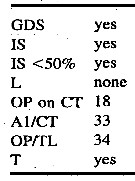 Issued from : E. Suarez-Morales & A. Morales-Ramirez in Proc. Biol. Soc. Washington, 2003, 116 (1). [p.210, Table 2]. Selected taxonomic features in Cymbasoma striatum. GDS = anterior half genital double-somite globose; IS = inner seta of P5 smallest; IS <50% = inner seta <50% as long as others; L = longest seta on P5; OP on CT = position of oral papilla on cephalothorax; AI/CT = relative length (as a percent) of A1 to cephalothorax; = relative length (as a percent) of position of oral papilla anteriorly on cephalothorax; T = transverse striations on ''neck'' area. Compare with species of Cymbasoma with uniramous P5 armed with 3 setae: C. concepcionae, C. reticulatum, C. bowmani, C. quintanarooense, C. boxshalli, C. bali, C. frondipes, C. claparedi, C. tumorifrons.
| | | | | NZ: | 1 | | |
|
Distribution map of Cymbasoma striatum by geographical zones
|
| | | | Loc: | | | E English Channel (Cap Land's End) | | | | N: | 2 | | | | Lg.: | | | (731) F*: 0,95; {F: 0,95}
* without caudal rami | | | | Rem.: | According to Suarez-Morales (2000 d, p.144) this species is the most similar to Cymbasoma tumorifro,ns.
Cf Table 2 from Lian & Tan (2019) in C. cheni. | | | Last update : 12/02/2020 | |
|
|
 Any use of this site for a publication will be mentioned with the following reference : Any use of this site for a publication will be mentioned with the following reference :
Razouls C., Desreumaux N., Kouwenberg J. and de Bovée F., 2005-2024. - Biodiversity of Marine Planktonic Copepods (morphology, geographical distribution and biological data). Sorbonne University, CNRS. Available at http://copepodes.obs-banyuls.fr/en [Accessed April 23, 2024] © copyright 2005-2024 Sorbonne University, CNRS
|
|
|
|




;)
;)
;)
;)
;)
;)