|
|
 |
|
Calanoida ( Order ) |
|
|
|
Clausocalanoidea ( Superfamily ) |
|
|
|
Aetideidae ( Family ) |
|
|
|
Gaetanus ( Genus ) |
|
|
| |
Gaetanus kruppii Giesbrecht, 1903 (F,M) | |
| | | | | | | Syn.: | Gaetanus major Wolfenden, 1903 (in Fowler, 1903 (p.125); 1904 (p.114, figs.F, Rem.M); Pearson, 1906 (p.14, Rem.); Wolfenden, 1908 (p.31); Farran, 1908 b (p.36); Wolfenden, 1911 (p.231, Rem.); Farran, 1926 (p.249, Rem.); Lysholm & Nordgaard, 1921 (p.14);
? G. antarcticus Brady, 1918 (p.19, figs.F);
Gaetanus microcanthus C.B. Wilson, 1950 (p.231, figs.F,M); Björnberg, 1973 (p.323, 386);
no G. kruppii : Sewell, 1947 (p.62, figs.M) | | | | Ref.: | | | Giesbrecht, 1903 (p.202, figs.F,M); Wolfenden, 1908 (p.32, Rem.); A. Scott, 1909 (p.48, figs.F, Rem.F,M); With, 1915 (p.97, figs.F,M); Sars, 1925 (p.61, figs.F,M); Sewell, 1929 (p.102); Rose, 1929 (p.19); Wilson, 1932 a (p.52, figs.F,M); Rose, 1933 a (p.99, figs.F,M); Jespersen, 1934 (p.62); 1940 (p.22); Lysholm & al., 1945 (p.17); Sewell, 1947 (p.58, 62, 64, Rem.F, non M, non figs.M, Rem.); C.B. Wilson, 1950 (p.231); Vervoort, 1952 e (n°46, p.3, figs.F,M); Tanaka, 1957 b (p.169, figs.F,M); Vervoort, 1963 b (p.126, Rem.); Mazza, 1965 a (p.285, figs.juv., F,M); 1966 (p.54: figs.F,M, p.55: Rem.); 1967 (p.123, 139, 367, 387, figs.juv., F,M); Owre & Foyo, 1967 (p.44, figs.F,M); Mazza, 1968 (p.533, figs.); Tanaka, 1969 (p.261: Rem., fig.4i: F); Tanaka & Omori, 1970 (p.135, figs.M, Rem.F); Razouls, 1972 (p.94, Annexe: p.43, figs.F); Park, 1975 a (p.24, figs.M); 1978 (p.136, figs.F); Bradford & Jillett, 1980 (p.48, figs.F,M, Rem.M, as kruppi, distribution chart); Markhaseva, 1996 (p.196, figs.F,M); Chihara & Murano, 1997 (p.687, Pl.43,44: F,M); Bradford-Grieve & al., 1999 (p.879, 922, figs.F,M); Yamaguchi & al., 2005 (p.835, Tabl. VIII); Vives & Shmeleva, 2007 (p.577, figs.F,M, Rem.) | 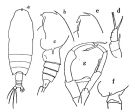 issued from : Tanaka O. in Publ. Seto Mar. Biol. Lab., 1957, 6 (2). [Fig.41, p.170]. Female (from Sagami): a, habitus (dorsal aspect); b, head (lateral aspect); c, last thoracic segment and urosome (lateral aspect); d, exopodite of P1. Male: e, head (lateral aspect); f, last thoracic segment (lateral aspect); g, P5. Nota Female: - Cephalothorax about 3.75 times the abdomen length (3.95 : 1.00). - Forehead with a median spine directing forwards and slightly downwards. - Rostrum short. - Last thoracic segment with lateral spines slightly divergent , reaching the middle of genital segment. - Abdomen 4-segmented; segments and caudal rami proportional lengths 42 : 17 : 12 : 12 : 17 = 100. - Caudal rami a little longer than wide. - A1 24-segmented, extends beyond distal end of abdomen by last 3 segments. - A2 exopod about 1.2 times as long as endopod; distal segment of endopod bears 14 setae. - Md with a small exopod. - Mx1 with 7+2 setae on outer lobe; 11 setae on exopod; 4+4+7 setae on endopod; 5 setae on 2nd basal; 4 setae on 3rd inner lobe; 4 setae on 2nd inner lobe; 3rd inner lobe with, beside 4 setae, a conical process. - Mxp with a lamellous process on the middle of the anterior surface of 1st basal segment. - P1 with an articular membrane between 1st and 2nd exopodal segment. - P2 with 20 teeth on terminal spine of exopod; teeth are connected by a short lamella; endopod 2-segmented. - P3 with 21 teeth on terminal spine of exopod. - P4 with 14 stiff triangulary pointed marginal bristles on posterior surface of coxa. Nota Male: - Cephalothorax about 3.35 times the abdomen length. - Cephalic spine slender and long. - Rostrum more clumsy. - Lateral spines of last thoracic segment shorter than female. - Abdomen 5-segmented; segments and caudal rami proportional lenths 20 : 28 : 22 : 15 : 3 : 12 = 100. - Caudal rami about as long as wide - A1 22-segmented, segmentation in 8th to 14th segments are, as stated by With, difficult to make out. - A2 exopod about as long as endopod; 1st exopodal segment furnished with hairs on the posterior margin; 1st segment of endopod rather clumsy. - Md with a broad 2nd basal segment furnished with a single short seta; both exopod and endopod well developed. - Mx1 slightly reduced; outer lobe with 7, long setae and 2 short ones; exopod with 11 setae; endopod with 5+2+2 setae; 2nd basal segment with 1 long and 2 short setae. - Mx2 much reduced and soft-skinned. - Mxp without lamellous process on 1st basal segment (as observed in female); distal part of 1st basal segment is produced into a claw-like lamellous process. - P1, outer edge spine of 2nd exopodal segment represented by a minute spinule. - Terminal spine of exopod of P2 with 29 to 34 teeth; that of P3 and P4 with each 28 and 30 teeth respectively. - P5 (as described by With), but the small process at base of 3rd exopodal segment of left leg was not observed in the present specimen.
|
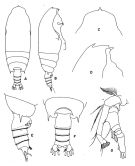 issued from : T. Park in Antarctic Res. Ser. Washington, 1978, 27. [p.137, Fig.21]. Female: A, habitus (dorsal view); B, idem (right lateral side); C, forehead (dorsal view); D, idem (right lateral side); E, posterior part of metasome and urosome (rignt lateral side); F, idem (dorsal view); G, A2.
|
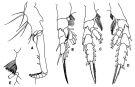 issued from : T. Park in Antarctic Res. Ser. Washington, 1978, 27. [p.138, Fig.22]. Female: A, Mxp; B, P1; C, P2; D, P3; E, medial part of coxa of P4 (posterior). P1-3: legs (anterior view).
|
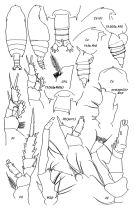 issued from : E.L. Markhaseva in Proc. Zool. Inst. RAN, St. Petersburg, 1996, 268. [p.200, Fig.157]. Female (from different specimens of Izu-Bonin Trench and SE Pacif.). Ce: forehead (lateral and dorsal).
|
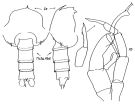 issued from : E.L. Markhaseva in Proc. Zool. Inst. RAN, St. Petersburg, 1996, 268. [p.201, Fig.158]. Male (from SE Pacif.)
|
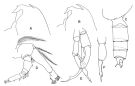 issued from : T. Park in Bull. Mar. Sci., 1975, 25 (1). [p.24, Fig.8]. Male: A, B, forehead (showing a variability of the cephalic process of rostrum); C, posterior part of metasome and urosome (lateral); D, A2; F, fifth pair of legs (posterior); F, last two exopodal segments of left fifth leg (medial). Note: In habitus, the male closely resembles that of G. pileatus. See: left fifth leg ( length of the endopod and characteristic third exopodal segment) and presence of setae on the second exopodal segment of A2
|
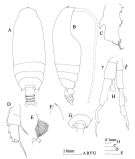 issued from : J.M. Bradford & J.B. Jillett in Mem. N.Z. Oceanogr. Inst., 86, 1980. [p.50, Fig.32]. As .
Female: A, habitus (dorsal); B, idem (lateral right side); C, basipod 1 of Mxp; D, exopod of P1; E, inner border of basipod 1 of P4.
Nota: The south-west specimens have long posterior metasomal points and a metasome with a length less than three times its width.
Male: F, forehead (lateral); G, posterior of thorax and 1st urosomal segment (dorsal); H, P5 (r = right; l = left).
Nota: Right P5 endopod not reaching beyond left leg endopod, left leg endopod about two thirds length of left leg exopod joint 1 and may be two-jointed.
|
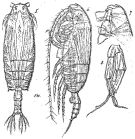 Issued from: G.O. Sars in Résult. Camp. Scient. Prince Albert I, 69, pls.1-127 (1924). [Pl.XVIII, figs.5-8]. Female: 5, habitus (dorsal); 6, idem (lateral left side). Male: 7, forehead (lateral); 8, P5. Nota Female: - Abdomen length about 1/3 cephalthorax. - Genital segment as lon as than the two following segments together, and swollen ventrally.
|
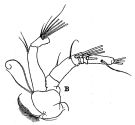 issued from : R.B.S. Sewell in The John Murray Expedition, 1933-34, Scientific Reports, VIII (1), 1947. [p.63, Fig.10, B]. Female (from Arabian Sea): B, A2.
|
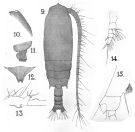 issued from : A. Scott in Siboga-Expedition, 1909, XIX a. [Plate IX, Figs.9-15]. Female (from Indonesia-Malaysia): 9, habitus (dorsal); 10, forehead (lateral); 11, last thoracic and genital segments (left side); 12, rostrum; 13, Mxp (basal portion); 14, P1; 15, P4 (basal portion).
|
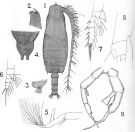 issued from : A. Scott in Siboga-Expedition, 1909, XIX a. [Plate X, Figs.1-9]. Male (from Indonesia-Malaysia): 1, habitus (dorsal); 2, forehead (lateral); 3, last thoracic and genital segments (left side); 4, rostrum; 5, Mxp; 6, P1; 7, P2; 8, P4 (basal portion); 9, P5.
|
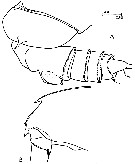 issued from : C. Razouls in Th. Doc. Etat Fac. Sc. Paris VI, 1972, Annexe. [Fig.43, A, B]. Female (from Banyuls, G. of Lion): A, thoracic segment 5 and urosome (lateral); B, forehead (lateral).
|
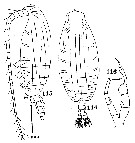 issued from : C.B. Wilson in Bull. U.S. natn. Mus., 1950, 100, 14 (4). [Pl. 11, Figs.114-116]. As Gaetanus microcanthus. Female (from 11°30'S, 87°19'W): 114-115, habitus (dorsal and lateral, respectively). Male: 116, P5.
|
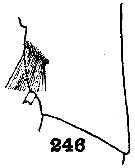 issued from : C.B. Wilson in Bull. U.S. natn. Mus., 1950, 100, 14 (4). [Pl. 19, Fig.246]. As Gaetanus microcanthus. Female: 246, basipod of P4.
|
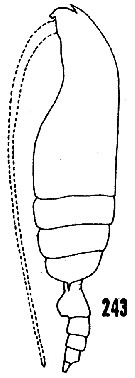 issued from : H.B. Owre & M. Foyo in Fauna Caribaea, 1, Crustacea, 1: Copepoda. Copepods of the Florida Current. [p.44, Fig.243]. Female (from 23°38'N, 83°06'W): 243, habitus (lateral).
|
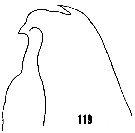 issued from : H.B. Owre & M. Foyo in Fauna Caribaea, 1, Crustacea, 1: Copepoda. Copepods of the Florida Current. [p.26, Figs.119]. Female: forehead (lateral).
|
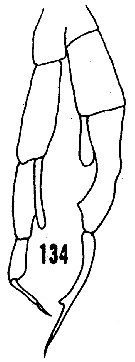 issued from : H.B. Owre & M. Foyo in Fauna Caribaea, 1, Crustacea, 1: Copepoda. Copepods of the Florida Current. [p.29, Fig.134]. Male: 134, P5.
|
 Gaetanus krupii Gaetanus krupii female: 1 - Anterior part of cephalon with frontal spine. 2 - Exopodal segment 1 of A2 without seta, segment 2 with 2 setae. 2nd internal lobe of Mx1 with 4 setae. Exopod of P1 always with 2 external sopines. 3 - Mxp protopodite with lateral plate. 4 - Exopodal segment 2 of A2 with 2 setae. 5 - Spines on last thoracic segment directed straight backward (lateral view). 6 - Exopod of P1 3-segmented. Endopod of P2 2-segmented.
|
 Gaetanus krupii Gaetanus krupii male: 1 - Cephalon with frontal spine. 2 - Exopodal segment 3 of left P5 prolonged, stylet-like, never bilobated. It is always longer than exopodal segment 2. 3 - Frontal spine is in anterior part of cephalon dorsally (lateral view), well visible. 4 - Spines on last thoracic segment significantly shorter than in G. simplex. 5 - Endopod of left P5 longer than half length of exopodal segment 1, or even longer.
|
 issued from : Tanaka O. in Publ. Seto Mar. Biol. Lab., 1957, 6 (2). [p.170]. Female A1: proportional lengths of segments. - A1 24-segmented, extends beyond distal end of abdomen by last 3 segments. - With describes that segments 2, 8-9 and 20 are about equal lengths, but in the Japanese specimen the 20th is the longest.
|
 issued from : Tanaka O. in Publ. Seto Mar. Biol. Lab., 1957, 6 (2). [p.171]. Male A1: proportional lengths of segments. - A1 extends to the middle of 3rd abdominal segment . - Segmentation in 8th to 14th segments are difficult to see.
| | | | | Compl. Ref.: | | | Wilson, 1942 a (p.187); Massuti Alzamora, 1942 (p.110); Sewell, 1948 (p.330, 500, 508, 520, 529, 531, 534, 539, 545, 556, 566); C.B. Wilson, 1950 (p.231); Fagetti, 1962 (p.18); V.N. Greze, 1963 a (tabl.2); Grice, 1963 a (p.495); Gaudy, 1963 (p.22, Rem.); De Decker & Mombeck, 1964 (p.12); Mazza, 1966 (p.70); Furuhashi, 1966 a (p.295, vertical distribution in Oyashio region); Grice & Hulsemann, 1967 (p.15); 1968 (tab.2); Vinogradov, 1968 (1970) (p.268); Evans, 1968 (p.13); Roe, 1972 (p.277, tabl.1, tabl.2); Bainbridge, 1972 (p.61, Appendix Table III: occurrence); Björnberg, 1973 (p.323, 386); Vives & al., 1975 (tab.II); Gaudy, 1975 (p.109, fig.1, Table I, 4, respiration); Deevey & Brooks, 1977 (p.256, tab.: as kruppi<*em>, Station "S"); Vaissière & Séguin, 1980 (p.23, tab.2); Kovalev & Schmeleva, 1982 (p.83); Vives, 1982 (p.291); Scotto di Carlo & Ianora, 1983 (p.150); Scotto di Carlo & al., 1984 (p.1042); Lozano Soldevilla & al., 1988 (p.58); Pancucci-Papadopoulou & al., 1990 (p.199); Scotto di Carlo & al., 1991 (p.270); Suarez Gasca, 1991 (tab.2); Suarez, 1992 (App.1); Suarez-Morales & Gasca, 1998 a (p108); Lapernat, 2000 (tabl. 3, 4); Razouls & al., 2000 (p.343, Appendix); Holmes, 2001 (p.48); Sameoto & al., 2002 (p.12); Fernandes, 2008 (p.465, Tabl.2); Galbraith, 2009 (pers. comm.); Licandro & Icardi, 2009 (p.17, Table 4); Park & Ferrari, 2009 (p.143, Table 5, Appendix 1, biogeography); Hidalgo & al., 2010 (p.2089, Table 2); Mazzocchi & Di Capua, 2010 (p.423); Medellin-Mora & Navas S., 2010 (p.265, Tab. 2); Brugnano & al., 2012 (p.207, Table 2, 3); Teuber & al., 2013 (p.1, Table 1, abundance vs oxygen minimum zone); Bonecker & a., 2014 (p.445, Table II: frequency, horizontal & vertical distributions) ; Zaafa & al., 2014 (p.67, Table I: as kruppi, occurrence); Bode & al., 2015 (p.268, Table 1, chemical components, trophic level, geographic zone); El Arraj & al., 2017 (p.272, table 2, spatial distribution); Belmonte, 2018 (p.273, Table I: Italian zones); Bode & al., 2018 (p.840, Table 1, respiration & ingestion rates, depth) | | | | NZ: | 20 | | |
|
Distribution map of Gaetanus kruppii by geographical zones
|
| | | | | | | | | | | | | | | 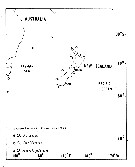 Issued from : J.M. Bradford & J.B. Jillett in New Zealand Ocean. Inst. Memoir, 86, 1980. [p.89, Figs.64]. Issued from : J.M. Bradford & J.B. Jillett in New Zealand Ocean. Inst. Memoir, 86, 1980. [p.89, Figs.64].
Distribution of several species of Gaetanus in the Tasman Sea and around New Zealand. |
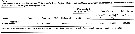 Issued from : M. Bode, R. Koppelmann, L. Teuber, W. Hagen & H. Auel inGlobal Biogeochemical Cycles, 2018, 32. [p.844, Table 1). Issued from : M. Bode, R. Koppelmann, L. Teuber, W. Hagen & H. Auel inGlobal Biogeochemical Cycles, 2018, 32. [p.844, Table 1).
Cf. explanations of these measures in Calanoides natalis from the same authors.
Compare with Gaetanus pileatus, G. brevicornis. |
| | | | Loc: | | | sub-Antarct. (SE Pacif.), South Africa (E), off Tristan da Cunha E, Angola, G. of Guinea, off Lagos, off E St. Paul Is., off NW Cape Verde Is., off Morocco-Mauritania, Canary Is., off Madeira, off Portugal, Azores, Brazil, off Rio de Janeiro, Caribbean Colombia, G. of Mexico, Florida, Sargasso Sea, Station "S" (32°10'N, 64°30'W), off Woods Hole, S Nova Scotia, Faroe Channel, off Ireland (S & W), Bay of Biscay, North Sea, S Strait of Davis, Iceland, Faroe Is., Ibero-moroccan Bay,off W Tangier, Medit. (Alboran Sea, Banyuls, Marseille, Ligurian Sea, Tyrrhenian Sea, Strait of Messina, Malta, Ionian Sea, Lebanon Basin), G. of Aden, Arabian Sea, off SW Sri Lanka, Madagascar (Nosy Bé), Indian, Bay of Bengal, Indonesia-Malaysia, Philippines, Japan (Izu), Mariana Trench, Kuril-Kamchatka, Bering Sea, Vancouver Is., New Zealand, Pacif. (tropical & N central), Marquesas Is., Hawaii, California, off Galapagos, off Peru, off Juan Fernandez Is., Chile (., N).
Type locality: Mediterranean Sea. | | | | N: | 81 | | | | Lg.: | | | (1) F: 5,2; M: 4,1; (2): F: 4-3,6; M: 3,7; (5) F: 5,7; (7) F: 5,4; M: 5,04; (10) F: 5,6-5; (14) F: 5,6-4,7; M: 4,4-4,2; (20) F: 5,66-5,16; (32) F: 4-3,6; M: 3,7; (37) F: 5,7-4,7; M: 5,2-4,5; (38) F: 4,8-4,45; (40) F: 5,25-4,83; M: 4,91-4,32; (45) F: 4,5-3,6; M: 5-3,7; (56) F: 4,95; M: 4,87; (113) F: 5,3-4,7; M: 4,9-4,5; (199) F: 5,28-4,1; M: 4,67; (201) F: 5,4-5; M: 4,6; (207) F: 4,56-3,7; M: 4,04; (260) F: 4,56-3,7; M: 4,04; (866) M: 3,7-5,6; {F: 3,60-5,70; M: 3,70-5,60} | | | | Rem.: | bathypelagic. Sargasso Sea: 500-1500 m (Deevey & Brooks, 1977, station "S");
Sampling depth (sub-Antarct.) : 0-800-2000 m.
Vervoort (1963 b, p.127) follows Sewell (1947, p.62) that G. clarus Esterly (1906, p.57) is the male of G. kruppii, and have no doubt that G. major Wolfenden (1904) is conspecific with G. kruppi, inclining not to attach too much importance to the fact that in Wolenden's desciptions asserted that the lamella is present on the coxa of Mxp; the thin lamella is easily ruptured during dissection or is easily folds under the coxa and becomes more or less invisible.Furthermore, the greatly increased interest in Atlantic deep water copepods would almost certainty have turned up a species of Gaetanus of the G. kruppii type without a lamella if Wolfenden's G. major were a species distinct from G. kruppii.
R. Stephen: Data sheets of NIO, Kochi, India (on line). | | | Last update : 28/10/2022 | |
|
|
 Any use of this site for a publication will be mentioned with the following reference : Any use of this site for a publication will be mentioned with the following reference :
Razouls C., Desreumaux N., Kouwenberg J. and de Bovée F., 2005-2024. - Biodiversity of Marine Planktonic Copepods (morphology, geographical distribution and biological data). Sorbonne University, CNRS. Available at http://copepodes.obs-banyuls.fr/en [Accessed April 25, 2024] © copyright 2005-2024 Sorbonne University, CNRS
|
|
|
|




;)
;)
;)
;)
;)
;)
;)
;)
;)
;)
;)
;)
;)
;)
;)
;)
;)
;)
;)
;)
;)

;)
;)