|
|
 |
|
Calanoida ( Ordre ) |
|
|
|
Clausocalanoidea ( Superfamille ) |
|
|
| |
| | | |
| Kyphocalanidae Markhaseva & Schulz, 2009 ( Clausocalanoidea ) | | Ref.: | Markhaseva & Schulz, 2009 (p.22); Markhaseva & al., 2014 (p.63, 67, 79, Table 1, 2, 3, 4, Rem, Def..); Laakmann & al., 2019 (p.330, Table 1, fig. 1, 2, 3, Table A, phylogenetic relationships) | | Rem.: | 1 G. : Kyphocalanus. |  Issued from : E.L. Markhaseva, S. Laakmann & J. Renz in Mar. Biodiv., 2014, 44 [p.70, Fig.5]. Schematic view of right A1 in males of ''Bradfordian'' families. Kyphocalanidae. Roman numerals: ancestral segments; black arrows: fused ancestral segments. |
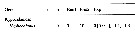 Issued from : E.L. Markhaseva, S. Laakmann & J. Renz in Mar. Biodiv., 2014, 44 [p.73, Table 1]. A2 armament (number of seta) in different ''Bradfordian'' genera (females). Kyphocalanidae. c: coxa; b: basis; End1: endopod segment 1; End2: endopod segment 2; Exp: exopod. |
 Issued from : E.L. Markhaseva, S. Laakmann & J. Renz in Mar. Biodiv., 2014, 44 [p.74, Table 2]. Md armament (number of seta) in different ''Bradfordian'' genera (females). Kyphocalanidae. b: basis; End1: endopod segment 1; End2: endopod segment 2; Exp: exopod; gn: gnathobase. |
 Issued from : E.L. Markhaseva, S. Laakmann & J. Renz in Mar. Biodiv., 2014, 44 [p.76, Table 3]. Mx1 armament (number of seta) in different ''Bradfordian'' genera (females). Kyphocalanidae. pa: praecoxal arthrite (setal formula of praecoxal arthrite: terminal+posterior+anterior setae); ce: coxal endite; bp: proximal basal endite; bd: distal basal endite; End: endopod; Exp: exopod; Epi: epipodite. |
 Issued from : E.L. Markhaseva, S. Laakmann & J. Renz in Mar. Biodiv., 2014, 44 [p.78, Table 4]. Mx2 armament (number of seta) in different ''Bradfordian'' genara (females). Kyphocalanidae. at: attenuation; pe: praecoxal endite; ce: coxal endite; bp: proximal basal endite; bd: distal basal endite; el: enditic-like lobe of proximal endopodal segment; End: endopod; w: worm-like seta; br: brush-like seta; sc: sclerotised seta. |
 Issued from : E.L. Markhaseva, S. Laakmann & J. Renz in Mar. Biodiv., 2014, 44 [p.80, Table 5]. Mxp setation (number of seta) in different ''Bradfordian'' genera (females). Kyphocalanidae. at: attenuation; pes: praecoxal endites of syncoxa (from proximal to distal); ces: coxal endite of syncoxa; bp: basis proximal; bd: basis distal; End: endopod. For more detailed morphology of the seta on the praecoxal endites of the maxilliped syncoxa see Markhaseva & Ferrari (2005) and Markhaseva & al. (2008). |
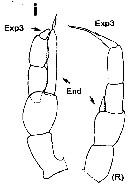 Issued from :E.L. Markhaseva, S. Laakmann & J. Renz in Mar. Biodiv., 2014, 44 [p.72, Fig.7 i]. P5 from Kyphocalanus sp. R: right leg; Exp: exopod; end: endopod. Markhaseva (pers. obs.) |
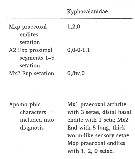 Issued from : S. Laakmann, E.L. Markhaseva & J. Renz in Mol. Phylog. Evol., 2019, 130. [p.331, Table 1]. compilation of information on relationships among ''Bradfodian'' genera from Markhaseva & Ferrari 2005) and Markhaseva & al. (2014). Abbreviations: A2, antenna; Md, mandible; Mx1, maxillule; Mx2, maxilla; Mxp, maxilliped ; P5, leg 5. w, worm-like sensory seta; b, brush-like sensory seta; s, sclerotized seta. | | | | | (1) Kyphocalanus Markhaseva & Schulz, 2009 | |
| | Ref.: | Markhaseva & Schulz, 2009 (p.23); Markhaseva & al., 2013 (p.6, Table 1, 2, 3, 4, Rem.); Renz & Markhaseva, 2015 (p.96, Table 4, fig.3, biogeography); Laakmann & al., 2019 (p.330, Table 1) | | Rem.: | Type species: Kyphocalanus atlanticus. 1 sp + 4 indet. | | Remarques sur les dimensions et le sex-ratio: | | The mean female size is 2.10 mm (n = 4; SD = 0.1980), and only for one male 2.25 mm. | 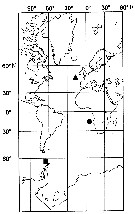 issued from : E.L. Markhaseva & K. Schulz in Zootaxa, 2009, 2304. [p.37, Fig.11]. Distribution of species of Kyphocalanus in the Atlantic Ocean. K. atlanticus and K. sp.1: filled black circle; K. sp.2: triangle; K. sp.3: square. |
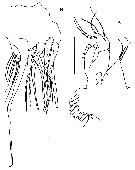 Issued from : E.L. Markhaseva in Arthropoda Selecta, 2014, 23 (3). [p.262, Fig.3]. Kyphocalanus sp. Male: A, maxillule; B, maxilla. Scale bar: 0.1 mm. Nota: Specimen from Atlantic Ocean (00°42.7' S, 05°31.2' W), above seabed at a depth of 5140 m. |
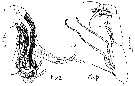 Issued from : E.L. Markhaseva & K. Dchulz in Zootaxa, 2009, 2304. [p.27, Fig.3 B & Fig;4]. Kyphocalanus antarcticus Female (16°18' S, 05°27' E): maxilla (Mx2) and maxilliped (Mxp). Note maxilla endopod with 8 long and thick worm-like sensory and syncoxa of maxiliped with 1 worm-like, comparably thin and short sensory seta on proximal praecoxal lobe and 2 long and thick worm-like setae on middle lobe extending to distal part of endopod; distal praecoxal lobe without setae; coxal lobe with 1 seta; basis with 3 setae; endopod 6-segmented with 2, 4, 2, 2, 2+1, and 4 setae. Species collected at abyssal depths (5390 m) above the sea bed. | | | | | |
|
|
 Toute utilisation de ce site pour une publication sera mentionnée avec la référence suivante : Toute utilisation de ce site pour une publication sera mentionnée avec la référence suivante :
Razouls C., Desreumaux N., Kouwenberg J. et de Bovée F., 2005-2024. - Biodiversité des Copépodes planctoniques marins (morphologie, répartition géographique et données biologiques). Sorbonne Université, CNRS. Disponible sur http://copepodes.obs-banyuls.fr [Accédé le 23 avril 2024] © copyright 2005-2024 Sorbonne Université, CNRS
|
|
|
|




;)
;)
;)
;)
;)
;)
;)
;)
;)
;)
;)