|
|
 |
Fiche d'espèce de Copépode |
|
|
Calanoida ( Ordre ) |
|
|
|
Clausocalanoidea ( Superfamille ) |
|
|
|
Aetideidae ( Famille ) |
|
|
|
Euchirella ( Genre ) |
|
|
| |
Euchirella curticauda Giesbrecht, 1888 (F,M) | |
| | | | | | | Syn.: | Euchirella curticauda atlantica Wolfenden, 1904 (p.116); Pearson, 1906 (p.16, Rem.: 52°N, 12°W);
E. atlantica Wolfenden, 1905 a (p.20, Rem.F) | | | | Ref.: | | | Giesbrecht, 1892 (p.233, 244, 772, figs.F); Giesbrecht & Schmeil, 1898 (p.36, Rem. F); Esterly, 1906 a (p.59, figs.F); ? Farran, 1908 b (p.38, Rem.); A. Scott, 1909 (p.55, Rem.); Wolfenden, 1911 (p.236); With, 1915 (p.118, figs.F,M); Lysholm & Nordgaard, 1921 (p.15); Sars, 1925 (p.72, figs.F,M); Farran, 1926 (p.251); Sewell, 1929 (p.107, 109, fig.F); Wilson, 1932 a (p.59, figs.F,M); Rose, 1933 a (p.105, figs.F,M); Jespersen, 1934 (p.64); 1940 (p.23); Lysholm & al., 1945 (p.18); Sewell, 1947 (p.69); Davis, 1949 (p.30, figs.F), Rem.F,M); C.B. Wilson, 1950 (p.221, fig.M); Brodsky, 1950 (1967) (p.176, figs.F,M); Vervoort, 1952 f (n°47, p.4, figs.F,M); Tanaka, 1957 b (p.187, figs.F,M); Grice, 1962 (p.196, figs.F); Vervoort, 1963 b (p.148, Rem.); Owre & Foyo, 1967 (p.46, figs.F,M); Vinogradov, 1968 (1970) (p.261); Tanaka & Omori, 1969 (p.42, Rem.); 1969 a (p.157); Shih & al., 1971 (p.32); Vaupel Klein, 1972 (p.501, 504, figs.F); Park, 1976 a (p.110, figs.F,M); Bradford & Jillett, 1980 (p.35, figs.F,M, fig. 73, distribution chart); Gardner & Szabo, 1982 (p.234, figs.F,M); Roe, 1984 (p.357); Vaupel Klein, 1984 a (p.38, Table II: characters, Rem.); Markhaseva, 1996 (p.149, figs.F,M); Chihara & Murano, 1997 (p.685, Pl.35,36: F,M); Vaupel Klein, 1998 a (p.386: Table 1, fig.F, fig.5); Bradford-Grieve & al., 1999 (p.879, 921, figs.F,M); Mulyadi, 2001 (p.813, figs.F,M, Rem.); G. Harding, 2004 (p.56, figs.F,M); Mulyadi, 2004 (p.43, figs.F,M, Rem.); Vives & Shmeleva, 2007 (p.564, figs.F,M, Rem.) | 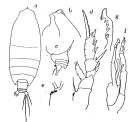 issued from : Tanaka O. in Publ. Seto mar. Biol., Lab., 1957, 6 (2). [Fig.51, p.188]. Female (from Suruga): a, habitus (dorsal aspect); b, head (lateral aspect); c, last thoracic segment and urosome (lateral aspect); d, P2; e, inner margin of first basal joint (= coxa) of P4. Male (from Sagami): f, P5; g, distal joint of exopodite of right P5. Nota Female: - Cephalothorax about 6 times the abdomen length (3.0 : 0.5). - Head and 1st pediger segment faintly visible, 4th and 5th thoracic segments fused. - Head with median crest; frontal organ prominent. - Rostrum very short. Abdomen 4-segmented; segments and caudal rami in the proportional lengths 52 : 8 : 12 : 8 : 22 = 100.Genital segment with lateral projections on each side of genital opening (in ventral view). - A1 extends to distal end of last thoracic segment; segment 2 longer than segments 8-9, which are about as long as segment 13 or 14. - A2 exopod 4 times as long as endopod; 1st exopodal segment with a process on inner margin. - Mx1 with 9 setae on outer lobe; 11 setae on exopod; 3 setae on endopod; 3 setae on 2nd basal segment; 4 setae on 2nd inner lobe; 4 setae on 3rd inner lobe; - Mx2 robust and stout. - Mxp with on 1st basal segment a knob-like process on anterior surface near the distal marin. - P2 with a strong outer edge spine on 2nd exopodal segment; terminal spine of exopod with 20 teeth. - P4 with 24 teeth on terminal spine of exopod; coxa with 11 spines on the left, and 8 on the right at the base of inner marginal seta. Nota Male: - Cephalothorax about 3.5 times the abdomen length (2.45 : 0.70). - Rostrum more distinct than in female. - Abdomen 5-segmented; segments and caudal rami in proportional lengths 27 : 22 : 19 : 16 : 5 : 11 = 100. - Caudal rami shorter than wide. A1 22-segmented on left side, extends to distal end of thoracic segment. Segments 20 and 21 fused on the right side. - A2 endopod about 3/4 as long as exopod. - P1 with a slender exopod. - P5 as figured by Sars.
|
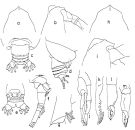 issued from : T. Park in Contr. Mar. Sci., 1976, 20. [p.111, Fig.3]. Female: a, b, dorsal and lateral, respectively); c, d, e, posterior part of metasome and urosome (dorsal, lateral, ventral, respectively); f, A2; g, coxa of fourth leg (posterior). Male: h, i, forehead (dorsal, lateral); j, fifth pair of legs (anterior); k, distal part of exopod of right fifth leg (anterior); l, distal part of exopod of left fifth leg (anterior);.
|
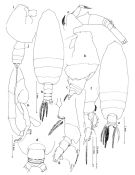 issued from : Mulyadi in Crustaceana, 2001, 74 (9). [p.814, Fig.2]. Female: a, habitus (dorsal); b, head (left lateral side); c, last thoracic segment and urosome (left lateral side); d, idem (dorsal); e, A2; f, P1; g, P4. Male: h, habitus (dorsal); i, forehead (right lateral side); j, last thoracic segment and urosome (right lateral side); k, P5.
|
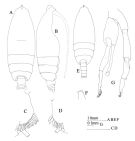 issued from : J.M. Bradford & J.B. Jillett in Mem. N.Z. Oceanogr. Inst., 86, 1980. [p.36, Fig.21]. Female: A, habitus (dorsal); B, idem (lateral right side); C, inner edge of basipod 1 of P4; D, idem (specimen from another station). Male: E, habitus (dorsal); F, forehead (lateral); G, P5.
|
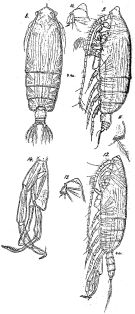 Issued from : G.O. Sars in Résult. Camp. Scient. Prince Albert I, 69, pls.1-127 (1924). [Pl.XXI, figs.8-14]. Female:8, habitus (dorsal); 9, idem (lateral left side); 10, forehead (lateral): 11, inner end of the basipodal segment of P4. Male: 12, habitus (dorsal); 13, forehead (lateral); 14, P5.
|
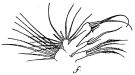 issued from : R.B.S. Sewell in Mem. Indian Mus., 1929, X. [p.111, Fig.41, f]. Female (from Laccadive Sea): f, Mx1.
|
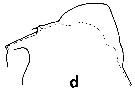 issued from : J.C. von Vaupel Klein in Crustaceana, Supplt 9, Studies on Copepoda, III, 1984. [p.61, Fig.4, d]. Female: d, triangular crest on forehead (left lateral side).
|
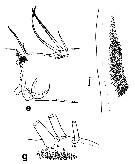 issued from : J.C. von Vaupel Klein in Crustaceana, Supplt 9, Studies on Copepoda, III, 1984. [p.75, Fig.13, e, g, j]. Female: e, a rounded, lateral tubercle present on basipodite 1 of Mxp (distal part of left appendage, lateral aspect); g, patch of spinules adjacent to the insertions ofthe setae of group III on basipodite 1 of Mxp (detail of left appendage in lateral view); j, arrangement of more than 150 small, slender spinules on the proximal part of the medial face of basipodite 2 of Mxp (right appendage in medial view). Nota: basipodite 1 of Mxp with about 55 cone-shaped spunules of varying size, arranged in a discrete patch of spinules.
|
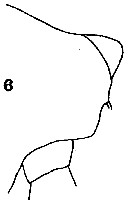 issued from : C.O. Esterly in Univ. Calif. Publs Zool., 1906, 3 (5). [Pl.9, Fig.6]. Female (from San Diego, California): 6, forehead (lateral).
|
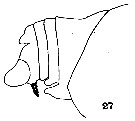 issued from : C.O. Esterly in Univ. Calif. Publs Zool., 1906, 3 (5). [Pl.10, Fig.27]. Female: 27, part of last thoracic segment and urosome (lateral).
|
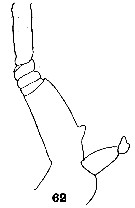 issued from : C.O. Esterly in Univ. Calif. Publs Zool., 1906, 3 (5). [Pl.12, Fig.62]. Female: A2 (bistles not shown). Nota: Endopod of A2 one-fourth as long as exopod, 1st segment of latter with a knob-like projection; 2nd segment of exopod with 5 bristles
|
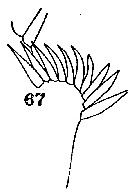 issued from : C.O. Esterly in Univ. Calif. Publs Zool., 1906, 3 (5). [Pl.13, Fig.67]. Female: 67, distal portion of inner margin of 1st basal segment of P4. Nota: Segment with a series of 10 to 13 tooth-like spines on the inner margin.
|
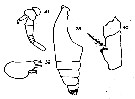 issued from : C.C. Davis in Univ. Wash. Publs Biol., 1949, 14. [Pl.3, Figs.38-41]. Female (from NE Pacific): 38, habitus (lateral); 39, 2nd endopodal segment of A2; 40, basipod of P4; 41, A2. Nota : Front with a very pronounced, though short, crest. Rostrum very poorly developed and consists of only one point. Head and 1st thoracic segment fused, 4th and 5th segments fused. Last segment of prosome rounded at the posterior corners. Urosome very short ; each segment broader than long ; genital segment as long as the three following segments together, plus the caudal rami. Caudal rami about as long as broad and are placed wide apart. A1 24-segmented. Endopod of A2 very short, terminal segment with 5 setae ; 1st segment of exopod with a knob-like projection on the inner border. 1st basal segment of P4 with a row of 10 to 13 broad, short spines on the inner border. P5 lacking.
|
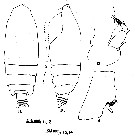 issued from : G.D. Grice in Fish. Bull. Fish and Wildl. Ser., 1962, 61. [p.195, Pl.10, Figs.11-14]. Female (from 00°35'N, 170°11'E): 11, dorsal and lateral, respectively); 13, endopod of A2; 14, 1st basipodal segment of P4. Nota: Presence of a crest. Absence of a rostrum. Presence of a comb of spines on the 1st basipodal segment of P4.
|
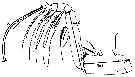 issued from : J.C. von Vaupel Klein in Zool. Verh. Leiden, 1998, 323. [p.387, Fig.2]. Measurements taken from maxilliped: Ba1 = length of basipodal segment 1; Ba2 = length of Ba2; S = length of the longest seta of the only ramus (endopodite). measurements used to compare with other species (tables 1 and 2) in view of the speciation (see discussion after Von Vaupel Klein (1998, pp.389-397) in the genus Euchirella.
|
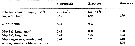 issued from : J.C. von Vaupel Klein in Zool. Verh. Leiden, 1998, 323. [p.386, Table 1]. Dimensions of adult females of E. curticauda and E. maxima, allegedly relevant in niche separation. 1/ See Material and methods Von Vaupel Klein, 1998, pp.385-387); 2/ Present collections: 3.45-4.15 mm.; 3/ Present collections: 6.5-8.05 mm.; 4/ From Von Vaupel Klein (1984, p.93).
|
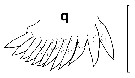 issued from : J.C. von Vaupel Klein in Crustaceana, Supplt 9, Studies on Copepoda, III, 1984. [p.80, Fig.16, q]. Female: q, arrangement of medial spines on the posterior face of basal segment 1 of right P4 . Scale bar 0.067 mm. Nota: 12 subequal, stout spines on a common base.
|
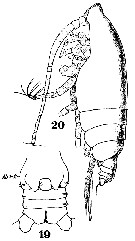 Issued from : W. Giesbrecht in Systematik und Faunistik der Pelagischen Copepoden des Golfes von Neapel und der angrenzenden Meeres-Abschnitte. – Fauna Flora Golf. Neapel, 1892, 19 , Atlas von 54 Tafeln. [Taf.36, Figs.19, 20]. Female : 19, urosome (ventral); 20, habitus (lateral). Ab 1-2 : genital double somite.
|
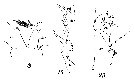 Issued from : W. Giesbrecht in Systematik und Faunistik der Pelagischen Copepoden des Golfes von Neapel und der angrenzenden Meeres-Abschnitte. – Fauna Flora Golf. Neapel, 1892, 19 , Atlas von 54 Tafeln. [Taf.15, Figs.3, 13, 25]. Female: 3, A2; 13, part of P2; 25, basal part of P4 (posterior view). Ri 1= endopodite segment 1.
|
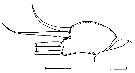 issued from : J.C. von Vaupel Klein in Crustaceana, Supplt 9, Studies on Copepoda, III, 1984. [p.65, Fig.6 d]. Euchirella curticauda: a, Setal armature of endopodte 2+3 of A2. Conditions are expressed are expressed in formulae as follows: number of setae in regular row on proximal lobe / relative development of seta in position no. 9 on this lobe / number of setae in approximately linear row on terminal lobe / relative development of appendicular seta no. 7 and its supporting pedestral (absent, vestigial, moderate or well developed: see Table I, p.87 and Table II, p.93). upper and lower lobes= proximal and terminal lobes (details of right appendage shown in medial aspect. Scale bar = 0.1 mm. Nota: Condition 2/2/3/0 in curticauda.
|
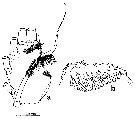 Issued from : J.C. von Vaupel-Klein in Zool. Meded., Leiden, 19972, 47 (41). [p.507, Fig.3, a-b]. Female: a, endopodite of the right P1 (specimen from 37°05'N, 160°08'E); b, detail of spinules on tubercle, more or less antero-lateral view (highly magnified, drawn from SE-micrograph) (specimen from 1°30'N, 10°10'W). Nota: This special structure will be named 'organ of Vaupel Klein'. The definite function or functions are unknown. For the author, considering the many hairs and the peculiar, curved seta, acting as a counter part to the row of distinctly tooth-like spinules, one may assume that is a grooming-apparatus. This seems probable because at the distal part of the tubercle a number of pores may be observed, while in this area the integument is rather thin. The presence of some glandular function in this region may be expected. The position of such a grooming-apparatus, immediately behind the mouthparts, seems not unlikely. Other functions in feeding behaviour might also be present, next to the locomotory function of the P1.
|
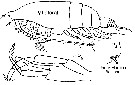 issued from : G. Harding in Key to the adullt pelagic calanoid copepods found over the continental shelf of the Canadian Atlantic coast. Bedford Inst. Oceanogr., Dartmouth, Nova Scotia, 2004. [p.56]. Female & Male. Nota: Forehead crested in both sexes..
|
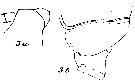 issued from : C. With in The Danish Ingolf-Expedition, Copepoda I, 1915, III, 4. [Pl. IV, Fig.3, a-b]. Female (from 48°09'N, 8°30'W): a, forehead (lateral); b, last thoracic segment and genital segment (lateral).
|
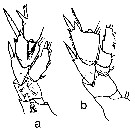 issued from : C. With in The Danish Ingolf-Expedition, Copepoda I, 1915, III, 4. [Text-fig.30, a-b]. Female: a, left P2 (anterior view); b, P3.
|
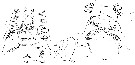 issued from : C. With in The Danish Ingolf-Expedition, Copepoda I, 1915, III, 4. [Pl. IV, Fig.3, c-e]. Female: c, labrum (oral view); d, lamina labialis and serrula 6-dentata; e, left lobius labial.
|
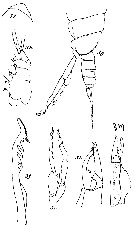 issued from : C. With in The Danish Ingolf-Expedition, Copepoda I, 1915, III, 4. [Pl. IV, Fig.3, f-m]. Male: f, forehead; g, last thoracic segments and urosome (left lateral); h, left Mx2 (posterior view); i, P5 (posterior view); j, exopodite segment 3 of right P5; l, last segment of the exopodite of the left P5; m, last segments of the exopodite of the left P5.
|
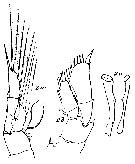 issued from : C. With in The Danish Ingolf-Expedition, Copepoda I, 1915, III, 4. [Pl. VIII, Fig.2, a-c]. Male: a, left P1 (anterior view); b, right P2 (anterior view in an abnormal specimen); c, right P5 (endopodite). Endopodite rather slender, extending somewhat beyond the end of exopodal segments 1-2; it is most narrow in the middle, extending, as well, towards the base, but especially towards the tip, and the anterior surface is slightly concave, with the lateral margin somewhat turned over inwards; the lateral margin has two distal processes, of which the one is placed near the tip.
|
 Euchirella curticauda Euchirella curticauda female: 1 - Genital segment symmetrical. 2 - Crest present. Rostrum rudimentary.
|
 Euchirella curticauda Euchirella curticauda Male: 1 - P5 always biramous. Endopod of left P5 well developed, equal to its half length. Exopodal segment 2 and endopod of right P5 are not elongated and not sharpened into their distal parts; do not form tongs. Endopod of right P5 slightly exceeding distal border of exopodal segment 1. 2 - Crest present. Rostrum not large. 3 - Terminal part exopodal segment 2 of right P5 with teeth.
|
 issued from : Tanaka O. in Publ. Seto mar. Biol., Lab., 1957, 6 (2). [p.188]. Male A1: proportional lengths of segments. - A1 extends to distal end of thoracic segment. Segments 20 and 21 fused on the right side.
|
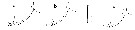 Issued from : J.C. von Vaupel Klein in Studies on Copepoda III. Crustaceana, Suppl. 9, 1984 a. [p.113, Fig.26]. Proximal part of lateral margin of endopodite of P2 female. a, anterior view of aberrant, double-pointed condition interpreted as an atavism on left leg of specimen from ''Dana'' Exp. (9/8/1982) at station 4771; b, normal structure on right P2 of the same specimen (drawn from a posterior view to yield a comparable picture); c, normal endopodite margin of P2 from specimen at the same locality (17/12/1970), added for comparison. Scale bar: 0.05 mm. Note the close similarity of the aberrant condition in (a) with the normal, likewise double-pointed marin of Undeuchaeta spp. ( U. incisa)
|
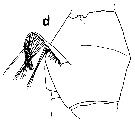 issued from : J.C. von Vaupel Klein in Crustaceana, Supplt 9, Studies on Copepoda, III, 1984. [p.68, Fig.8, d]. Euchirella curticauda: Structure and setal armature of basipode 2 of Md (right appendage medial. One well developed seta with exceptionally long plumosity.
|
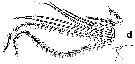 Issued from : J.C. von Vaupel Klein in Crustaceana, Supplt 9, Studies on Copepoda, III, 1984. [p.70, Fig.10, d]. Euchirella curticauda: Structure and setal complement on the outer lobe of basis 1 of Mx1 (detail of left appendage in posterior aspect). Presumably recurred 9-setae condition (in view of the similarity with the rostrata-group and non- Euchirella spp. in the sequence of relative sizes of consecutive setae. See difference with Euchirella splendens (fig.10, b).
|
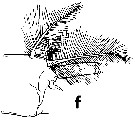 Issued from : J.C. von Vaupel Klein in Crustaceana, Supplt 9, Studies on Copepoda, III, 1984. [p.70, Fig.10, f]. Euchirella curticauda: Setal armature on proximo-distal corner of basis, adjacent to the endopod of Mx1 (left appendage in postrior view; secondary structures on large setae are not shown, and neither are the hairs on the basis proper). The usual Euchirella condition of 1 long, stout seta plus 2 small and slender, densely plumose setae, as in Euchirella formosa (fig.10e) but with the small setae inserting widely spaced.
|
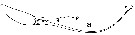 Issued from : J.C. von Vaupel Klein in Crustaceana, Supplt 9, Studies on Copepoda, III, 1984. [p.72, Fig.11, a]. Euchirella curticauda. Structure of Mx1, terminal configuration of setae plus the 'blunt tooth (= tubular pore) on the endite of basis (Ba2) (plumosity and/or spinules on setae, as well as hairs on lobe, omitted, right appendage in anterior view). Showing the usual Euchirella complement of, from anterior to posterior: short proximal seta (p), long central seta (c), blunt tooth (dotted outline) and shortest, distal seta (d).
|
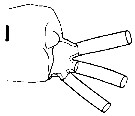 Issued from : J.C. von Vaupel Klein in Crustaceana, Supplt 9, Studies on Copepoda, III, 1984. [p.70, Fig.11, l]. Euchirella curticauda: Setal armature of the endopod of Mx1 (detail of left appendage in posterior aspect; setules/spinules omitted). 3-setae condition as in E. rostrata (compare with E. formosa Fig.11, i; and E. truncata Fig.11, J).
|
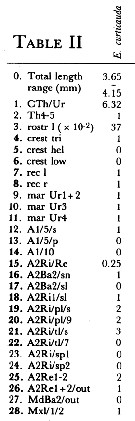 Issued from : J.C. von Vaupel Klein in Crustaceana, (Supplement) 9, 1984. [p.93, Table II]. Euchirella curticauda Female: Datamatrix stating observed states of characters from Table I (p.87-90) presently examined; nos. refer to the input nos. used in Table I (see to the family Aetideidae).
|
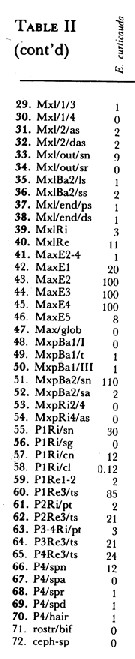 Issued from : J.C. von Vaupel Klein in Crustaceana, (Supplement) 9, 1984. [p.94, Table II (cont' d) ]. Euchirella curticauda Female: Datamatrix stating observed states of characters from Table I (p.87-90) presently examined; nos. refer to the input nos. used in Table I (see to the family Aetideidae).
|
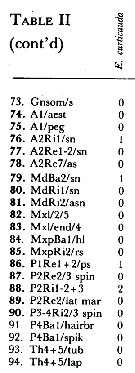 Issued from : J.C. von Vaupel Klein in Crustaceana, (Supplement) 9, 1984. [p.95, Table II (cont' d) ]. Euchirella curticauda Female: Datamatrix stating observed states of characters from Table I (p.87-90) presently examined; nos. refer to the input nos. used in Table I (see to the family Aetideidae).
| | | | | Ref. compl.: | | | Pearson, 1906 (p.15); Wolfenden, 1911 (p.236); Wilson, 1942 a (p.185); Sewell, 1948 (p.348, 500, 520, 545, 556, 566); 1949 (p.133); Østvedt, 1955 (p.15: Table 3, p.63); Gaudy, 1963 (p.22, Rem.); De Decker & Mombeck, 1964 (p.12); Mullin, 1966 (p.546, Table I, III, diet, gut contents); Grice & Hulsemann, 1967 (p.15); Fleminger, 1967 a (tabl.1); Morris, 1970 (p.2300); Park, 1970 (p.475); Timonin, 1971 (p.281, trophic group); Deevey, 1971 (p.224); Roe, 1972 (p.277, tabl.1, tabl.2); Bainbridge, 1972 (p.61, Appendix Table III: occurrence); Björnberg, 1973 (p.324, 386); Vives & al., 1975 (p., tab.II); Deevey & Brooks, 1977 (p.256, tab.2, Station "S"); Carter, 1977 (1978) (p.35); Dessier, 1979 (p.204); Svetlichnyi, 1980 (p.28, Table 1 as Fuchirella curticauda, passive submersion); Brenning, 1983 (p.3, 4, spatial distribution, T-S diagram, Rem.); Minkina, 1983 (p.38, speed swimming); Guangshan & Honglin, 1984 (p.118, tab.); Stephen, 1984 (p.161, 169, Distribution vs thermocline & geographic); Petipa & Borichenko, 1985 (tab.2); Brenning, 1985 a (p.28, Table 2); Madhupratap & Haridas, 1986 (p.105, tab.1); Rudyakov, 1986 (tab.1); Lozano Soldevilla & al., 1988 (p.58); Cervantes-Duarte & Hernandez-Trujillo, 1989 (tab.3); Heinrich, 1990 (p.17); Hernandez-Trujillo, 1991 (1993) (tab.I); Yen & al., 1992 (p.495, tab.1, mechanoreception); Suarez, 1992 (App.1); Shih & Young, 1995 (p.67); Mauchline, 1998 (tab.30, 63, 64, 65); Suarez-Morales & Gasca, 1998 a (p107); d'Elbée, 2001(tabl. 1); Holmes, 2001 (p.47); Beaugrand & al., 2002 (p.179, figs.5, 6); Hsiao & al., 2004 (p.325, tab.1); Lo & al., 2004 (p.89, tab.1); Lavaniegos & Jiménez-Pérez, 2006 (Tab.2, 4, Rem.); Papastephanou & al., 2006 (p.3078, Table 3);; Hwang & al., 2007 (p.23); Dur & al., 2007 (p.197, Table IV); Cabal & al., 2008 (289, Table 1); Fernandes, 2008 (p.465, Tabl.2); Gaard & al., 2008 (p.59, Table 1, N Mid-Atlantic Ridge); Galbraith, 2009 (pers. comm.); Williamson & McGowan, 2010 (p.273, Table 3, Pacific central gyres: N and S); Andersen N.G. & al., 2011 (p.71, Fig.3: abundance); Hsiao S.H. & al., 2011 (p.475, Appendix I); Salah S. & al., 2012 (p.155, Tableau 1); in CalCOFI regional list (MDO, Nov. 2013; M. Ohman, comm. pers.); Hirai & al., 2013 (p.1, Table I, molecular marker); Sano & al., 2013 (p.11, Table 7, food habits) ; Lidvanov & al., 2013 (p.290, Table 2, % composition); Bonecker & a., 2014 (p.445, Table II: frequency, horizontal & vertical distributions); El Arraj & al., 2017 (p.272, table 2, spatial distribution); Bode & al., 2018 (p.840, Table 1, respiration & ingestion rates, depth) | | | | NZ: | 19 | | |
|
Carte de distribution de Euchirella curticauda par zones géographiques
|
| | | | | | | | | | | | 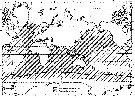 issued from : J.C. von Vaupel Klein in Zool. Verh. Leiden, 1998, 323. [p.392, Fig.6]. issued from : J.C. von Vaupel Klein in Zool. Verh. Leiden, 1998, 323. [p.392, Fig.6].
Map showing the distributional areas of E. curticauda Giesbrecht, 1888 and E. maxima Wolfenden, 1905, respectively; note the large overlap in ranges. Antarctic convergence i(AC) |
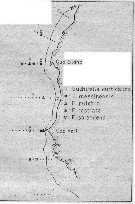 issued from : U. Brenning in Wiss. Z. Wilhelm-Pieck-Univ. Rostock - 32. Jahrgang 1983. Mat.-nat. wiss. Reihe, 5. [p.1, Fig.1]. issued from : U. Brenning in Wiss. Z. Wilhelm-Pieck-Univ. Rostock - 32. Jahrgang 1983. Mat.-nat. wiss. Reihe, 5. [p.1, Fig.1].
Spatial distribution for Euchirella curticauda, E. messinensis , E. pulchra, E. rostrata, E. splendens from 8° S - 26° N; 16°- 20° W. |
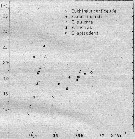 issued from : U. Brenning in Wiss. Z. Wilhelm-Pieck-Univ. Rostock - 32. Jahrgang 1983. Mat.-nat. wiss. Reihe, 5. [p.3, Fig.3]. issued from : U. Brenning in Wiss. Z. Wilhelm-Pieck-Univ. Rostock - 32. Jahrgang 1983. Mat.-nat. wiss. Reihe, 5. [p.3, Fig.3].
T-S Diagram for Euchirella curticauda, E. messinensis, E. pulchra, E. rostrata, E. splendens from 8° S - 26° N; 16°- 20° W. |
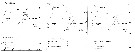 Issued from : J.M. Bradford & J.B. Jillett in New Zealand Ocean. Inst. Memoir, 86, 1980. [p.88-89, Figs.65-67]. Issued from : J.M. Bradford & J.B. Jillett in New Zealand Ocean. Inst. Memoir, 86, 1980. [p.88-89, Figs.65-67].
Distribution of several species of Euchirella in the Tasman Sea and around New Zealand.
Nota: Euchirella indica (= Euchirella massinensis indica). |
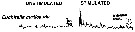 issued from : J. Yen, P.H. Lenz, D.V. Gassie & D.K. Hartline in J. Plankton Res., 1992, 14 (4). [p.502, Fig. 4]. issued from : J. Yen, P.H. Lenz, D.V. Gassie & D.K. Hartline in J. Plankton Res., 1992, 14 (4). [p.502, Fig. 4].
Neural activity from the A1 of Euchirella curticauda from deep pelagic (600 m), Hawaii.
Left side: spontaneous background activity. Right side: responses to a variety of mechanical stimuli (antennal shake). All recordings are 40 ms long.
Compare with Labidocera madurae, Acartia fossae, Ubdinula vulgaris, Pleuromamma xiphias. |
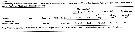 Issued from : M. Bode, R. Koppelmann, L. Teuber, W. Hagen & H. Auel inGlobal Biogeochemical Cycles, 2018, 32. [p.844, Table 1). Issued from : M. Bode, R. Koppelmann, L. Teuber, W. Hagen & H. Auel inGlobal Biogeochemical Cycles, 2018, 32. [p.844, Table 1).
Cf. explanations of these measures in Calanoides natalis from the same authors.
Compare with Euchirella rostrata, E. pulchra, E. splendens. |
| | | | Loc: | | | Atlant. (tropical, temperate), South Africa (E), off S Ascension Is., off E St. Paul Is., G. of Guinea, off Lagos, off Morocco-Mauritania, Cap Ghir, Canary Is., S Brazil, off Rio de Janeiro, off Amazon, Caribbean Sea, G. of Mexico, Florida, Sargasso Sea, off Bermuda: Station "S" (32°10'N, 64°30'W), off Woods Hole, off Nova Scotia, off Ireland (S & W), off N Scotland, S Davis Strait, Denmark Strait, Iceland, W Ireland, Faroe, Norway Sea, North Sea, Bay of Biscay, off W Cape Finisterre, Ibero-moroccan Bay, off SW Sri Lanka, Natal, S equarorial Indian Ocean, SW Indian, Bay of Bengal, Indonesia-Malaysia, Flores Sea, Philippines, Pacif. (equatorial), China Seas (East China Sea, South China Sea), Taiwan (SW, S, E, N: Mienhua Canyon), Japan (Izu), off SE Hokkaido, Kuril-Kamchatka, Aleutian Is., Vancouver Is., California, W Baja California, Hawaii, Pacif. (central subtropical N), Pacif. (W equatorial), Pacific (central gyres: N and S), off S Australia, New Zealand, off Galapagos, off Peru, Pacif. (SE tropical), Chile.
Type locality: Pacific (equatorial part). | | | | N: | 103 | | | | Lg.: | | | (1) F: 4,4; (7) F: 4,26; M: 3,73; (14) F: 3,65-3,5; M: 3,5; (17) F: 3,6; (37) F: 4,55-3,5; M: 4,3-3,14; (38) F: 4,6-4,42; M: 4,14-3,9; (45) F: 4,8-2,5; M: 3,75-3; (56) F: 3,5; M: 3,14; (59) F: 4,8-2,5; M: 4,3-3; (101) F: 3,62; 3,52; (110) F: 3,77-3,3; (199) F: 4,94-3,8; M: 3,57-3,42; (201) F: 4,55-3,3; M: 4; (235) F: 3,92-3,36; M: 3,52-3,44; (238) F: 4,08; (413) F: 4,4-2,7; (855) F: 3,45-3,5; M: 3,35-3,6; (866) F: 2,5-4,8; (1109) F: 3,5-4,18; M: 5,02-5,55; (1122) F: 3,5; M: 3,5; (1257) F: 3,65-4,15; {F: 2,50-4,94; M: 3,0-5,55}
The mean female size is 3.802 mm (n = 34; SD = 0.6837), and the mean male size is 3.756 mm (n = 21; SD = 0.6388). The size ratio (male : female) is 0.988. | | | | Rem.: | épi-bathypélagique.
Le rostre est donné comme rudimentaire ou absent.
Voir aussi les remarques en anglais | | | Dernière mise à jour : 28/10/2022 | |
|
|
 Toute utilisation de ce site pour une publication sera mentionnée avec la référence suivante : Toute utilisation de ce site pour une publication sera mentionnée avec la référence suivante :
Razouls C., Desreumaux N., Kouwenberg J. et de Bovée F., 2005-2024. - Biodiversité des Copépodes planctoniques marins (morphologie, répartition géographique et données biologiques). Sorbonne Université, CNRS. Disponible sur http://copepodes.obs-banyuls.fr [Accédé le 20 avril 2024] © copyright 2005-2024 Sorbonne Université, CNRS
|
|
|
|




;)
;)
;)
;)
;)
;)
;)
;)
;)
;)
;)
;)
;)
;)
;)
;)
;)
;)
;)
;)
;)
;)
;)
;)
;)
;)
;)
;)
;)
;)
;)
;)
;)
;)
;)
;)
;)
;)
;)

;)
;)
;)
;)
;)
;)