|
|
 |
Fiche d'espèce de Copépode |
|
|
Calanoida ( Ordre ) |
|
|
|
Clausocalanoidea ( Superfamille ) |
|
|
|
Aetideidae ( Famille ) |
|
|
|
Euchirella ( Genre ) |
|
|
| |
Euchirella rostromagna Wolfenden, 1911 (F,M) | |
| | | | | | | Syn.: | Euchirella rostrata magna Wolfenden, 1905 a (p.18);
E. plumosa Brady, 1918 (p.20) | | | | Ref.: | | | Wolfenden, 1911 (p.235, Rem.); Farran, 1929 (p.208, 236, figs.F,M); Sewell, 1929 (p.107); Vervoort, 1951 (p.82, figs.F, Rem.); 1957 (p.63, Rem.); 1963 b (p.135); Vaupel Klein, 1972 (p.502, 505, fig.F); Björnberg, 1973 (p.380, 386); Park, 1978 (part., p.151, figs.F, no fig.31f); Séret, 1979 (p.79, 84, figs.F); Bradford & Jillett, 1980 (p.40, figs.F,M, fig. 73, distribution chart); Björnberg & al., 1981 (p.605, 632, figs.F); Vaupel Klein, 1984 a (p.44, fig.F, Table II: characters, Rem.); Razouls, 1994 (p.78, figs.F,M); Markhaseva, 1996 (p.145, Rem.); Vaupel Klein, 1998 a (p.386: Table 2, fig.F, fig.5) | 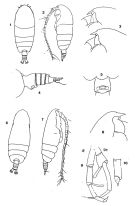 issued from : Park T.-S. in Antarct. Res. Ser. Washington, 1978, 27: 91-290. As Euchaeta rasa. Female: 1, 2, habitus (dorsal, lateral); 3, Head (lateral); 4, Urosome (lateral); 5, genital segment (ventral). Male: 6, 7, (dorsal, lateral); 8, Head (lateral); 9, P5 (G: left, Dt: right); 10, distal exopodite of left P5.
|
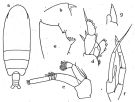 issued from : G.P. Farran in British Antarctic (\"Terra Nova\") Expedition, 1910. Natural History Reports. Zoology. Vol. VIII. Crustacea, 1929. [p.236, Fig.8]. Female: a, habitus (dorsal view); b, rostrum (right view); c, A2; d, first foot; e, first basal joint of fifth foot. Male: f, fifth feet; g, terminal portion of right fifth foot.
|
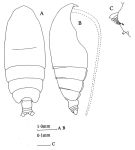 issued from : J.M. Bradford & J.B. Jillett in Mem. N.Z. oceanogr. Inst., 86, 1980. [p.42, Fig.26]. Female: A, habitus (dorsal); B, idem (lateral right side); C, inner edge of basipod 1 of P4. Nota: The number of teeth on the female P4 basipod 1 varies: 12 and 10 on the specimen from the same Antarctic station and 13 on the specimen from an another antarctic station.
|
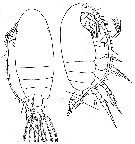 issued from : W. Vervoort in Verh. K. ned. Akad. Wet., Afd. Natuurk., 1951, (Sect. 2) 47 (2). [p.83, Fig.45]. Female (from 66°11'S, 12°14'W): a-b, habitus (dorsal and lateral, respectively). Nota: Proportional lengths of cephalothorax and abdomen as 38:9. Body
|
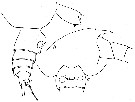 issued from : W. Vervoort in Verh. K. ned. Akad. Wet., Afd. Natuurk., 1951, (Sect. 2) 47 (2). [p.84, Fig.46]. Female: a, posterior part cephalothorax and urosome (lateral); b, forehead (lateral); c, genital somite (ventral). Nota: Genital segment symmetrical, dorsally appears to be slightly swollen on both sides; laterally provided with a big genital swelling; vental aspect of genital tubercle with a small genital flap, covering 2 small genital orifices; ridge at caudal border distinctly visible. Caudal borders of first three abdominal segments with hyaline lamella, on the dorsal side formed into plate like teeth.
|
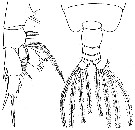 issued from : W. Vervoort in Verh. K. ned. Akad. Wet., Afd. Natuurk., 1951, (Sect. 2) 47 (2). [p.85, Fig.47]. Female: a, right P1 (anterior); b, posterior part cephalothorax and urosome (dorsal). Nota: Anal segment with small, rounded flap.Caudal rami as long as wide, carrying 4 strong, suequal marginal setae, densely plumose, in addition each ramus carries 1 short, strong, nude external seta and 1 plumose, curved internal (appendicular seta; internal surface of the rami haired.
|
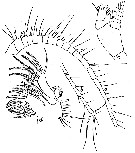 issued from : W. Vervoort in Verh. K. ned. Akad. Wet., Afd. Natuurk., 1951, (Sect. 2) 47 (2). [p.86, Fig.48]. Female: a-b, A1 (the numbers 19 and 20 indicate the 19th and 20th segments); c, right Md (mandiobular palp); d, left Mx1. Nota: A1 24-segmented (8th-9th segments completely fused). Nota: Mx1 with slightly elongate 1st inner lobe and a small, squarish 1st outer lobe; 1st inner lobe has 9 very strong and 3 smaller setiform spines, plus 1 setiform spine is present on the anterior surface; 2nd inner lobe elongate, with 2 strong setae and 1 much smaller seta; 3rd inner lobe carrying 2 setae; 1st outer lobe with 9 setae, 5 of which strong, 4 small and curved, all plumose; 2nd outer lobe not observed; 2nd basal segment elongate indistinctly separated from the fused endopodal segments, there are apparently 3 setae on the 2nd basal segment and 3 on the endopod; exopod remarkably small, with 10 plumose setae.
|
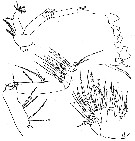 issued from : W. Vervoort in Verh. K. ned. Akad. Wet., Afd. Natuurk., 1951, (Sect. 2) 47 (2). [p.88, Fig.49]. Female: a, left A2; b, right Md (cutting edge); c, left Mxp; d, left Mx2. Nota: Endopod of A2 less than half the length of the exopod. Mx2 short, with 5 prominent lobes; lobe 1-4 found on the 1st basal segment, each with 2 plumose setae and 1 short, spinulose seta; on lobe 4 one of the setae has the shape of a strong spine; internal surface of the lobes with a horizontal row of fine spinules, which are less distinctly developed on the 1st lobe; lobe 5 has a short but remarkably strong, curved spine, coalescent with the lobe, in addition to 1 small and 1 elongate seta, no spinules on the internal surface; the endopod has a small 6th lobe, which carries 1 seta; there are 2 proximal endopodal segments, each with an elongate, plumose seta, at the base of which a much smaller seta (1 on each segment); 3rd (apical) endopodal segment with 3 plumose setae
|
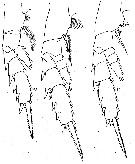 issued from : W. Vervoort in Verh. K. ned. Akad. Wet., Afd. Natuurk., 1951, (Sect. 2) 47 (2). [p.90, Fig.50]. Female: a-c, P2 to P4 (right feet; anterior surface). Nota: Endspines on the 3rd exopodal segments with 24 teeth in P3 and 26 in P4.
|
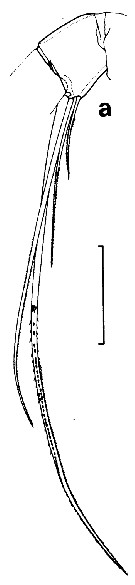 issued from : J.C. von Vaupel Klein in Crustaceana, Supplt 9, Studies on Copepoda, III, 1984. [p.76, Fig.14, a]. Female: a, exopodite 2 of Mxp (with 4 setae). Scale bar = 0.2 mm.
|
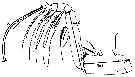 issued from : J.C. von Vaupel Klein in Zool. Verh. Leiden, 1998, 323. [p.387, Fig.2]. Measurements taken from maxilliped: Ba1 = length of basipodal segment 1; Ba2 = length of Ba2; S = length of the longest seta of the only ramus (endopodite). measurements used to compare with other species (tables 1 and 2) in view of the speciation (see discussion after Von Vaupel Klein (1998, pp.389-397) in the genus Euchirella.
|
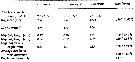 issued from : J.C. von Vaupel Klein in Zool. Verh. Leiden, 1998, 323. [p.386, Table 2]. Dimensions of adult females of E. rostrata, E. rostromagna, and E. latirostris, presumably relevant in the separation of niches. 1/ See Material and methods (Von Vaupel Klein, 1998, pp.385-385); 2/ Present collections: 2.7-3.85 mm; 3/ Present collections: 5.3-6.2 mm; 4/ Present collections: 5.4-6.2 mm; 5/ Of E. rostrata vs the average of the two larger spp.; 6/ Of E. rostromagna vs E. latirostris; 7/ From Von Vaupel Klein 1984, p.93); 8/ Of E. rostrata vs E. rostromagna and of E. rostrata vs E. latirostris, respectively.
|
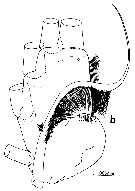 Issued from : J.C. von Vaupel-Klein in Zool. Meded., Leiden, 19972, 47 (41). [p.511, Fig.5, b]. Female (from 55°34'S, 170°27'E): Endopodite of right P1 (anterior view). Nota: 'organ of Vaupel Klein' (see explanation to Euchirella curticauda.)
|
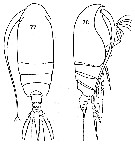 Issued from : C. Séret inThesis 3ème Cycle UPMC, Paris VI, 1979. [Pl. XII, Figs.71-73]. Female (from 46°S, 64°E)): 77-78, habitus (dorsal and lateral, respectively).
|
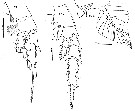 Issued from : C. Séret inThesis 3ème Cycle UPMC, Paris VI, 1979. [Pl. XIII, Figs.79-80]. Female: 79, P1; 80 a, P4; 80 b, coxa of P4. Nota: The specimens from show two differences with Vervoort's description (1951): 1 - the inner apical seta of exopodal segment 2 of P1 is 2.41 times longer than the outer apical spine. The ratio is 1.87 in E. rostromagna from Vervoort. 2 - The coxa of P4 bears on inner margin 11 to 12 triangular teeth of dicrease size, there are 8 or 9 teeth in Vervoort whereas
|
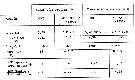 Issued from : C. Séret inThesis 3ème Cycle UPMC, Paris VI, 1979. [p. 84, Tableau VIII]. Female: Comparison of any characters of E. rostrata Giesbrecht (1892), Euchirella rostromagna Vervoort (1951) and samples from ''MD03 Expedition'' around Kerguelen Islands.
|
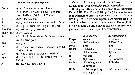 Issued from : C. Razouls in Ann. Inst. océanogr., Paris, 1994, 70 (1). [p.78]. Caractéristiques morphologiques de Euchirella rostromagna femelle et mâle adultes. Comparaison avec E. latirostris. Terminologie et abbréviations: voir à Calanus propinquus.
|
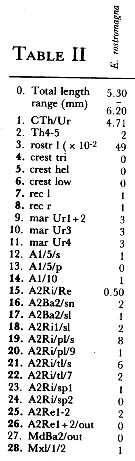 Issued from : J.C. von Vaupel Klein in Crustaceana, (Supplement) 9, 1984. [p.93, Table II ]. Euchirella rostromagna Female: Datamatrix stating observed states of characters from Table I (p.87-90) presently examined; nos. refer to the input nos. used in Table I (see to the family Aetideidae).
|
 Issued from : J.C. von Vaupel Klein in Crustaceana, (Supplement) 9, 1984. [p.94, Table II (cont' d) ]. Euchirella rostromagna Female: Datamatrix starting observed states of characters from Table I (p.87-90) presently examined; nos. refer to the input nos. used in Table I (see to the family Aetideidae).
|
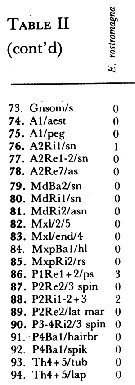 Issued from : J.C. von Vaupel Klein in Crustaceana, (Supplement) 9, 1984. [p.95, Table II (cont' d) ]. Euchirella rostromagna Female: Datamatrix stating observed states of characters from Table I (p.87-90) presently examined; nos. refer to the input nos. used in Table I (see to the family Aetideidae).
| | | | | Ref. compl.: | | | Sewell, 1948 (p.574); Baker, 1954 (p.203, 211, fig.5); Björnberg, 1973 (p.324, 386); Dearborn & al., 1986 (p.1, predation by benthic star); Zmijewska, 1987 (tab.2a); Hopkins, 1985 (p.197, Table 1, gut contents); Hopkins & Torres, 1988 (tab.1); Ward, 1989 (tab.2); Hosie & Cochran, 1994 (tab.2); Donnelly & al., 1994 (p.171, chemical composition); Albers & al., 1996 (p.347, lipids v.s. diet); Pakhomov & McQuaid, 1996 (p.271, abundance, distribution, seabirds); Fransz & Gonzalez, 1997 (p.395, weight-length, biomass vs. N-S transect); Errhif & al., 1997 (p.422); Razouls & al., 2000 (p.343, tab. 3, 4, Appendix); Pakhomov & al., 2000 (p.1663, Table 2, transect Cape Town-SANAE antarctic base); Kattner & al., 2007 (p.1628, Table 1); Schnack-Schiel & al., 2008 (p.1045: Tab.2); Park & Ferrari, 2009 (p.143, Table 3, 7: common deepwater species, fig.1, Appendix 1, biogeography from Southern Ocean); Swadling & al., 2010 (p.887, Table 2, 3, A1, abundance, indicator species); Ojima & al., 2013 (p.1293, Table 2, 3, abundance); Sano & al., 2013 (p.11, Table 7, food habits) | | | | NZ: | 5 | | |
|
Carte de distribution de Euchirella rostromagna par zones géographiques
|
| | | | | | 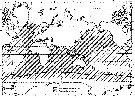 issued from : J.C. von Vaupel Klein in Zool. Verh. Leiden, 1998, 323. [p.392, Fig.5]. issued from : J.C. von Vaupel Klein in Zool. Verh. Leiden, 1998, 323. [p.392, Fig.5].
Map showing the distributional areas of E. rostrata (Claus, 1866), E. rostromagna Wolfenden, 1911, and E. latirostris Farran, 1929 , respectively; note the considerable overlap in range of E. rostrata and the other two species which, in their turn, are virtually coinciding in a strictly geographic sense. Antarctic convergence i(AC). |
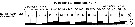 issued from A. de C. Baker in 'Discovery' Rep., 1954, 27. [p.215, Fig.5]. issued from A. de C. Baker in 'Discovery' Rep., 1954, 27. [p.215, Fig.5].
Occurrence of Euchirella rostromagna in all longitudes around Antarctic zone of the Southern Ocean.
The percentage frequency of occurrence in samples taken within every 20° of longitude.
Nota: During the 'Discovery' investigations some thousands of plankton samples have been taken from stations spread over the whole of the Southern Ocean at all seasons of the year, the majority south of the Antarctic Convergence. An arbitrary selection of samples has been made from hauls between the surface and a depth of 250 m, which means that they have been taken from within the limits of the Antarctic surface water.
The data suggest that the Southern Ocean is an uninterrupted circumpolar belt with more or less uniform conditions prevailing in east and west directions, the range of planktonic species of the Antarctic surface water may be expected to extend as far as these uniform conditions persist, i.e to be circumpolar. |
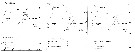 Issued from : J.M. Bradford & J.B. Jillett in New Zealand Ocean. Inst. Memoir, 86, 1980. [p.88-89, Figs.65-67]. Issued from : J.M. Bradford & J.B. Jillett in New Zealand Ocean. Inst. Memoir, 86, 1980. [p.88-89, Figs.65-67].
Distribution of several species of Euchirella in the Tasman Sea and around New Zealand.
Nota: Euchirella indica (= Euchirella massinensis indica). |
 Issued from : E.T. Park & F.D. Ferrari in A selection from Smithsonian at the Poles Contributions to International Polar year. I. Krupnik, M.A. Lang and S.E. Miller, eds., Publs. by Smithsonian Institution Scholarly Press, Washington DC., 2009. [p.165, Fig.1] Issued from : E.T. Park & F.D. Ferrari in A selection from Smithsonian at the Poles Contributions to International Polar year. I. Krupnik, M.A. Lang and S.E. Miller, eds., Publs. by Smithsonian Institution Scholarly Press, Washington DC., 2009. [p.165, Fig.1]
Distribution of selected pelagic calanoids Euchirella rostromagna of the Southern Ocean and the closest relative. |
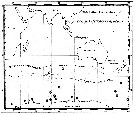 Issued from : C. Séret in Thesis 3ème Cycle, UPMC, Paris 6. 1979, Annexe. [p.33]. Issued from : C. Séret in Thesis 3ème Cycle, UPMC, Paris 6. 1979, Annexe. [p.33].
Geographical occurrences of Euchirella rostromagna in the Indian Ocean and Antarctic zone. [after publications from: Brady, 1883, 1918; Thompson, 1900; Wolfenden, 1908, 1911; With , 1915; Rosendorn, 1917; Farran, 1929; Sewell, 1929, 1947; Brady & Gunther, 1935; Steuer, 1929, 1392, 1933; Ommaney, 1936; Vervoort, 1957; Tanaka, 1960; Brodsky, 1964; Seno, 1966; Andrews, 1966; Grice & Hulsemann, 1967; Seno, 1966; Frost & Fleminger, 1968; Voronina, 1970; Zverva, 1972].
C. Séret notes the occurrence at station 46°S, 64°E. |
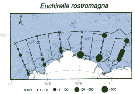 Issued from : K.M. Swadling, So. Kawaguchi & G.W. Hosie in Deep-Sea Research II, 2010, 57. [p.896, Fig.6]. Issued from : K.M. Swadling, So. Kawaguchi & G.W. Hosie in Deep-Sea Research II, 2010, 57. [p.896, Fig.6].
Distribution of indicator species Euchirella rostromagna from the BROKE-West survey (southwest Indian Ocean) during January-February 2006.
Sampling with a RMT1 net (mesh aperture: 315 µm), oblque tow from the surface to 200 m.
The survey area was located predominantly within the seasonal ice zone, and in the month prior to the survey there was considerable ice coverage over the western section but none over the east.
See map showing sampling sites in Calanus propinquus. |
| | | | Loc: | | | Antarct. (Croker Passage, Peninsula, Weddell Sea, Atlant. (SW & SE), Indian, Lützow-Holm Bay, SW & SE Pacif.), sub-Antarct. (Indian, Kerguelen Is., SW & SE Pacif.), Chile, Brazil, Argentina, New Zealand | | | | N: | 36 | | | | Lg.: | | | (10) F: 6; (25) F: 5,99-5,45; (31) F: 6,65-5,85; (35) F: 6,2-5,52; M: 5,3; (246) F: 5,93-5,78; (413) F: 6,65-5,3; (1257) F: 5,3-6,2; {F: 5,30-6,65; M: 5,30}
The mean female size is 5.938 mm (n = 11; SD = 0.4407) and for only one male 5.300 mm. The size ratio should be around 0.90. | | | | Rem.: | méso-bathypélagique.
Sampling depth (Antarct., sub-Antarct.) : 100-500-1000 m
Voir aussi les remarques en anglais | | | Dernière mise à jour : 17/06/2021 | |
|
|
 Toute utilisation de ce site pour une publication sera mentionnée avec la référence suivante : Toute utilisation de ce site pour une publication sera mentionnée avec la référence suivante :
Razouls C., Desreumaux N., Kouwenberg J. et de Bovée F., 2005-2024. - Biodiversité des Copépodes planctoniques marins (morphologie, répartition géographique et données biologiques). Sorbonne Université, CNRS. Disponible sur http://copepodes.obs-banyuls.fr [Accédé le 24 avril 2024] © copyright 2005-2024 Sorbonne Université, CNRS
|
|
|
|




;)
;)
;)
;)
;)
;)
;)
;)
;)
;)
;)
;)
;)
;)
;)
;)
;)
;)
;)
;)

;)
;)
;)
;)
;)
;)