|
|
 |
| Clytemnestridae A. Scott, 1909 ( Harpacticoida, Oligarthra ) | | Syn.: | Pseudo-Peltididae Poppe, 1891; Pseudopeltidiidae : Lang, 1948 a (p.460); Bowman & Abele, 1982 (p.10); Peltidiidae : Vives & Shmeleva, 2010 (p.93, Rem., genera key) | | Ref.: | A. Scott, 1909 (p.231); Sars, 1921 (p.99); Monard, 1927 (p.150); 1928 (p.300); Boxshall, 1979 (p.232, Rem.); Razouls, 1982 (p.738); Zheng Zhong & al.,1984 (1989) (p.268, Rem.); Bodin, 1988 (p.66); Huys & Boxshall, 1991 (p.409, 420); Chihara & Murano, 1997 (p.954); Bradford-Grieve & al., 1999 (p.887, 968); Huys & Conroy-Dalton, 2000 (p.4, Déf., Rem.); Boxshall & Halsey, 2004 (p.17; 277: Def.) | | Rem.: | The name of the family established by Scott must be maintained and not the Pseudopeltidiidae Poppe, 1891. Huys & Conroy-Dalton (2000) give the history of the name of this family (p.4) and restore the genus Goniopsyllus (p.44).
The generic concepts of Goniopsyllus and Clytemnestra (as Goniopelte) intoduced by Claus (1891), but dismissed by subsequent authors, are reinstated. Claus based the distinction on differences in A1 segmentation and setation of the exopod of A2, and on the presence or absence of sexual dimorphism in the caudal rami. Goniopsyllus is clearly more advanced than Clytemnestra, being illustrated by several reductions in the cephalic appendages, P1 and male P6 which provide additional discrepancies between both genera. | 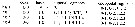 Issued from : G.A. Boxshall & S.H. Halsey in An Introduction to Copepod Diversity, Part II, The Ray Society, 2004, Part II, No 166. [p.277]. Armature formula of swimming legs P1 to P4. | | | | | (1) Clytemnestra Dana, 1848 | |
| | Syn.: | non Goniopsyllus Brady, 1883 (p.107); non Sapphir Car, 1890; Goniopelte Claus, 1891 | | Ref.: | Giesbrecht, 1892 (p.79, 565); Pesta, 1920 (p.630); T. Scott, 1894 b (p.106); Wheeler, 1901 (p.188); Esterly, 1905 (p.213); van Breemen, 1908 a (p.179); A. Scott, 1909 (p.231); Sars, 1921 (p.99); Monard, 1928 (p.301); Wilson, 1932 a (p.292); Rose, 1933 a (p.290); Mori, 1937 (1964) (p.117); Klie, 1943 a (n°4, p.3); Lang, 1948 a (p.460, spp. Key); Davis, 1949 (p.70); Carvalho, 1952 a (p.162); Wells, 1970 (n°133, p.5); Boxshall, 1979 (p.231); Razouls, 1982 (p.738); Chihara & Murano, 1997 (p.954); Huys & Conroy-Dalton, 2000 (p.5, Def., Rem.); Boxshall & Halsey, 2004 (p.278: spp. key); Vives & Shmeleva, 2010 (p.93, Rem., spp. key) | | Rem.: | Type: Clytemnestra scutellata Dana,1847. Total: 6 spp.
Diagnosis from Huys and Conroy-Dalton in Bull. nat. Mus. Lond., 2000, 66 (1), p.5:
- Body without dorsal pattern of denticles or spinules on urosomites.
- A1 distinctly 7-segmented in both sexes (and not 8 in the female because the basal pedestal sometimes misinterpreted as an additional segment). Male segmental homologies : 1 (I) ; 2 (II-VIII) ; 3 (IX-XIII) ; 4 (XIV-XVII) ; 5, XVIII) ; 6 (XIX-XX) ; 7 (XXI-XXVIII). Segment 5 in male with large spine.
- A2 with 1 lateral and 5 apical elements on distal endopod segment. Exopod represented by well defined segment bearing 2 long setae.
- Mx1 represented by bilobated segment with 1 lateral setaz and 2 apical spines.
- Mx2 syncoxa with 1-2 endites ; proximal endite represented by very long seta, sometimes absent ; distal endite bearing 3 setae.
- P1 with outer seta on basis ; exopod with 4 setae.
- P2 without outer spine on exopodal segment 1.
- P1-P4 armature formula (see Table).
- P5 exopod with 5 or 6 setae in both sexes.
- Genital apertures paired in female ; closed off by paired P6 bearing 1 vestigial element ; copulatory pore small, located anteriorly between genital apertures ; copulatory duct probably very short and definitely not strongly chitinized.
- Male P6 almost symmetrical, fused medially forming membranous operculum closing off single median genital aperture ; produced into cylindrical process bearing 3 small setae.
- Caudal rami parallel, almost cylindrical ; sexually dimorphic with setae IV-V short and pinnate in female, long and multiplumose in male ; additional sexual dimorphism also noted in setae III and VI.
The revision of the genus by Huys & Conroy-Dalton (2000) introduces a serious doubt for the most part of the given references as for the geographical data before 2000. | | Remarks on dimensions and sex ratio: | | The mean female size is 1.056 mm. (n = 7, SD = 0.276), and the mean male size is 1.073 mm (n = 5, SD = 0.446). The size ratio male: female is 1. | | | | | Rem.: The revision of the genus by Huys & Conroy-Dalton (2000) introduces a serious doubt on most of the references given, as for locations. | | | | (2) Goniopsyllus Brady, 1883 | |
| | Syn.: | Sapphir Car,1890 | | Ref.: | Huys & Conroy-Dalton, 2000 (p.29, Def.); Huys & Boxshall, 2004 (p.278: spp. key; Rem.); Vives & Shmeleva, 2010 (p.97, Rem., spp. key) | | Rem.: | Type: Goniopsyllus rostratus Brady, 1883. Total: 3 spp. (+ 1 doubtful).
Diagnosis after Huys and Conroy-Dalton (2000, p.29):
- Body with dorsal pattern of denticles and spinules on urosomites.
- A1 6-segmented in female, indistinctly 7-segmented in male with segments 3-4 incompletely fused ; male segmental homologies : 1 (I) ; 2 (II-VIII) ; 3 (IX-XII) ; 4 (XIII) ; 5 (XIV-XVII) ; 6 (XVIII-XX) ; 7 (XXI-XXVIII).
- A2 with 1 lateral and 4 apical elements on distal endopod segment ; exopod represented by membranous segment bearing 1 long seta.
- Mx1 represented by triangular segment with 1 apical spine.
- Mx2 syncoxa with 1 endite bearing 2 setae.
- P1 without outer seta on basis ; exopod with 3 setae.
- P2 with outer spine on exopodal segment 1.
- P1-P4 armature formula (see Table).
- P5 exopod with 5 setae in both sexes.
- Genital apertures fused in female forming common medial slit; closed off by paired P6 bearing well developed seta; copulatory pore located medially in large circular depression halfway the length of the genital double-somite ; copulatory duct strongly chitinized.
- Male P6 asymmetrical, forming membranous opercula closing off single (sinistral or dextral) genital aperture ; bearing 1 seta.
- Caudal rami convergent, relatively short and conical; not sexually dimorphic.
All the localisations and the lengths indicated by the authors previous the revision of the genus by Huys and Conroy-Dalton (2000) are doubtful. | | Remarks on dimensions and sex ratio: | | The mean female size is 1.005 mm (n = 6, SD = 0.270), and the mean male size is 3.380 mm (n = 2, SD = 0.014). The size ratio male: female is 0.995 (based on 1 species) | | | | | Rem.: All locations and lengths shown are doubtful because of the revision of the genus by Huys & Conroy-Dalton (2000). | | | | | |
|
|
 Any use of this site for a publication will be mentioned with the following reference : Any use of this site for a publication will be mentioned with the following reference :
Razouls C., Desreumaux N., Kouwenberg J. and de Bovée F., 2005-2025. - Biodiversity of Marine Planktonic Copepods (morphology, geographical distribution and biological data). Sorbonne University, CNRS. Available at http://copepodes.obs-banyuls.fr/en [Accessed August 26, 2025] © copyright 2005-2025 Sorbonne University, CNRS
|
|
|
|




;)