|
|
 |
|
Calanoida ( Order ) |
|
|
|
Metridinidae ( Family ) |
|
|
|
Pleuromamma ( Genus ) |
|
|
| |
Pleuromamma piseki Farran, 1929 (F,M) | |
| | | | | | | Syn.: | Pleuromamma gracilis piseki Steuer, 1931 (p.6); 1932 a (p.34, 50, 77); 1933 (p.19); Dakin & Colefax, 1940 (p.85, figs.F); Tanaka, 1963 (p.24); Chen & Zhang, 1965 (part., p.70-71, figs.F,M); Vervoort, 1965 (p.109, Rem.); Zheng & al., 1982 (p.46, figs.F) | | | | Ref.: | | | Farran, 1929 (p.209, 261, figs.F, Rem.); Rose, 1933 a (p.182, figs.F, Rem.); Farran, 1936 a (p.111); Tanaka, 1937 (p.267, figs.F, Rem.); C.B. Wilson, 1950 (p.289, figs.M, Rem.); Vervoort, 1957 (p.124, Rem.); Tanaka, 1960 (p.51, Rem.); Giron-Reguer, 1963 (p.33, figs.F); Paiva, 1963 (p.55); Vervoort, 1965 (p.110, Rem.); Owre & Foyo, 1967 (p.73, figs.F, Rem.); Vilela, 1968 (p.24, figs.F,M); Corral Estrada, 1970 (p.179: Rem.); Bowman, 1971 b (p.36, figs.F,M, Rem.); Björnberg & al., 1981 (p.642, figs.F,M); Ferrari, 1984 a (p.167, fig.F); J.S. Park & Mauchline, 1994 (p.108 & suiv., fig.F); J. S. Park, 1995 (p.212, figs.); Bradford-Grieve & al., 1999 (p.884, 949, figs.F,M); Bradford-Grieve,1999 b (p.122, figs.F,M, Rem., figs.179, 192); Conway & al., 2003 (p.94, figs.F,M, Rem.); Vives & Shmeleva, 2007 (p.381, figs.F,M, Rem.); Park & Ferrari, 2009 (p.143, Appendix 1); Halbert & al., 2013 (p.1, fig.5, DNA sequence, Rem.: cryptic forms); Cheng F. & al., 2013 (p.119, molecular biology, GenBank); Blanco-Bercial & al., 2014 (p.6, Rem.: problematical for barcoding) | 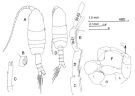 isued from : J.M. Bradford-Grieve in The Marine Fauna of New Zealand: Pelagic Calanoid Copepoda. National Institute of Water and Atmospheric Research (NIWA). NIWA Biodiversity Memoir, 111, 1999. [p.122, Fig.83]. Female (28°52'S, 178°05'W): A, habitus (dorsal); B, genital somite (right lateral side); C, P5. Male: D, habitus (dorsal); E, segments 17-23 of geniculate A1; F, P5. Female characteristics: Distinguished from P. gracilis by its genital segment which has a marked groove or constriction on the left side parallel to, and close to, the posterior margin of the segment and a large black pigmented area around the genital pore. - Anal segment with parallel lateral margins. - P5 imperfectly segmented 4.5-5 times as long as wide, terminating in 3 short syout spines, shorter than the width of the segment. Male characteristics: Geniculate A1 with a double tooth row on segments 19-21; segment 17 naked. - Left P5 segment 3 process with a knob separated from the process by slight notch.
|
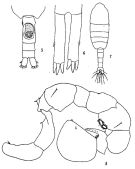 issued from: Q.-c Chen & S.-z. Zhang in Studia Marina Sinica, 1965, 7. [Pl.24, 5, 6, 7, 8]. As Pleuromamma gracilis Forma piseki. Female (from E China Sea): 5, urosome (ventral); 6, P5 (posterior). Male: 7, habitus (dorsal); 8, P5 (posterior).
|
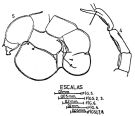 issued from : J. Corral Estrada in Tesis Doct., Univ. Madrid, A-129, Sec. Biologicas, 1970. [Lam.48, figs.4-5]. Male (from Canarias Is.): 4, right A1 (grasping segments); 5, P5 (part.).
|
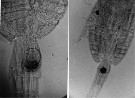 issued from : F. Giron-Reguer in Thèse Fac. Sc. Paris, 1963 [Figs.14, 15]. Female (from Alboran Sea):14, thoracic segments and urosome (ventral view); 15, detail of genital segment (ventral).
|
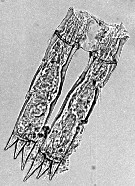 issued from : F. Giron-Reguer in Thèse Fac. Sc. Paris, 1963 [Fig.16]. Female: P5.
|
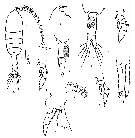 issued from : Z. Zheng, S. Li, S.J. Li & B. Chen in Marine planktonic copepods in Chinese waters. Shanghai Sc. Techn. Press, 1982 [p.49, Fig.27-2, f-J]. As Pleuromamma gracilis f. piseki. Female: a, habitus (dorsal); b, forehead (lateral); c-d, urosome (lateral and ventral, respectively); e, proximal segments of A1; f, P2; g, basipodite, exopodal segment 1 and endopod of P2; h, P3; i, P4; j, P5. Scale bar in mm.
|
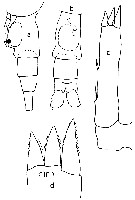 issued from : T.E. Bowman in Smithson. Contr. Zool., 1971, 96. [p.44, Fig.39, a-d]. Female (from Florida): a-b, urosome (lateral and dorsal, respectively); c, P5; d, P5 (terminal spines).
|
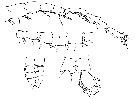 issued from : T.E. Bowman in Smithson. Contr. Zool., 1971, 96. [p.43, Fig.38, a-d]. Male: a, distal segments of left A1; b, segments 13-16 of left A1; c, posterior segments of prosome, lateral showing position of spermatophore; d, anal segment and caudal ramus (dorsal).
|
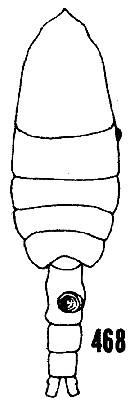 issued from : H.B. Owre & M. Foyo in Fauna Caribaea, 1, Crustacea, 1: Copepoda. Copepods of the Florida Current. 1967. [p.72, Fig;468]. Female: 468, habitus (dorsal).
|
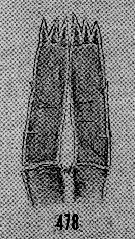 issued from : H.B. Owre & M. Foyo in Fauna Caribaea, 1, Crustacea, 1: Copepoda. Copepods of the Florida Current. 1967. [p.73, Fig.478]. Female: 478, P5.
|
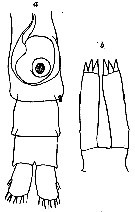 Issued from : O. Tanaka in Japanese J. Zool., 1937, VII, 13. [p.268, Fig.16]. Female (from coast of Heda, Japan): a, abdomen (ventral); b, P5.
|
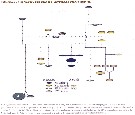 Issued from : L. Blanco-bercial, A. Cornils, N. Copley & A. Bucklin in PLoS Currents, 2014, Version 1, p.8]. TCS analysis on the Pleuromamma piseki and Pleuromamma gracilis sequences. For the authors, a detailed analysis of these two taxa showed a complex pattern, with strong regional-scale genetic structuring of P. gracilis, but no clear isolation from P. piseki . P. gracilis from the SE Atlantic showed a number of highly divergent haplotypes, but still no amino acid substitutions. Regional-scale genetic structure and the presence of highly-divergent rare haplotypes may be related to the large effective population size of cosmopolitan marine copepods. In contrast P. piseki did not show strong spatial structure and lacked genetic divergence from P. gracilis. Similar results have been recently reported for the same species complex for other mitochondrial markers (see Halbert, Goetze & Carlon, 2013). Clearly, integrated molecular and morphological analysis of both species throughout their distributional ranges is needed to clarify both the status of the species and their population structure.
| | | | | Compl. Ref.: | | | Sewell, 1948 (p.503, 547); Duran, 1963 (p.20); Giron-Reguer, 1963 (p.33); Grice, 1963 a (p.496); Gaudy, 1963 (p.25, Rem.); Deevey, 1964 (p.589, Table 1, lengths variation); De Decker & Mombeck, 1964 (p.13); Grice & Hulsemann, 1965 (p.224); Mazza, 1966 (p.71); Mullin, 1966 (p.546, Table I, III, diet); Grice & Hulsemann, 1967 (p.17); De Decker, 1968 (p.45); Deevey, 1971 (p.224); Roe, 1972 (p.277, tabl.1, tabl.2); 1972 b (p.550, Rem.); Björnberg, 1973 (p.340, 388); Corral Estrada & Pereiro Muñoz, 1974 (tab.I); Vives & al., 1975 (p.47, tab.II); Deevey & Brooks, 1977 (p.256, tab.2, Station "S"); Tranter, 1977 (p.596, 602: Rem.); Carter, 1977 (1978) (p.36); Hayward, 1980 (p.295, Table 2, vertical distribution, feeding); Vives, 1982 (p.293); Kovalev & Shmeleva, 1982 (p.84); Evstigneev, 1983 (p.281, bioluminescence); Dessier, 1983 (p.89, Tableau 1, 2, Rem., %); Tremblay & Anderson, 1984 (p.5: Rem.); De Decker, 1984 (p.316, 360: carte); Binet,1984 (tab.2, 3); 1985 (p.85, tab.3); Brenning, 1985 a (p.28, Table 2, fig.9); Sazhina, 1985 a (p.491, tab.2); Petipa & Borichenko, 1985 (tab.2); Wishner & Allison, 1986 (tab.2); Brenning, 1986 (p.10, spatial distribution, T-S diagram, Rem.); Saraswathy, 1986 (p.189); Madhupratap & Haridas, 1986 (p.105, tab.1); Ambler & Miller, 1987 (tab.2, 4, 5); Lozano Soldevilla & al., 1988 (p.59); Dessier, 1988 (tabl.1); Suarez & al., 1990 (tab.2); Suarez & Gasca, 1991 (tab.2); Suarez, 1992 (App.1); Ashjian & Wishner, 1993 (p.483, abundance, species group distributions); Seguin & al., 1993 (p.26, Rem.); Gilabert & Moreno, 1998 (tab.1, 2); Suarez-Morales, 1998 (p.345, Table 1); Suarez-Morales & Gasca, 1998 a (p.110); Mauchline, 1998 (tab.33); Lapernat, 2000 (tabl. 3, 4); Razouls & al., 2000 (p.343, Appendix); Haury & al., 2000 (p.69, Table 1); Rebstock, 2001 (tab.2); 2002 (p.71, Table 3, 6, Fig.2, climatic variability); Beaugrand & al., 2002 (p.1692); Beaugrand & al., 2002 (p.179, figs.5, 6); Pusch & al., 2004 (251, tab.3); Gallienne & al., 2004 (p.5, tab.3); CPR, 2004 (p.60, fig.178); Prusova & Smith, 2005 (p.75); Lavaniegos Jiménez-Pérez, 2006 (p.152, tab.2, 4, Rem.); Mackas & al., 2006 (L22S07, Table 2); Khelifi-Touhami & al., 2007 (p.327, Table 1); Castro & al., 2007 (p.486, fig.3, 5, Table 1, 2, 3); Neumann-Leitao & al., 2008 (p.799: Tab.II, fig.6); Morales-Ramirez & Suarez-Morales, 2008 (p.520); Ayon & al., 2008 (p.238, Table 4: Peruvian samples); Labat & al., 2009 (p.1746, Table 2); Williamson & McGowan, 2010 (p.273, Table III, Pacific central gyres: N & S); Schnack-Schiel & al., 2010 (p.2064, Table 2: E Atlantic subtropical/tropical); Dias & al., 2010 (p.230, Table 1); Mazzocchi & Di Capua, 2010 (p.426); Medellin-Mora & Navas S., 2010 (p.265, Tab. 2); in CalCOFI regional list (MDO, Nov. 2013; M. Ohman, comm. pers.); Lidvanov & al., 2013 (p.290, Table 2, % composition); Zaafa & al., 2014 (p.67, Table I, occurrence); Bonecker & a., 2014 (p.445, Table II: frequency, horizontal & vertical distributions); Fierro Gonzalvez, 2014 (p.1, Tab. 3, 5, occurrence, abundance); Dias & al., 2015 (p.483, Table 2, abundance, biomass, production); Zakaria & al., 2016 (p.1, Table 1, Rem.); El Arraj & al., 2017 (p.272, table 2, spatial distribution); Belmonte, 2018 (p.273, Table I: Italian zones) | | | | NZ: | 19 | | |
|
Distribution map of Pleuromamma piseki by geographical zones
|
| | | | | | | | | | | | | | | 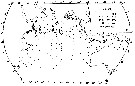 issued from : M. Saraswathy in Mahasagar-Bull. Nat. Inst. Oceanogr., 1986, 19 (3). [p.188, Fig.1C]. issued from : M. Saraswathy in Mahasagar-Bull. Nat. Inst. Oceanogr., 1986, 19 (3). [p.188, Fig.1C].
Distribution of P. piseki in the Indian Ocean (upper water column of 200 m).
Triangle: South West Moonsoon season: April 16 to October 15 (white triangle = negative stations; black = animals collected). Circle: North East Moonsoon season: October 16 to April 15 (white circle = negative stations; black = numbers of ianimals collected).
Nota: The area between 10°N and 10°S appeared to be the most congenial for the species. Off the Somalia coast, the density of the species is moderate with high concentrations during the SW monsoom. |
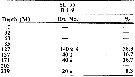 issued from : H.B. Owre & M. Foyo in Fauna Caribaea, 1, Crustacea, 1: Copepoda. Copepods of the Florida Current. 1967. [p.74, Table 30]. issued from : H.B. Owre & M. Foyo in Fauna Caribaea, 1, Crustacea, 1: Copepoda. Copepods of the Florida Current. 1967. [p.74, Table 30].
Vertical distribution of Pleuromamma piseki at the ''40-Mile station'' in the Florida Current (± 25°35'N, 79°27'W).
SL 53: 18 V 1958; SL 55: 21 VII 1958. A: during midday; B;: during midnight. |
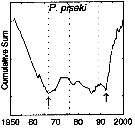 issued from : G.A. Rebstock in Global change Biology, 2002, 8. [p.77, Fig.2 e]. issued from : G.A. Rebstock in Global change Biology, 2002, 8. [p.77, Fig.2 e].
Climatic regime shifts and decadal-scale variability in calanoid copepod populations off southern California (31°-35°N, 117°-122°W.
Cumulative sums of nonseasonal anomalies from the long-term means of copepod abundance from years 1950 to 2000.
A negative slope indicates a period of below-average anomalies; a positive slope indicates a period of above-average anomalies. Abrupt changes in slope indicate step changes. Step changes are marked with arrows (downward -pointing for decreases).
The October 1966 cruise (prior to the increase in sampling depth), March 1976 cruise (prior to the 1976-77 climatic regime shift), and October 1988 cruise (prior to the hypothesized 1989 climatic regime shift) are marked with vertical lines. |
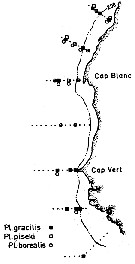 issued from : U. Brenning in Wiss. Z. Wilhelm-Pieck-Univ. Rostock - 35. Jahrgang 1986. Mat.-nat. wiss. Reihe, 5. [p.8, Fig.5]. issued from : U. Brenning in Wiss. Z. Wilhelm-Pieck-Univ. Rostock - 35. Jahrgang 1986. Mat.-nat. wiss. Reihe, 5. [p.8, Fig.5].
Spatial distribution for Pleuromamma piseki, P. gracilis and P. borealis from 8° S - 26° N; 16°- 20° W. |
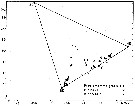 issued from : U. Brenning in Wiss. Z. Wilhelm-Pieck-Univ. Rostock - 35. Jahrgang 1986. Mat.-nat. wiss. Reihe, 5. [p.10, Fig.7]. issued from : U. Brenning in Wiss. Z. Wilhelm-Pieck-Univ. Rostock - 35. Jahrgang 1986. Mat.-nat. wiss. Reihe, 5. [p.10, Fig.7].
T-S Diagram for Pleuromamma piseki, P. gracilis and P. borealis from 8° S - 26° N; 16°- 20° W.
SO: Southern Surface Water (S °/oo: 34,50; T°C: 29,0); ND: Northern Water of the Surface Layer (S °/oo: 37,5; T°C: 21,0); SD: Southern Deep Water of the surface layer (S °/oo: 35,33; T°C: 13,4). See commentary in Temora stylifera and Brenning (1985 a, p.6). |
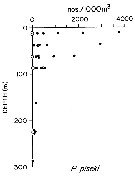 issued from : T.L. Hayward in Mar. Biol., 1980, 58. [p.299, Fig.2]. issued from : T.L. Hayward in Mar. Biol., 1980, 58. [p.299, Fig.2].
Plots of day (open circle) and night (filled circle) depth distributions of Pleuromamma piseki in the North Pacific central gyre (main sampling location: 25°N, 155°W with drogue), September 1968. |
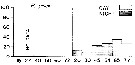 issued from : T.L. Hayward in Mar. Biol., 1980, 58. [p.302, Fig.4]. issued from : T.L. Hayward in Mar. Biol., 1980, 58. [p.302, Fig.4].
Day and night feeding indices (relative degree of gut fullness of copepods collected under differing environmental conditions) for females Pleuromamma piseki from N Pacific central gyre (main sampling location: 28°N, 155°W), June 1973.
Numbers in abscisse : stations. |
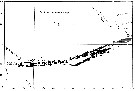 Issued from : A. Dessier in Oceanol. Acta, 1983, 6 (1). [p.101, Fig.8 C]. Issued from : A. Dessier in Oceanol. Acta, 1983, 6 (1). [p.101, Fig.8 C].
Geographic distribution of Pleuromamma piseki along the transect Noumea (New Caledonia) to Panama.
black square: more than 18 organisms; black point inside square: 1 to 18 organisms.
Nota: Sampling by net (mesh aperture = 330 µ) between depth 5 and 10 m, 34 hours after sunset. From November 1977 to September 1981 (90 % of samples obtained since 1979). |
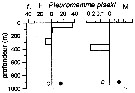 Issued from : P.-E. Lapernat in DEA Océanogr. Biol., Univ. P. & M. Curie, Paris VI. July 5, 2000. [Fig.10 f]. Issued from : P.-E. Lapernat in DEA Océanogr. Biol., Univ. P. & M. Curie, Paris VI. July 5, 2000. [Fig.10 f].
Verical distribution of Pleuromamma piseki at an oligotrophe site (off NW Cape Verde Islands: 21° N, 31° W) in females (F) and males (M) (ind. per m3) in the day (white circle) and night (black circle).
Nota: Sampling in the water column 0-1000 m, one during the day and another during the night with BIONESS multiple-net: 0-75; 75-150; 150-250; 250-350; 350-450; 450-550; 550-700; 700-850; 850-965 m. In May-June 1992. |
 Issued from : G. Deevey in J. mar. biol. Ass. U.K., 1964, 44. [p.593, Fig. 1, A] Issued from : G. Deevey in J. mar. biol. Ass. U.K., 1964, 44. [p.593, Fig. 1, A]
Histogram showing the length distribution, plotted as numbers measured of females of Pleuromamma piseki from 1958-1959, at Station "S' (32°8' N, 64°42' W), 15 miles south-east of Brermuda. Samples by plankton net, oblique hauls from 500 m to the surface |
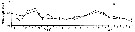 Issued from : G. Deevey in J. mar. biol. Ass. U.K., 1964, 44. [p.595, Fig. 2, B] Issued from : G. Deevey in J. mar. biol. Ass. U.K., 1964, 44. [p.595, Fig. 2, B]
The observed variations in mean cephalothorax length of Pleuromamma piseki females, compared with the calculated lengths based on the phytoplankton data ( amount of Chlorophyll a values present in the upper 100 m during the month preceding each length measurement of the copepod adults.
Simple and partial correlation coefficients for the mean lengths of females and Chlorophyll a of the upper 100 m and surface temperatures averaged for the month preceding each mean lengthy measurement:
Number of pairs : 23.
Simple correlations:
: XY = -0.669; XZ = 0.795; YZ = -0.832.
Partial correlations:
XY, Z constant = -0.022; XZ, Y constant = 0.578.
X: length; Y: temperature; Z: Clorophyll.
All values highly significant (P <0.01) except XY, Z constant.
|
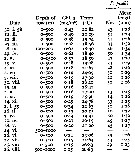 Issued from : G. Deevey in J. mar. biol. Ass. U.K., 1964, 44. [p.592, Table 1] Issued from : G. Deevey in J. mar. biol. Ass. U.K., 1964, 44. [p.592, Table 1]
Mean cephalothorax lengths and numbers measured of females and the mean surface temperature and Chlorophyll a of the month preceding each measurement at Station 'S' (SE off Bermuda). |
| | | | Loc: | | | sub-Antarct. (S Tasmania, SE Pacif.), South Africa (E & W), SE Atlant., G. of Guinea, Cape Verde Is., off Mauritania-NW Cape Verde Is., off Morocco-Mauritania, Great Meteor Seamount, Canary Is., Madeira Is., off Portugal, Brazil, off Rio de Janeiro, Campos Basin, off Macaé, off Amazon, Barbados Is., Caribbean Colombia, Caribbean Sea, Yucatan, G. of Mexico, Cuba, Florida, off Bermuda: Station ‘’ S’’ (32°10’N, 64°30’W), Sargasso Sea, off Cape Hatteras, Flemish Cape, SW Ireland, Ibero-moroccan Bay, off W Tangier, Medit. (Alboran Sea, Gulf of Annaba, Baleares, NW Basin, Ligurian Sea, Tyrrhenian Sea, Strait of Messina, Adriatic Sea, E Basin, W Egyptian coast), Arabian Sea, S Indian, Mascarene Basin, off E La Réunion Is., Rodrigues Is. - Seychelles, Natal, W Australia, Japan (Suruga Bay), Philippines, China Seas (South China Sea), Australia (Great Barrier), New Caledonia, New Zealand (N North Island), Tasman Sea, S Tasmania, Pacif. (equatorial), Pacific (central gyres: N & S), Hawaii, off NE Hawaii, California, W Baja California, W Costa Rica, off Galapagos, Peru, Chile (N & S, sub-antarct.) | | | | N: | 107 | | | | Lg.: | | | (16) F: 1,9-1,75; M: 1,81-1,6; (26) F: 2,15-2,09; (34) F: 1,84-1,71; (35) F: 1,85 [Atlant. N]; F: 1,83-1,7 [Atlant. tropical]; F: 2,4-2,28 [Is. Auckland & Campbell]; (66) F: 1,9-1,85 [Indian: tropical]; (73) F: 2,06-1,93; (128) F: 2,15-2,09; (199) F: 1,98-1,75; M: 1,82-1,6; (327) F: 2,14-1,94; M: 1,87-1,82; (864) F: 1,69-1,98; (909) F: 1,7-2,15; M: 1,7-1,9; (991) F: 1,7-2,02; M: 1,7-1,96; (1108) F: 1,7-2,13; M: 1,7-2,0; {F: 1,70-2,40; M: 1,60-2,00}
The mean female size is 1.943 mm (n = 29; SD = 0.1949), and the mean male size is 1.790 mm (n = 12; SD = 0.1315). The size ratio (male : female) is 0.94 (n = 6; SD = 0.0299). | | | | Rem.: | epi-mesopelagic. Considered as vetical migrator. Sampling depth (sub-Antarct.) : 100-250 m. Overall Depth Range in Sargasso Sea: 0-1000 m (Deevey & Brooks, 1977, Station "S");
Vervoort (1957, p.124) does not maintain the specific rank of this species, following Steuer (1931) as a variety of Pleuromamma gracilis (P. gracilis piseki), but in 1965 (p109) it should be referred to as the Farran's species..
After Tanaka (1960, p.52) the specimen from Suruga Bay measured 1.86 mm; the anal segment of the female has paralell lateral margins; the body larger and stouter than in P. gracilis.
After Bradford-Grieve (1999 b, p.121) the identity of the males is not always clear, there is a possibility that P. gracilis, P. piseki, P. borealis have been confused when they have not been dissected.
See in DVP Conway & al., 2003 (version 1) | | | Last update : 28/10/2022 | |
|
|
 Any use of this site for a publication will be mentioned with the following reference : Any use of this site for a publication will be mentioned with the following reference :
Razouls C., Desreumaux N., Kouwenberg J. and de Bovée F., 2005-2025. - Biodiversity of Marine Planktonic Copepods (morphology, geographical distribution and biological data). Sorbonne University, CNRS. Available at http://copepodes.obs-banyuls.fr/en [Accessed January 01, 2026] © copyright 2005-2025 Sorbonne University, CNRS
|
|
|
|




;)
;)
;)
;)
;)
;)
;)
;)
;)
;)
;)
;)

;)
;)
;)
;)
;)
;)
;)
;)
;)
;)
;)
;)