|
|
 |
|
Calanoida ( Order ) |
|
|
|
Clausocalanoidea ( Superfamily ) |
|
|
|
Phaennidae ( Family ) |
|
|
|
Cornucalanus ( Genus ) |
|
|
| |
Cornucalanus indicus Sewell, 1929 (F,M) | |
| | | | | | | Ref.: | | | Sewell, 1929 (p.179, Descr.F, figs.F); 1948 (p.540); Brodsky, 1950 (1967) (p.236, figs.F, Rem.); Vervoort, 1957 (p.93, Rem.); Tanaka, 1960 a (p.122, figs. juv.F); Tanaka & Omori, 1967 (p.250); Arashkevich, 1969 (p.702, figs.F); Silas, 1972 (p.647); Brodsky & Zvereva, 1976 (p.188, Descr.M, figs.M); Tanaka & Omori, 1992 (p.258, Rem.F,M, figs.M); Chihara & Murano, 1997 (p.853, Pl.139: F); Vives & Shmeleva, 2007 (p.685, figs.F,M, Rem.) | 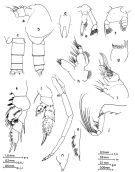 issued from : O. Tanaka & M. Omori in Publ. Sero Mar. Biol. Lab., 1992, 35 (4/5). [p.259, Fig.3]. Male (from Izu region): a, forehead (lateral); b, last thoracic segments and urosome (lateral left side); c, urosome ((dorsal); d, rostrum (frontal view); e, A2; f, Md (mandibular palp); g, Md (cutting edge); h, Mx1; i, Mx2; j, Mxp; k, P1 (posterior); l, P2; m, P5; n, distal part of right P5; o, distal part of left P5. Nota: Rostrum consist of a plate with stout rami, each of which is followed by a small projection at apex. A1 extends to end of first urosomal segment. Mx1 reduced: 7 setae on outer lobe; 9 on exopod, 5 on basis, 3+6 on endopod, and 4 on 3rd and 2 on 2nd inner lobe; first inner lobe large but only armed with few small setae. Mx2 reduced: 4th and 5th lobes each armed with a large claw-like spiniform seta; endopod with 8 weak sensory filaments of which one is slender and longer than others. Prosome/Urosome lengths ratio 77 : 23. Cephalosome and 1st metasomal segment separated, 4th and 5th incompletely separated by a line of demarcation. Urosomal segments without spinules and caudal rami in the proportional lengths 16 : 33 : 26 : 15 : 4 : 6 = 100. P5, the right leg 3-segmented; distal segment armed with 2 spines; left leg 5-segmented and long; 1st to 4th segments about equal in length; 5th segment short, and with 1 distal and 1 lateral spine and patches of hairs.
|
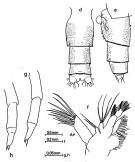 issued from : O. Tanaka & M. Omori in Publ. Sero Mar. Biol. Lab., 1992, 35 (4/5). [p.257, Fig.2]. Female (from Izu region): d, urosome and caudal rami (dorsal); e, idem (lateral left side); f, Mx1; g, h, P5. Nota: Prosome/urosome length ratio 74 : 26. Forehead round with no trace of cephalic spine. Urosome covered with spinules. Proportional lengths of segments and caudal rami 50 : 25 : 15 : 2 : 8 = 100. Lateral margin of genital complex inflated; genital tubercle prominent. Mx1: 9 setae on outer lobe, 10 on exiopod, 5 on basis, 10 on endopod, 4 on 3rd, 2 on 2nd and 10 on 1st inner lobe. P5 very small, 3-segmented; 2nd segment longer than the 3rd; there is a faint line of demarcation near the proximal 1/3 of 3rd segment; 3rd segment armed with a large inner terminal spine and small outer spine (although the inner terminal spine not developed well in another specimen).
|
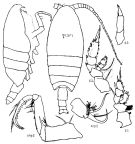 Issued from : K.A. Brodskii in Calanoida of the Far Eastern Seas and Polar Basin of the USSR. Opred. Fauna SSSR, 1950, 35 (Israel Program for Scientific Translations, Jerusalem, 1967) [p.237, Fig.148]. Female (from NW Pacif.): habitus (dorsal and lateral right side); Mp1, Mx2; Mp2, Mxp; S1, P1; S3, P3; S5, P5. Nota: P5 slightly asymmetrical in size and form. A specimen from the Pacific shows the following differences in comparison with those described from the Bay of Bengal: Head less rounded, spines of Mxp larger. The Pacific form possibly represents a separate variety.
|
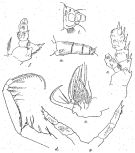 issued from : R.B.S. Sewell in Mem. Indian Mus., 1929, X. [p.180, Fig.66]. Female (from off SE Sri-Lanka): a, posterior thoracic margin and urosome (lateral left side); b, anal segment and furcal ramus (lateral): c, Mx2; d, Mxp; e, P2; f, P4; g, P5.
|
 issued from : O. Tanaka & M. Omori in Publ. Sero Mar. Biol. Lab., 1992, 35 (4/5). [p. 260]. Male: Proportional lengths of segments of A1.
| | | | | Compl. Ref.: | | | Grice & Hulsemann, 1967 (p.16); Roe, 1972 (p.277, tabl.1, tabl.2); Vives, 1982 (p.292); Lozano Soldevilla & al., 1988 (p.58); Suarez-Morales & Gasca, 1998 a (p.110); Ikeda & al., 2006 (p.1791,Table 2); Galbraith, 2009 (pers. comm.); Homma & Yamaguchi, 2010 (p.965, Table 2); Homma & al., 2011 (p.29, Table 2, 3, abundance, feeding pattern: suspension feeders) | | | | NZ: | 6 | | |
|
Distribution map of Cornucalanus indicus by geographical zones
|
| | | | | | | Loc: | | | Canary Is., off Morocco-Mauritania, G. of Mexico, Indian (off E Sri Lanka), Japan (Izu region, NE), Okhotsk Sea, Bering Sea, S Aleutian Basin, S Aleutian Is., off British Columbia (rare), | | | | N: | 7 | | | | Lg.: | | | (29) F: 8; (70) F: 9-8,2; (22) F: 9,24-8,8; (199) F: 7,37; (444) M: 7,65-7,3; (867) F: 8,9-9; M: 8,28; {F: 7,37-9,24; M: 7,30-8,28} | | | | Rem.: | meso-abyssopelagic.
According to Sewell (1929, p.179) this species is an intermediate form between C. chelifer (Thompson) and C. simplex Wolfenden.
After Vervoort (1957, p.93) the characteristics are : No cephalic spine; the postero-lateral thoracic border on each side is triangularly produced and distinctly mucronated, the spine at the apex, however, is blunt. P5 are very characteristic; apparently 3-segmented on each side, though the apical segment, by the presence of a transverse chitinous ridge, appears to be composed of two parts; the ultimate and penultimate segments are sparingly haired; the apex is drawn out into a narrowly tapering point, at the base of which, externally, occurs a small spine with a row of smaller spinules at its base. The P5 differs entirely from that of Cornucalanus robustus Vervoort, 1957, and may serve to distinguish both forms.
For Tanaka & Omori (1992, p.261) males of C. chelifer, C. indicus and C. robustus are known, but their diagnostic characters are insufficient, making separation from each other uneasy. park (1983) suggests that lateral view of forehead and rostrum, shape of spiniform setae of Mx2, and proportional lengths of 4th and 5th segments of left P5 are useful characteristics to separate C. robustus from C. chelifer. Male of C. indicus described by Brodsky & Zvereva (1976) has a forehead shape similar to that of C. chelifer. The male of Tanaka & Omori (1992) is more similar to C. robustus than C. chelifer in the same aspect. | | | Last update : 02/01/2015 | |
|
|
 Any use of this site for a publication will be mentioned with the following reference : Any use of this site for a publication will be mentioned with the following reference :
Razouls C., Desreumaux N., Kouwenberg J. and de Bovée F., 2005-2025. - Biodiversity of Marine Planktonic Copepods (morphology, geographical distribution and biological data). Sorbonne University, CNRS. Available at http://copepodes.obs-banyuls.fr/en [Accessed August 29, 2025] © copyright 2005-2025 Sorbonne University, CNRS
|
|
|
|




;)
;)
;)
;)
;)