|
|
 |
|
Monstrilloida ( Order ) |
|
|
|
Monstrillidae ( Family ) |
|
|
|
Monstrilla ( Genus ) |
|
|
| |
Monstrilla careli Suarez-Morales & Dias, 2000 (F) | |
| | | | | | | Ref.: | | | Suarez-Morales & Dias, 2000 (p.1031, Descr.F, figs.F); Suarez-Morales, 2001 b (p.11, Redescr.F, figs. F); Suarez-Morales & Gasca, 2004 (p.298, Rem. tab.1); Dias & Araujo, 2006 (p.96, figs.F, Rem., chart); Suarez-Morales, 2011 (p.9) | 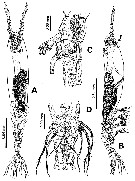 issued from : E. Suarez-Morales & C. Dias in J. mar. Biol. Ass. U.K., 2000, 80. [p.1032, Fig.1]. Female (from Rio de Janeiro: Brazil): A-B, habitus (dorsal and lateral, respectively); C, 5th pedigerous somite and genital double-somite (lateral); D, idem (ventral view). Arrow indicates convex protuberance. Nota: Cephalothorax (incorporating 1st pedigerous somite) accounting for 64 % ofbtotal body length. Forehead flat in dorsal view, with pair of short, slender sensillae. Anteriormost part of cephalothorax with ventral, low rounded convex protuberance between oral papilla and antennular bases (arrowed in fig.1B). Oral papilla located close to anteriormost part of body, lying midventrally 0.12 of way back along cephalothorax. Nauplius eye present, weakly developed, ocelli slightly pigmented, with rounded shape; eyes separated by a distance equal to 1.6 eye diameter. P5 short, bilobed, fused medially; outer lobe about 2.2 times thicker than inner one, armed with 3 long, lightly plumose seta, subequal in length and breadth, outermost slightly longer; outer lobe setae reach distal margin of caudal rami; inner lobe small, rounded, armed with distal seta, about 25 % shorter than those of outer lobe. Urosome consisting of 5th pedigerous somite, genital double-somite, and 2 free abdominal somites. Genital double-somite with partial intersegmental division, visible in dorsal view; representing almost half the length of urosome; ratio of length 32.2:45.1:11.3:11.4 = 100. Genital double-somite bearing short ovigerous spines, basally separated, about 12.4 % of total body length
, extending slightly distal margin of anal somite.
|
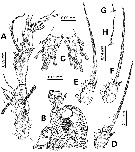 issued from : E. Suarez-Morales & C. Dias in J. mar. Biol. Ass. U.K., 2000, 80. [p.1033, Fig.2]. Female:A, right A1 (dorsal view); B, head (lateral); C, caudal rami (dorsal); D, terminal segment exopod of P1; E, terminal segment of exopod of P4; F, terminal segment of exopod of P3; G, basipodal seta of P1; H, idem on P3. Nota: - A1 4-segmented; ratio of length antennule segments 12.3 : 18.4 : 12.56 : 56.4 = 100.; A1 relatively long (mainly the terminal segment, more than half the length of this appendage), slightly longer than 25.3 % of total body length, and about 38 % the length of cephalothorax. - Caudal rami about 2 times longer than wide, moderately divergent, bearing 2 outer, 3 terminal, and 1 dorsal setae; dorsal seta relatively long, about twice as long as rami.
|
 issued from : E. Suarez-Morales & C. Dias in J. mar.Biol. Ass. U.K., 2000, 80. [p.1034]. Female: armature of swimming legs P1 to P4.
|
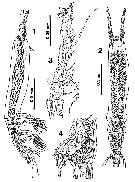 issued from : E. Suarez-Morales in Ann. Inst. Biol. Univ. Nac. Aut. Mexico, ser. Zool., 2001, 72 (1). [p.12, Figs.1-4]. Female (from 18°43'51''N, 87°24'22''W): 1-2, habitus (lateral an dorsal); 3, left A1 (dorsal); 4, 5th pedigerous and genital -double somites showing P5 and base of ovigerous spines (lateral). Nota: - Cephalothorax (incorporating 1st pedigerous somite) accounting for 63.7% of total body length (caudal rami excluded). - Forhead with pair of short, slender sensilla. - Anteriormost part of cephalothorax not protuberant in ventral view, with 2 pairs of nipple-like cuticular processes, one (ln in fig.8) surronded by a field of short curved ridges, other pair (2n in fig.8) near oral papilla, represented by single circular process with no surrounding structure (fig.8). - Oral papilla protuberant, located near anteriormost part of body, lying midventrally 0.11 of distance posteriorly along cephalothorax. - Nauplius eye present, weakly developed, ocelli moderately pigmented on outer side, with rounded shape, eyes separated by distance equal to slightly less than two eye diameters. - Cuticular ornamentation on cephalothorax represented by faint reticulation on proximal 1/3 of dorsal and ventral surfaces. - A1 4-segmented, relatively long, slender, slightly longer than 22% of total body length, and about 35% length of cephalothorax. - Urosome of 5th pedigerous somite, genital double-somite and 2 free abdominal somites. Urosome (excluding caudal rami) accounting for 15.7% of total body length. - Genital double-somite with partial intersegmental division (visible in dorsal view) and reaching around about midlength of somite. Double-somite representing almost half length of urosome.Medial anterior ventral portion of genital double-somite swollen. Posterior section bearing ovigerous spines, these basally separated, not swollen but slender distally; length of ovigerous spines representing about 20.4% of total body length, extending beyond distal margin of anal somite. - Caudal rami 2 times longer than wide, moderately divergent, bearing 6 setae including 2 outer, 3 terminal, and 1 dorsal seta.
|
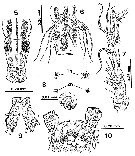 issued from : E. Suarez-Morales in Ann. Inst. Biol. Univ. Nac. Aut. Mexico, ser. Zool., 2001, 72 (1). [p.14, Figs.5-10]. Female: 5, urosome (dorsal; caudal rami not shown); 6, 5th pedigerous somite and genital double-somite showing P5 and base of ovigerous spines (ventral); 7, right A1 (dorsal): 8, cuticular ornamentation around the oral papilla (ventral); 9, caudal rami (dorsal); forhead (dorsal). 1n & 2n: two pairs nipple-like cuticular processes, one (1n) surrounded by a field of short curved ridges; other pair (2n) near oral papilla , represented by single circular process with no surrounding structure. The P5 of the mexican material differs slightly from the pattern shown by the Brazilian specimens. In the former, the main lobe is slendrer than in the type specimens. The seta on the inner lobe is relatively longer in the Brazilian specimens, reaching well beyond the posterior margin of the genital somite. In the Mexican specimens this seta does not reach the posterior margin of the genital double-somite. In the Mexican specimens the basal area at which the ovigerous spines are inserted shows an ornamentation pattern (fig.6) not found in the Brazilian material, which has a semicircular structure at the base of the spines.
|
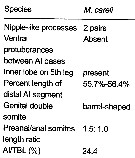 Issued from : E. Suarez-Morales & R. Gasca in Zool. Studies, 2004, 43 (2). [p.298, Table 1] Female: Characteristic of morphological features in M. careli. Distal antennular segment comprising over 50% of A1 length and 4 setae on P5. A1: antennule; TBL: total body length. Compare with M. longa and M. careloides.
| | | | | Compl. Ref.: | | | Dias & Bonecker, 2007 (p.270, 272, fig.3, tab.II) | | | | NZ: | 2 | | |
|
Distribution map of Monstrilla careli by geographical zones
|
| | | 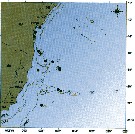 issued from : C. de O. Dias & A.V. Araujo in Atlas Zoopl. reg. central da Zona Econ. exclus. brasileira, S.L. Costa Bonecker (Edit), 2006, Série Livros 21. [p.97]. issued from : C. de O. Dias & A.V. Araujo in Atlas Zoopl. reg. central da Zona Econ. exclus. brasileira, S.L. Costa Bonecker (Edit), 2006, Série Livros 21. [p.97].
Chart of occurrence in Brazilian waters (sampling between 10°-24° S).
Nota: sampling 28 specimens. |
| | | | Loc: | | | Brazil (Rio de Janeiro, off Vitoria-Cabo de Sao Tomé, Salvador, Recife), Caribbean Sea: Mexico (Banco Chinchorro)
For Suarez-Morales (2001 b, p.15), the new occurrence of this species represents a significant latitudinal expansion of the geographical distribution, from 22°S to the northwestern Atlantic (18°N). It is expected that the distribution will include the western Caribbean, Central America, and northern South America. | | | | N: | 4 | | | | Lg.: | | | (843) F: 3,31-3,70; (873*) F: 3,5; 3,9 [without furca]; {F: 3,31-3,90} | | | | Rem.: | For Suarez-Morales & Dias (2000, p.1034) the position of the oral papilla on the cephalothorax is not a valid character to separate the genus Monstrilla because it can be found high up along the cephalothorax or on its middle section. The generic division still depends largely on the number of urosomites. Following Isaac's identification key, in which the position of the oral papilla on the cephalothorax is considered, this species would key down, incorrectly, to the genus Monstrillopsis.
The most striking difference of this species with respect to the other Monstrilla is the extremely long terminal segment of A1 (it represents more than half the length of this appendage. Another character is the extremely long dorsal seta on the caudal rami, more than twice as long as bearing ramus. | | | Last update : 26/01/2016 | |
|
|
 Any use of this site for a publication will be mentioned with the following reference : Any use of this site for a publication will be mentioned with the following reference :
Razouls C., Desreumaux N., Kouwenberg J. and de Bovée F., 2005-2026. - Biodiversity of Marine Planktonic Copepods (morphology, geographical distribution and biological data). Sorbonne University, CNRS. Available at http://copepodes.obs-banyuls.fr/en [Accessed February 28, 2026] © copyright 2005-2026 Sorbonne University, CNRS
|
|
|
|




;)
;)
;)
;)
;)
;)
;)