|
|
 |
|
Calanoida ( Order ) |
|
|
|
Diaptomoidea ( Superfamily ) |
|
|
|
Acartiidae ( Family ) |
|
|
|
Acartia ( Genus ) |
|
|
|
Acartiura ( Sub-Genus ) |
|
|
| |
Acartia (Acartiura) discaudata (Giesbrecht, 1881) (F,M) | |
| | | | | | | Syn.: | Dias discaudata Giesbrecht, 1881; 1882. | | | | Ref.: | | | Giesbrecht, 1892 (p.507, 522, figs.F,M); Giesbrecht & Schmeil, 1898 (p.153); Sars, 1903 (p.152, figs.F,M); Steuer, 1923 (p.11, figs.F,M); Gurney, 1931 a (p.228, figs.F,M); Wilson, 1932 a (p.163, figs.F,M); Rose, 1933 a (p.272, figs.F,M); Farran, 1948 a (n°12, p.3, figs.F); Razouls, 1972 (p.95, Annexe: p.97); Bradford, 1976 (p.195, figs.M); Brylinski, 1981 (p.257, figs.F,M); Schnack, 1982 (p.89, figs. Mx2, Md, Mxp); Behrends & al., 1997 (p.594, figs.F); Bradford-Grieve, 1999 (n°181, p.3, figs.F,M); Castro-Longoria, 2001 (p.225, fig.2); Avancini & al., 2006 (p.108, Pl. 76, figs.F,M, Rem.);Vives & Shmeleva, 2007 (p.416, figs.F,M, Rem.). | 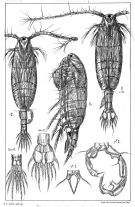 issued from : Sars G.O. in An Account of the Crustacea of Norway. Vol. IV. Copepoda Calanoida. Published by the Bergen Museum, 1903. [Pl.CII]. Famale and Male. Rem: P5 = fifth leg
|
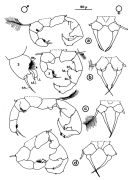 issued from : J.M. Brylinski in J. Plankton Res., 1981, 3 (2). [Fig.2, p.257]. Structure of P5 of the Acartia in the wet docks of the harbour of Dunkirk (Strait of Dover). Male and Female a: Acartia clausi; b: A. tonsa, c: A. discaudata, d: A. bifilosac.f.: curved finger, c.n.: curved needle, d.t.: distal tooth, l.: lamella, l.p.: lamellar process, p.t.: proximal tooth, s.: setae, sp.: spines, 3, segment 3 of left leg. Rem: P5 = fifth leg
|
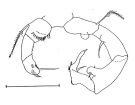 ssued from : J. M. Bradford in N.Z. J. Mar. Freshw. Res., 1976, 10 (1). [p.196, Fig.32b] Male (From W France: Brest Harbour): P5 (posterior view).
|
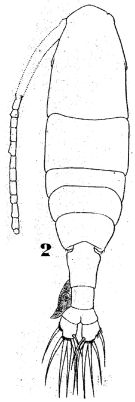 issued from : W. Giesbrecht in Fauna Flora Golf. Neapel, 1892, 19. [Taf.43, Fig.2]. Female: 2, habitus (dorsal).
|
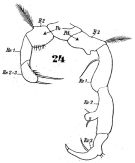 issued from : W. Giesbrecht in Fauna Flora Golf. Neapel, 1892, 19. [Taf.43, Fig.24]. Male: 24, P5 (Ps = left leg; Pd = right leg).
|
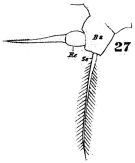 issued from : W. Giesbrecht in Fauna Flora Golf. Neapel, 1892, 19. [Taf.30, Fig.27]. Female: 27, P5.
|
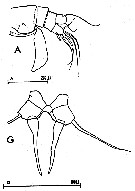 issued from : C. Razouls in Th. Doc. Etat Fac. Sc. Paris VI, 1972, Annexe. [Fig.56, A, G]. As var. mediterranea.
Female (from Banyuls, G. of Lion): A, urosome and spermatophore (lateral); G, P5.
|
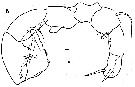 issued from : C. Razouls in Th. Doc. Etat Fac. Sc. Paris VI, 1972, Annexe. [Fig.57, B]. As Acartia discaudata var. mediterranea. Male: P5.
|
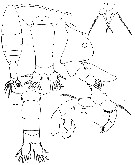 issued from : P. Crisafi & M. Crescenti in Boll. Pesca Piscic. Idrobiol., 1972 (1974), 27 (2). [p.242, Pl.II]. As Acartia discaudata var. mediterranea. Female (from Milazzo, Sicily): f, habitus (dorsal); f ad,
posterior thoracic part and urosome (dorsal); f ad l, urosome with spermatophore (lateral); f P5, P5. Male: m ad (urosome (dorsal); m P5, P5.
|
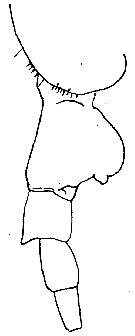 issued from : A. Steuer in Sber. Akad. Wiss. Wien, mat.-nat. K1, 138, Abt.1, 1929. [p.504, Fig.3]. As Acartia discaudata var. mediterranea nov. var. Male (from Naples, Mediterranean Sea]: 3, P5. B = basipodite; Re = exopodite.
|
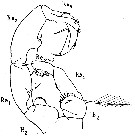 issued from : A. Steuer in Sber. Akad. Wiss. Wien, mat.-nat. K1, 138, Abt.1, 1929. [p.503, Fig.4]. As Acartia discaudata var. mediterranea nov. var. Male (from Naples, Mediterranean Sea]:
|
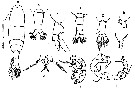 Issued from : M.G. Mazzocchi in Guida al Riconoscimento del plancton dei Mari Italiani, Vol. II, 2006. [p.84, Tav. 76]. After A. Comaschi. As Acartia mediterranea var. mediterranea: Female: a, habitus (dorsal); b, urosome (dorsal); c, same (lateral); d, P5. Male: e, urosome (dorsal); f, P5. Acartia discaudata: Female: g, urosome (dorsal); h, last thoracic segment with P5 and genital segment (lateral); i, left P5. male: L, P5.
| | | | | Compl. Ref.: | | | Gadeau de Kerville, 1894 (p.81); I.C. Thompson, 1903 a (p.31); Pearson, 1906 (p.31); Rose, 1925 (p.152); 1927 a (p.208); Sewell, 1948 (p.483); C.B. Wilson, 1950 (p.152); Fleury, 1950 (p.47, fig.2); Conover, 1959 (p.259, Table 1, 2, respiration); Marshall & Orr, 1962 (tab.3); Gaudy, 1962 (p.93, 99, Rem.: p.115) ; Mazza, 1966 (p.72); Champalbert, 1969 a (p.609); Paulmier, 1971 (p.168); Lefèvre-Lehoërff, 1972 (p.1681); Della Croce & al., 1972 (p.1, fig.2, Rem.); Guglielmo, 1973 (p.399); Arndt & Heidecke, 1973 (p.599, 603); Vives, 1982 (p.295); Castel & Courties, 1982 (p./417, Table II, fig.4, spatial & monthly distribution); d'Elbée, 1984 (p.24, Fig.3); Williams & Collins, 1985 (p.27); Lozano Soldevilla & al., 1988 (p.60); Lakkis, 1990 (p.63); Rodriguez & Jiménez, 1990 (p.497); Jouffre & al., 1991 (p.489, lagoon); Seguin & al., 1993 (p.23); Sautour & Castel, 1993 (p.279); Lakkis, 1994 (p.481); Behrends & al., 1997 (p.594, anomaly); Hure & Krsinic, 1998 (p.103); Mauchline, 1998 (tab.47); El-Sherif & Aboul Ezz, 2000 (p.61, Table 3: occurrence); d'Elbée, 2001 (tabl. 1); Holmes, 2001 (p.34, Rem.); Belmonte & Potenza, 2001 (p.173); Uysal & al., 2002 (p.17, tab.1); Zerouali & Melhaoui, 2002 (p.91, Tableau I, fig.5); Vaglio & al., 2005 (p.163); Uriarte & Villate, 2005 (p.863, tab.I); Valdés & al., 2007 (p.104: tab.1); Vincent & al., 2007 (p.295, Table 1, 3, 4, 5, 7, nitrogen transfert); Brylinski, 2009 (p.253: Tab.1, p.256: Rem.); Aravena & al., 2009 (p.621, seasonal & spatial distribution v.s. environmental factors); Mazzocchi & Di Capua, 2010 (p.423); Mazzocchi & al., 2011 (p.1163, fig.6, long-term time-series 1984-2006); Mazzocchi & al., 2012 (p.135, annual abundance 1984-2006); Boyer & al., 2012 (p.2, fig.2, abundance & annual change); Zizah & al., 2012 (p.79, Table I, Rem.: p.89 as A. grani); Belmonte & al., 2013 (p.222, Table 2, abundance vs stations); Lindeque & al., 2013 (p.737, molecular identification); Boyer & al., 2013 (p.125, egg production vs environmental parameters); Zaafa & al., 2014 (p.67, Table I, occurrence): Uriarte & al., 2016 (p.718, fig.5: abundance vs years 1998-2011); Benedetti & al., 2016 (p.159, Table I, fig.1, functional characters); Ben Ltaief & al., 2017 (p.1, Table III, Summer relative abundance); El Arraj & al., 2017 (p.272, table 2); Belmonte, 2018 (p.273, Table I: Italian zones); Richirt & al., 2019 (p.3, Table 1, fig.2, 3, 4, 5, abundance changes vs years 1998-2014, table 2: diversity index ) | | | | NZ: | 8 | | |
|
Distribution map of Acartia (Acartiura) discaudata by geographical zones
|
| | | | | | | | | 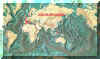 Chart of 1996 Chart of 1996 | |
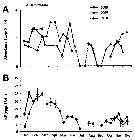 Issued from : S. Boyer, M. Bouvy & D. Bonnet in Estuar, Coast. Shelf Sci., 2013, 117. [p.129, Fig.3 A, B]. Issued from : S. Boyer, M. Bouvy & D. Bonnet in Estuar, Coast. Shelf Sci., 2013, 117. [p.129, Fig.3 A, B].
Acartia discaudata: A, Abundance (ind. 33) over a year at the monitoring station in 2008, 2009 and 2010. B, Egg production (EP) .
Bars: standards deviations.
Samples collected at a fixed station (43°25'N, 03°40'E) in the Thau lagoon, close to Sète channel, with a WP2 net (200 µm mesh aperture). Mesozooplankton collected by horizontal hauls at 1 m depth. |
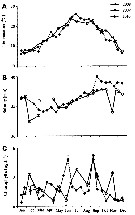 Issued from : S. Boyer, M. Bouvy & D. Bonnet in Estuar, Coast. Shelf Sci., 2013, 117. [p.128, Fig.2]. Issued from : S. Boyer, M. Bouvy & D. Bonnet in Estuar, Coast. Shelf Sci., 2013, 117. [p.128, Fig.2].
Environmental parameters at the sampling station in 2008, 2009, 2010, in the Thau lagoon, close to Sète channel.
Bars: Standards deviations.
A: temperature (°C); B, salinity (psu); c, chlorophyll a concentration (µg /L). |
 Issued from : S. Boyer, M. Bouvy & D. Bonnet in Estuar, Coast. Shelf Sci., 2013, 117. [p.132, Fig.6, A]. Issued from : S. Boyer, M. Bouvy & D. Bonnet in Estuar, Coast. Shelf Sci., 2013, 117. [p.132, Fig.6, A].
Acartia discaudata: Relationship between egg production (EP) and prosome length (PL), in the Thau lagoon, close to Sète channel.
Black dotted lines represent the linear regression for all points. |
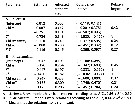 Isued from : S. Boyer, M. Bouvy & D. Bonnet in Estuar, Coast. Shelf Sci., 2013, 117. [p.130, Table 2]. Isued from : S. Boyer, M. Bouvy & D. Bonnet in Estuar, Coast. Shelf Sci., 2013, 117. [p.130, Table 2].
Summary results after model averaging: effects of each single environmental parameter Chl a (Chlorophyll a concentration), T (temperature), S (salinity and their interactions (:) on egg production in Acartia clausi and Acartia discaudata at the sampling station in 2008, 2009, 2010, in the Thau lagoon, close to Sète channel. |
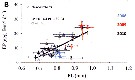
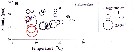 Issued from : S. Boyer, M. Bouvy & D. Bonnet in Estuar, Coast. Shelf Sci., 2013, 117. [p.131, Fig.5, B]. Issued from : S. Boyer, M. Bouvy & D. Bonnet in Estuar, Coast. Shelf Sci., 2013, 117. [p.131, Fig.5, B].
Acartia discaudata: Egg production (EP) in function of salinity (S) and temperature (T) in the Thau lagoon, close to Sète channel.
Blue circles: 2008; red circles: 2009; black circles: 2010. |
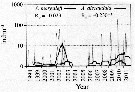 Issued from : I. Uriarte, F. Villate & A. Iriarte in J. Plankton Res., 2016, 38 (3). [p.724, Fig.5]. Issued from : I. Uriarte, F. Villate & A. Iriarte in J. Plankton Res., 2016, 38 (3). [p.724, Fig.5].
Monthly time-series from 1998 to 2011 of Acartia margalefi (black) and Acartia discaudata (grey) from inner Bilbao estuary (NW Spain). Thicker lines are moving averages. R0 is the Spearman's rank correlation coefficient (P <0.05; **P < 0.01).
Nota: A. discaudata showed positive correlation with precipitation and NAO index. |
| | | | Loc: | | | off Woods-Hole (in Wilson, 1932 a), Senegal, Canary Islands, off Morocco, Bay of Biscay (Bilbao estuary, St.-Jean-de-Luz, Arcachon Bay, Gironde estuary, Belon estuary), Ireland, Bristol Channel, English Channel, Morlaix estuary, Granville, Southampton, Pas de Calais, Norway, North Sea, Bay of Kiel, Gulf of Mecklenburger, Baltic Sea, G. of Bothnia, Faroe, off W Tangier, Medit. (Alboran Sea, Algiers Bay, N Tunisia, Castellon, Banyuls, Thau lagoon, Marseille (rare), Genova, Ligurian Sea, Tyrrhenian Sea, G. of Naples, Strait of Messina, G. of Gabes Taranto, Adriatic Sea, Lebanon), N Red Sea (Hurgada) in El-Sherif & Aboul Ezz, 2000 (p.71) [Indonesia-Malaysia, Philippines (in Wilson,1950)] | | | | N: | 79 | | | | Lg.: | | | (46) F: 1,05-1; M: 0,9; (65) F: 1,2; M: 1,1; (167) F: 1,2-1; M: 1,1-0,9; {F: 1,00-1,20; M: 0,90-1,10} | | | | Rem.: | Surface down to 700 m.
The female P5 may show anomalies (see Behrends et al., 1997).
Acartia discaudata mediterranea Steuer,1929 (F,M)
Ref.: Steuer, 1929 (p.502, figs.F,M); Rose, 1933 a (p.272: figs.F,M); Gaudy, 1962 (p.93, 99, Rem.: p.115) ; Crisafi & Crescenti, 1972 (1974) (p.226, figs.F,M, juv.); Bradford, 1976 (p.195, Rem.); Bradford-Grieve, 1999 (N°181, p.4, Rem.)
Ref. compl.: Guglielmo, 1973 (p.399); Lakkis & Abboud, 1976 (p.81); Kovalev & Shmeleva, 1982 (p.85); Guerrero & Rodriguez, 1997 (p.584); Belmonte & Potenza, 2001 (p.173); Khelifi-Touhami & al., 2007 (p.327, Table 1); Belmonte & al., 2013 (p.222, Table 2, abundance vs stations)
Loc.: W Medit. (Naples, Milazzo, Malaga, Banyuls, Gulf of Lion: Thau lagoon; Marseille: rare, Lebanon basin), Atlant. (Arcachon)
Lg.: (325) F: 1,19-1,06
According to Brylinski (2009, p.256) this species present in the wet docks of Dunkirk harbour is very rarely collected in the sea, and then only near the coast due to its affinity for brackish waters.
| | | Last update : 25/10/2022 | |
|
|
 Any use of this site for a publication will be mentioned with the following reference : Any use of this site for a publication will be mentioned with the following reference :
Razouls C., Desreumaux N., Kouwenberg J. and de Bovée F., 2005-2025. - Biodiversity of Marine Planktonic Copepods (morphology, geographical distribution and biological data). Sorbonne University, CNRS. Available at http://copepodes.obs-banyuls.fr/en [Accessed August 26, 2025] © copyright 2005-2025 Sorbonne University, CNRS
|
|
|
|




 discaudata - Plate 1 of morphological figures',750,500);)
 discaudata - Plate 2 of morphological figures',750,500);)
 discaudata - Plate 3 of morphological figures',750,500);)
 discaudata - Plate 4 of morphological figures',750,500);)
 discaudata - Plate 5 of morphological figures',750,500);)
 discaudata - Plate 6 of morphological figures',750,500);)
 discaudata - Plate 7 of morphological figures',750,500);)
 discaudata - Plate 8 of morphological figures',750,500);)
 discaudata - Plate 9 of morphological figures',750,500);)
 discaudata - Plate 10 of morphological figures',750,500);)
 discaudata - Plate 11 of morphological figures',750,500);)
 discaudata - Plate 12 of morphological figures',750,500);)

 discaudata - Distribution map 3',650,500);)
 discaudata - Distribution map 4',750,500);)
 discaudata - Distribution map 5',750,500);)
 discaudata - Distribution map 6',750,500);)
 discaudata - Distribution map 7',750,500);)
 discaudata - Distribution map 8',750,500);)
 discaudata - Distribution map 9',750,500);)








 discaudata - Plate 1 of morphological figures)
 discaudata - Plate 2 of morphological figures)
 discaudata - Plate 3 of morphological figures)
 discaudata - Plate 4 of morphological figures)
 discaudata - Plate 5 of morphological figures)
 discaudata - Plate 6 of morphological figures)
 discaudata - Plate 7 of morphological figures)
 discaudata - Plate 8 of morphological figures)
 discaudata - Plate 9 of morphological figures)
 discaudata - Plate 10 of morphological figures)
 discaudata - Plate 11 of morphological figures)
 discaudata - Plate 12 of morphological figures)
 discaudata - Distribution map 3)
 discaudata - Distribution map 4)
 discaudata - Distribution map 5)
 discaudata - Distribution map 6)
 discaudata - Distribution map 7)
 discaudata - Distribution map 8)
 discaudata - Distribution map 9)