|
|
 |
|
Harpacticoida ( Order ) |
|
|
|
Cervinioidea ( Superfamily ) |
|
|
|
Aegisthidae ( Family ) |
|
|
|
Andromastax ( Genus ) |
|
|
| |
Andromastax muricatus Conroy-Dalton & Huys, 1999 (F,M) | |
| | | | | | | Ref.: | | | Conroy-Dalton & Huys, 1999 (p.409, figs.F,M ) | 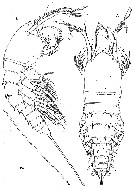 issued from : S. Conroy-Dalton & R. Huys in J. Crustacean Biol., 1999, 19 (2). [p.410, Fig.1]. Female (from Galapagos Rift): A, habitus (dorsal; caudal rami omitted); B, idem (lateral). Surface ornamentation on body omitted in A, B. Scale bar in microns
|
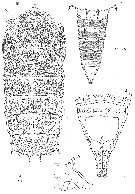 issued from : S. Conroy-Dalton & R. Huys in J. Crustacean Biol., 1999, 19 (2). [p.411, Fig.2]. Female: A, rostral area (dorsal); B, prosome (dorsal; showing detailed surface reticulation); C, urosome (dorsal; caudal rami omitted); D, anal somite and proximal part of caudal rami (dorsal). Scale bars in microns
|
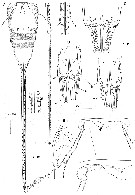 issued from : S. Conroy-Dalton & R. Huys in J. Crustacean Biol., 1999, 19 (2). [p.413, Fig.3]. Female: A, urosome (ventral; excluding P5-bearing somite) [insets showing position of pore marking original position of seta I (arrowed), and lateral scar indicating seta II]; B, genital field (arrow indicating copulatory pore; inset showing detail of closing apparatus); C, distal part of anal somite and proximal part of caudal rami (ventrall); D, distal part of caudal rami (dorsal); E, idem (ventral). Scale bars in microns.
|
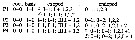 issued from : S. Conroy-Dalton & R. Huys in J. Crustacean Biol., 1999, 19 (2). [p.409]. Armature of swimming legs P1 to P4 in female and male. Roman numerals = spines; arabic numerals = setae.
|
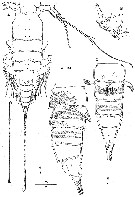 issued from : S. Conroy-Dalton & R. Huys in J. Crustacean Biol., 1999, 19 (2). [p.414, Fig.4]. Male: A, habitus (dorsal; surface ornamentation on body omitted); B, rostral area (dorsal); C, urosome (ventral; excluding P5-bearing somite; caudal rami omitted); D, idem (lateral). Scale bars in microns
|
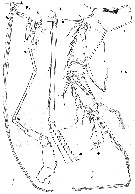 issued from : S. Conroy-Dalton & R. Huys in J. Crustacean Biol., 1999, 19 (2). [p.419, Fig.7]. Male: A, A1 (armature omitted); B1, A1: segments 1-7 (ventral); B2, A1: segment 8 and proximal portion of segment 9 (ventral); B3, A1: distal portion of segment 9 (ventral); C, idem (dorsal). Relative position of B1-3 indicated in A by markers black points and stars. Arrow in B3 and C indicating basally fused seta of acrothek on segment 9.
|
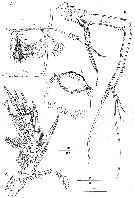 issued from : S. Conroy-Dalton & R. Huys in J. Crustacean Biol., 1999, 19 (2). [p.420, Fig.8]. Male: A, A1; C, P5 (anterior); D, genital and 1st abdominal somites (ventral). Female: B, labrum. Scale bars in microns.
|
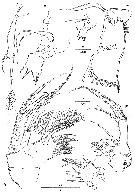 issued from : S. Conroy-Dalton & R. Huys in J. Crustacean Biol., 1999, 19 (2). [p.421, Fig.9]. Female: A, Md; B, Mx1 (anterior); C, P6. Male: D, Md (drawn at same scale as A); E, idem; F, Mx1 (anterior; drawn at same scale as B [inset showing detail of arthrite]. Scale bars in microns.
|
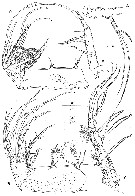 issued from : S. Conroy-Dalton & R. Huys in J. Crustacean Biol., 1999, 19 (2). [p.422, Fig.10]. Female: exopod of A2; B, Mx2. Male: D, Mx2; E, Mxp. Scale bars in microns.
|
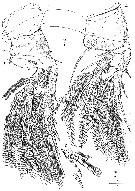 issued from : S. Conroy-Dalton & R. Huys in J. Crustacean Biol., 1999, 19 (2). [p.423, Fig.11]. Female: P1 (anterior); B, P2 (anterior). Male: C, distal part of P2 exopodite 3 (anterior). Scale bars in microns.
|
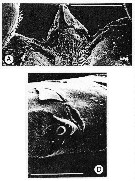 issued from : S. Conroy-Dalton & R. Huys in J. Crustacean Biol., 1999, 19 (2). [p.427, Fig.14]. Scanning electron micrographs. A, rostral area in male (ventral); D, caudal ramus showing tube pore replacing seta I in female. Scale bars = 50 microns (A); 5 microns (D).
|
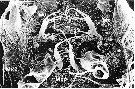 issued from : S. Conroy-Dalton & R. Huys in J. Crustacean Biol., 1999, 19 (2). [p.428, Fig.15]. Cephalosome showing atrophied mouthparts in male (ventral). Scale bar = 50 microns.
| | | | | NZ: | 1 | | |
|
Distribution map of Andromastax muricatus by geographical zones
|
| | | | Loc: | | | E Pacif. (Galapagos Rift: 2,494 m; washings of mussel-bed samples) | | | | N: | 1 | | | | Lg.: | | | (917) F: ± 3,37-3,61; M: ± 3,18-3,31; {F: 3,37-3,61; 3,18-3,31} | | | | Rem.: | epibenthic (depth: 2494 m)
For Conroy-Dalton & Huys (1999, p.425) the species can unequivocally be allocated to the family Aegisthidae (superfamily Cervinioidea) on the basis of a combination of primitive (P1-bearing somite not fused to cephalosome; P1 exop-1 with inner seta) and advanced characters (A1 female 7-segmented with aesthetasc on segment 3; A2 with allobasis and 2-segmented exopod; reduced mandibular palp; Mx1 endopod completely incorporated into basis and coxal epipodite absent; uniramous P5 in both sexes; P6 female produced into elongate and narrow extension; extreme elongation of caudal rami.
However, the inclusion of this species in Aegisthus proved impossible without grossly extending its generic boundaries. The species is regarded as the type of a new genus on account of the followin apomorphies (character derived from and differing from an ancestral condition): 1- pattern of conspicuous dorsal spinous processes on trunk somite; 2- cephalosome with lateral spinous process near bases of A2; 3- lateral process on coxae P2-P4; 4- anterior margin of female A1 segment 2 with lateral process; 5- Mx2 with allobasis and endopod 1 modified coarsely pinnate spines; 6- sexual dimorphism exhibited in distal outer spine of P2-P4 exopod 3, and in segmentation of P1 exopod (2-segmented in female, 3-segmented in male).
Further differentiating characters are: 6- relatively shorter caudal rami in comparison to other aegisthid species (only about 1.15 times length of all body somites combined); 7- sexual dimorphism of P1 inner base sspine, P2-P4 bases, P4 endopod 2, and anal somite.
There is compelling morphological evidence from both sexes that the species is more primitive than its holoplanktonic relatives currently placed in Aegisthus. Plesiomorphic character (ancestral or primitive) states displayed by the female are: 1- mandibular palp 2-segmented and bisetose; 2- Mx1 basis with 8 elements; 3- A2 exopod with 3 elements, formula [1, 2]; 4- endopod of Mxp with 4 setae; 5- P5 exopod with inner seta; 6- P6 with 3 setae. The primitive position is even more obvious from the male. | | | Last update : 11/07/2022 | |
|
|
 Any use of this site for a publication will be mentioned with the following reference : Any use of this site for a publication will be mentioned with the following reference :
Razouls C., Desreumaux N., Kouwenberg J. and de Bovée F., 2005-2026. - Biodiversity of Marine Planktonic Copepods (morphology, geographical distribution and biological data). Sorbonne University, CNRS. Available at http://copepodes.obs-banyuls.fr/en [Accessed January 06, 2026] © copyright 2005-2026 Sorbonne University, CNRS
|
|
|
|




;)
;)
;)
;)
;)
;)
;)
;)
;)
;)
;)
;)