|
|
 |
|
Calanoida ( Order ) |
|
|
|
Arietelloidea ( Superfamily ) |
|
|
|
Augaptilidae ( Family ) |
|
|
|
Haloptilus ( Genus ) |
|
|
| |
Haloptilus austini Grice, 1959 (F) | |
| | | | | | | Syn.: | ? Haloptilus longiceps Tanaka, 1964 b (p.44, figs.F) | | | | Ref.: | | | Grice, 1959 (p.193, Descr.F, figs.F); 1962 (p.223); Matthews, 1972 (p.48); Björnberg & al., 1981 (p.653, figs.F); Park, 1988 (p.3); He & al., 1992 (p.249, 250); Bradford-Grieve & al., 1999 (p.882, 941, figs.F); Vives & Shmeleva, 2007 (p.252, figs.F, Rem.) | 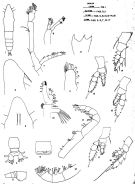 issued from : G.D. Grice in J. Wash. Acad. Sci., 1959, 49 (6). [p.194, Figs.1-18]. Female (from Pacific): 1, habitus (dorsal); 2, forehead (lateral); 3, idem (ventral); 4, urosome (dorsal); 5, idem (lateral right side); 6, genital segment (ventral); 7, A2; 8, Md (mandibular palp); 9, Md (bitting edge)); 10, Mx1; 11, terminal part of exopod of Mx1; 12, Mx2; 13, Mxp; 14, P1; 15, P2; 16, P3; 17, P4; 18, P5. Nota: The 2nd basal segment of Mx1 has 4 setae, the exopod has 11 setae, the endopod has 5 setae.
|
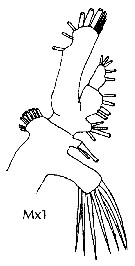 issued from : J.M. Bradford-Grieve, E.L. Markhaseva & C.E.F. Rocha & B. Abiahy in South Atlantic Zooplankton, Edit. D. Boltovskoy. 1999. Vol.2. Copepoda. [p.1042, Fig. 7.267]. Female: Mx1. Nota: Endopodite of Mx1 with 5 setae; exopodite with 11 setae; outer lobe 1 with 9 setae.
| | | | | Compl. Ref.: | | | Grice & Hart, 1962 (p.287, 293: Rem.); Fleminger, 1967 a (tabl.1); Carter, 1977 (1978) (p.36); Guangshan & Honglin, 1984 (p.118, tab., Rem.); Madhupratap & Haridas, 1986 (p.105, tab.1); Heinrich, 1990 (p.18); Shih & Young,1995 (p.68); Hsiao & al., 2004 (p.325, tab.1); Dur & al., 2007 (p.197, Table IV); Schnack-Schiel & al., 2010 (p.2064, Table 2: E Atlantic subtropical/tropical); Dias & al., 2010 (p.230, Table 1); Hsiao S.H. & al., 2011 (p.475, Appendix I); Tutasi & al., 2011 (p.791, Table 2, abundance distribution vs La Niña event); in CalCOFI regional list (MDO, Nov. 2013; M. Ohman, comm. pers.); Bonecker & a., 2014 (p.445, Table II: frequency, horizontal & vertical distributions) | | | | NZ: | 8 + 1 doubtful | | |
|
Distribution map of Haloptilus austini by geographical zones
|
| | | | | | | | | | Loc: | | | South Africa (E) (off Durban, Natal), Atlantic (equatorial), S Brazil, off Rio de Janeiro, off Macaé, off Amazon, New York < - > Bermuda, Pacif. (E equatorial), California, Baja California, China Seas ( East China Sea, South China Sea), Taiwan (SW, E), ? Japan, Pacif. (W equatorial), Pacif. (SE tropical), Galapagos-Ecuador (rare). | | | | N: | 19 | | | | Lg.: | | | (101) F: 3,33; 3,16; (311) F: 3,33-3,06; {F: 3,06-3,33} | | | | Rem.: | epipelagic. Known to occur at less than 100 m depth (Matthews, 1972).
The synonymy with H. longiceps is not admitted by all the authors.
For Grice (1959, p.195) the species resembles H. chierchiae (Giesbrecht) but may be distinguished from it by the shape of the head and the structure of Mx1 and P5. | | | Last update : 03/12/2020 | |
|
|
 Any use of this site for a publication will be mentioned with the following reference : Any use of this site for a publication will be mentioned with the following reference :
Razouls C., Desreumaux N., Kouwenberg J. and de Bovée F., 2005-2026. - Biodiversity of Marine Planktonic Copepods (morphology, geographical distribution and biological data). Sorbonne University, CNRS. Available at http://copepodes.obs-banyuls.fr/en [Accessed January 07, 2026] © copyright 2005-2026 Sorbonne University, CNRS
|
|
|
|




;)
;)