|
|
 |
|
Calanoida ( Order ) |
|
|
|
Calanoidea ( Superfamily ) |
|
|
|
Calanidae ( Family ) |
|
|
|
Calanus ( Genus ) |
|
|
| |
Calanus simillimus Giesbrecht, 1902 (F,M) | |
| | | | | | | Syn.: | Calanus propinquus : Giesbrecht, 1892 (part., p.91, 129, figs.); Ramirez, 1969 (p.35, figsF,M);
? C. aculeatus Brady, 1918 (p.14);
Calanus sp. Bary, 1951. | | | | Ref.: | | | Giesbrecht, 1902 (p.17, fig.F); Wolfenden, 1908 (p.10, figs.F); 1911 (p.192, Rem.F); Brady, 1918 (p.14, Rem.); Farran, 1929 (p.207, 213, Rem.); Vervoort, 1951 (p.11, figs.F,M, Rem.); 1957 (p.25, Rem.); Tanaka, 1960 (p.12, figs.F,M); 1964 (p.5); Vervoort, 1965 b (p.384, figs.F,M); Brodsky, 1967 b (p.225, fig.F); 1987 c (p.1441, fig.M); Vinogradov, 1968 (1970) (p.68, 234); Marshall & Orr, 1972 (p.8); Brodsky, 1972 (1975) (p.9, 71, 87, 117, figs.); Bradford & Jillett, 1974 (p.6); Vyshkvartzeva, 1976 (p.14); 1977 (p.97, figs.); Séret, 1979 (p.24, figs.F,M, Rem.); Björnberg & al., 1981 (p.618, figs.F,M); Fleminger, 1985 (p.275, 285, Table 1, 4, Rem.: A1); Bradford, 1988 (p.74, 76); Nishida, 1989 (p.173, table 1, 2: dorsal hump); Razouls, 1994 (p.28, figs.F,M); Bradford-Grieve, 1994 (p.33, figs.F,M, fig.98); Mazzochi al., 1995 (p.100, figs.F,M, Rem.); Bradford-Grieve & al., 1999 (p.877, 907, figs.F,M); Ramirez & Sabatini, 2000 (p.26, figs.F,M); Chiba & al., 2001 (p.95, tab.4); Hill & al., 2001 (p.279, fig.2: phylogeny); Marrari & al., 2004 (p.667, tab.1); Stupnikova & al., 2013 (p.451, genetic); | 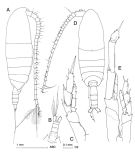 issued from : J.M. Bradford-Grieve in The Marine Fauna of New Zealand: Pelagic Calanoid Copepoda. National Institute of Water and Atmospheric Research (NIWA). New Zealand Oceanographic Institute Memoir, 102, 1994. [p.34, Fig.11]. Female: A, habitus (right lateral side); B, posterior body (dorsal); C, P5. Male: D, habitus (dorsal); E, P5.
|
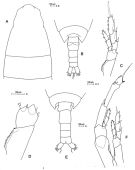 Issued from: M.G. Mazzocchi, G. Zagami, A. Ianora, L. Guglielmo & J. Hure in Atlas of Marine Zooplankton Straits of Magellan. Copepods. L. Guglielmo & A. Ianora (Eds.), 1995. [p.101, Fig.3.14.1]. Female: A, cephalosome (dorsal; B, urosome (dorsal); C, P5; D, basipod 1 and 2 of P5. Nota: Proportional lengths of urosomites and furca 36:17;14:13:20 = 100. Last thoracic somite with triangular-shaped margins which extend half-way across genital somite; postero-lateral corners pointed with points slightly produced. Genital somite longer than wide. Internal margins of basipod 1 of P5 carry about 18 triangular teeth of equal size and small cluster of 3-4 teeth isolated from the others. Male: E, urosome (dorsal); F, P5. Nota: Proportional lengths of urosomites and furca 12:31:17:13:13:14 = 100. basipod 1 of P5 with asymmetrical left and right sides, this latter shorter than the left; both furnished with triangular teeth on inner margin (20-22 on left. The specimens are similar to those described by Vervoort (1951) except for the toothing of the margins of basipods 1 of P5 in both females and males.
|
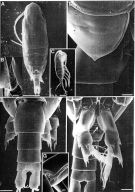 Issued from: M.G. Mazzocchi, G. Zagami, A. Ianora, L. Guglielmo & J. Hure in Atlas of Marine Zooplankton Straits of Magellan. Copepods. L. Guglielmo & A. Ianora (Eds.), 1995. [p.101, Fig.3.14.2]. Female (SEM preparation): A, habitus (dorsal); B, detail of fine hairs on inner margins of caudal rami; C, habitus (lateral right side); D, pointed postero-lateral rihht corner of last thoracic somite; E, urosome (dorsal); F, P5; G, detail of internal margin of basipod 1 of P5 bearing triangular teeth (arrow in F). Bars: A, C 0.500 mm; B, D 0.050 mm; E, F 0.100 mm; G 0.010 mm.
|
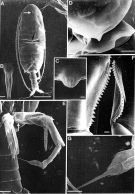 Issued from: M.G. Mazzocchi, G. Zagami, A. Ianora, L. Guglielmo & J. Hure in Atlas of Marine Zooplankton Straits of Magellan. Copepods. L. Guglielmo & A. Ianora (Eds.), 1995. [p.103, Fig.3.14.3]. Male (SEM preparation): A, habitus (dorsal); B, cephalic integumental organ (white arrow in A); C, integumental protuberance at midpoint of postero-dorsal margin of cephalon (black arrow in A); D, pointed postero-lateral left corner of last thoracic somite; E, P5; F, inner margin of basipod 1 of P5 bearing triangular teeth (arrow in E); G, detail of last segment of P5 left exopod. bars A 0.500 mm; B, C, F 0.010 mm; D, G, 0.050 mm; E 0.100 mm.
|
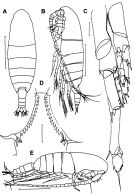 issued from : F.C. Ramirez in Contr. Inst. Biol. mar., Buenos Aires, 1969, 98. [p.36, Lam. IV, figs.18-22 ]. As Calanus propinquus. Female (from off Mar del Plata): 18, habitus (dorsal); 19, idem (lateral left side); 21, internal margin of basipodal segments 1 of P5. Male: 20, P5; 22, habitus (lateral right side). Scale bars in mm:
|
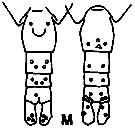 issued from K. Hulsemann in Invert. Taxon., 1994, 8. [p.1477, Fig.28, M]. Female: M, urosome (left: ventral); right: dorsal). Pore signature schematic by pooled samples (symbols are considerably larger than pores): Filled circle: 100 % presence; open circle: 95-99 % presence; triangle: 50-89 % presence. n = 20.
|
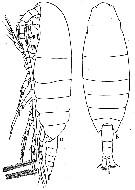 issued from : W. Vervoort in Verh. K. ned. Akad. Wet., Afd. Natuurk., 1951, (Sect. 2) 47 (2). [p.12, Fig.3]. Female (from 51°11'S, 11°17'E): a,-b, habitus (lateral and dorsal, respectively). Nota : The genaral shape of the body resembles that of Calanus finmarchicus. Head and 1st thoracic segment separated (the line separating these portions is less distinct than between the other thoracic somites), 4th and 5th separate. Head obtuse (in dorsal aspect), the extreme portion is broadly rounded and slightly produced, in lateral aspect smoothly rounded ; frontal organ scarcely visible ; rostrum consists of 2 selender filaments. Proportional lengths of cephalothorax and abdomen as 18.3 :6. Postero-lateral thoracic border pointed, points slightly produced but not acuminate, the last thoracic somite is triangulary produced, the apex reaches about the middle of the genital segment. Urosome 4-segmented, proportional lengths with the caudal rami 35 :18 :13 :13 :21 = 100. A1 25-segmented (segmentation between the 1st-2nd and 8th-9th segments is indistinct, although present).
|
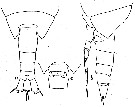 issued from : W. Vervoort in Verh. K. ned. Akad. Wet., Afd. Natuurk., 1951, (Sect. 2) 47 (2). [p.13, Fig.4]. Female: a-b, posterior part cephalothorax and urosome (dorsal and lateral, respectively; caudal setae omitted); c, genital somite (ventral). Nota: Genital segment about 1.5 times as long as wide, laterally with a distinct genital swelling ; in dorsal aspect it is symmetrical ; genital flap in middle of ventral surface, squarish, partly covering the outline of 2 small, circular receptacles. Anal segment wider than long, with distinct anal flap. Caudal rami about twice as long as wide, each with 4 marginal, plumose setae of equal length, each ramus carries 1 thin external seta and a curved, plumose internal seta ; no spines or hairs are to be found along the caudal borders of the abdominal segments and the internal margin of the caudal rami.
|
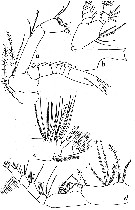 issued from : W. Vervoort in Verh. K. ned. Akad. Wet., Afd. Natuurk., 1951, (Sect. 2) 47 (2). [p.14, Fig.5]. Female: a, left A2; b, left Md; c, left Mx2; d, left Mxp. Nota: A2 and oral parts are not essentially different from those of Calanus finmarchicus. A2 with the 1st endopodal segment long, about 4 times as long as wide, with 2 plumose setae anong the internal margin, at ¾ of its length ; 2 nd endopodal segment short, with 8 setae on the interna land 6 setae on the external lobe, plus 2 setae on the posterior surface ; exopod 7-segmented. Exopod of mandibular palp 5-segmented ; 1st endopodal segment with sack-like tubercle, carrying 4 setae ; 2nd endopodal segment short, with 9 terminal setae and 2 setae on the posterior surface. Mx1 with rather small 1st inner lobe, carrying 10 strong and 4 slender spines ; 2nd and 3 rd lobes each with 4 setae ; 1st outer lobe small, with 9 plumose setae ; 2nd outer lobe with small, plumose seta ; 2 nd basal segment with 4 setae along the internal margin ; exopod with 11 setae ; 1st endopodal segment with 4, 2nd with 4 and apical segment with 7 setae. Mx2 with outer margin of the 1st basal segment not greatly arched, carrying a distinct, long, plumose seta ; the various lobes not greatly developed, the 1st lobe has 4 + 2, the 2nd 2 + 1, the 3rd 2 + 1, the 4th 2 + 1, the 5th 2 + 2 and the 6th 1 + 1 setae ; in addition there are setae on the segments of the endopod, viz., 1, 2, 2, respectively on each segment.
|
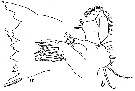 issued from : W. Vervoort in Verh. K. ned. Akad. Wet., Afd. Natuurk., 1951, (Sect. 2) 47 (2). [p.15, Fig.6]. Female: a, left Md (cutting edge); b, left Mx1.
|
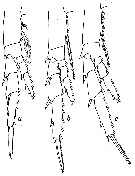 issued from : W. Vervoort in Verh. K. ned. Akad. Wet., Afd. Natuurk., 1951, (Sect. 2) 47 (2). [p.16, Fig.7]. Female: a-c, P2 to P4 (right feet; anterior surface).
|
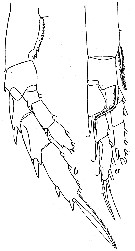 issued from : W. Vervoort in Verh. K. ned. Akad. Wet., Afd. Natuurk., 1951, (Sect. 2) 47 (2). [p.18, Fig.8]. Female: a, right P1; b, right P5 (of both feet the anterior surface figured). Nota: Internal margin of the 1st basl segment of P5 with 16 distinct, triangular teeth of nearly equal size, the basal 3 or 4 more or less separate from the rest.
|
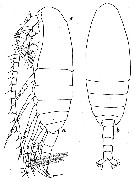 issued from : W. Vervoort in Verh. K. ned. Akad. Wet., Afd. Natuurk., 1951, (Sect. 2) 47 (2). [p.19, Fig.9]. Male: a-b, habitus (lateral and dorsal, respectively). Nota : The genaral shape of the body differs only slightly from that of the female. Head and 1st thoracic segment separate, 4th and 5th separate. Head smoothly and broadly rounded into filiform rostrum, which is slightly shorter than in the female. Frontal organ distinct, with a pair of minute hairs. Profil of the head back with a distinct, rounded knob opposite the place of attachement of A2. Proportional lengths of cephalothorax and abdomen as 173 :55. Postero-lateral thoracic border produced into small, triangular flaps, reaching the distal margin of the 1st urosomal segment. Urosome 5-segmented ; proportions of segments, with the caudal rami, 10 :29 :17 :13 :16 :15 = 100. Genital segment (1st urosomal segment) produced on the left side. Anal segment with a distinct anal flap. Caudal rami diverging, about twice as long as broad, each ramus with 4 marginal setae of equal length and thickeness, in addition 1 curved internal seta and 1 small external seta, all setae are densely plumose. A1 22-segmented (1st-2nd segments and 3rd-5th segments fused, although weak lines separating the segments can be observed), reaching the anal segment, the two subapical segments have long and densely plumose setae.
|
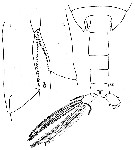 issued from : W. Vervoort in Verh. K. ned. Akad. Wet., Afd. Natuurk., 1951, (Sect. 2) 47 (2). [p.20, Fig.10]. Male: a, posterior part cephalothorax and urosome (dorsal (right caudal setae omitted); b, basal portion of P5 (posterior surface; rt = right 1st basal segment, lt = left 1st basal segment).
|
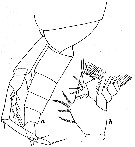 issued from : W. Vervoort in Verh. K. ned. Akad. Wet., Afd. Natuurk., 1951, (Sect. 2) 47 (2). [p.21, Fig.11]. Male: a, posterior part cephalothorax, left P5 and urosome (lateral view); b, left Md (mandibular palp).
|
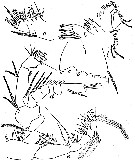 issued from : W. Vervoort in Verh. K. ned. Akad. Wet., Afd. Natuurk., 1951, (Sect. 2) 47 (2). [p.22, Fig.12]. Male: a, left Mx2; b, left Mx1; c, Md (cutting edge); d, left A2; e, left Mxp. Nota: A2 and oral parts, compared with those of te female, slightly reduced in length ; the more noticiable differences are to be observed in the A2, mandibular palp and Mxp. A2 has the same number of setae as in female, but the endopod is of reduced length, the exopod being slightly longer ; 1st endopodal segment about 3 times as long as wide, with a patch of long hairs along the distal part of the external margin ; external marginof the 2nd endopodal segment with some long, scattered hairs. The mandibular palp differs from that the female by the broader 2nd endopodal segment, which carries rather thick setae, 9 along the margin and 2 on the posterior surface. The sack-like protuberance on the 1st endopodal segment is very distinct, it has 4 setae ; the cutting edge of the manducatory plate differs mainly in size from that of the female, the same number of groups of teeth is to be observed, but some are reduced in length. Mx1 and Mx2 differ from those of the female in size, while some of the plumose setae observed in the female appear to be spinulose in the male. Mxp of the male differs by the reduced length of the endopod, but the same number of setae has been found.
|
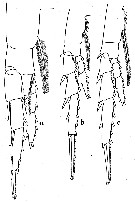 issued from : W. Vervoort in Verh. K. ned. Akad. Wet., Afd. Natuurk., 1951, (Sect. 2) 47 (2). [p.23, Fig.13]. Male: a, right P1; b, right P2; c, right P3/ (The anterior surface of all feet has been figured). Nota: P1 to P4 are nearly identical with those of the female.
|
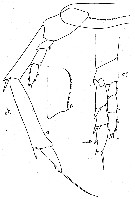 issued from : W. Vervoort in Verh. K. ned. Akad. Wet., Afd. Natuurk., 1951, (Sect. 2) 47 (2). [p.25, Fig.14]. Male: a, left P5 (posterior surface; basal segments drawn from slightly oblique position); b, 1st basal segment ot the right P5 (anterior surface; 2 teeth are invisible); c, right P5 (anterior surface; basal segments slightly turned, so that the teeth along the inner edge of the 1st basal segment are invisible. Nota: 1st basal segment of the left P5 longer than on the right side, with internally a row of 18-22 triangular spinules (smaller than in the female) ; right P5 not greatly modified, reaching slightly beyond the distal margin of the left 1st exopodal segment ; 1st basal segment with 16-21 small, triangular teeth along the internal border.
|
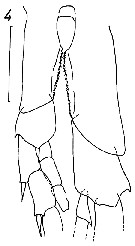 issued from : D.F. Arcos in Rev. Com. Perm. Pacifico Sur, 1976, 5. [Fig. 4]. Male (from 54°26.7 S, 69°02.4 W): 4, P5 Scale bar: 200 µ. Nota; environmental range in temperature 4.83 °C to 7.11°C and salinity 28.29 to 30.62 p.1000.
|
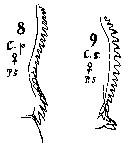 issued from : W. Giesbrecht in Copepoden. Res. voyage du S. Y. Belgica. Rapports scientifiques, Zoologie, 1902. [Taf. I, Figs.8, 9]. Comparison between the inner margin basipod segment 1 (= coxa) of P5 from Calanus propinquus (8) and Calanus simillimus (9).
|
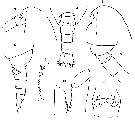 Issued from : O. Tanaka in Spec. Publs. Seto mar. biol. Lab., 10, 1960 [p.Pl. II, Figs.3-10]. Female (from 54°13'S, 39°40'E): 3, head (lateral); 4, last thoracic segment and urosome (ventral); 5, same (lateral); 6, inner margin of coxa of P5; 7, genital segment (ventral). Nota: Cephalothorax and abdomen in the proportional length 76 to 24. Posterior margin of the last thoracic segment pointed in dorsal aspect, reaches the middle of the genital segment; in lateral view triangularly produced into a sharp point. Abdomen 4-segmented; ths segments and caudal rami in the proportions 35 : 18 : 14 : 23 : 20 = 100. In P5, coxae with 14 teerh on the inner margin, of which the distal 4 were separated from the rest. The 1st exopodal segment has an inner marginal seta. Male: 8, head (lateral); 9, last thoracic segment and first two urosomal segments (lateral); 10, coxae of P5. Nota: Cephalothorax and abdomen in the proportions 71 to 29. The lateral margin of the last thoracic segment not produced as in the female, but apex blunty pointed. Abdominal segments and caudal rami in the proportional length 12 : 28 : 17 : 14 : 12 : 17 = 100. Coxa of right P5 shorter than the left, furnished with 19 teeth on the inner margin; the left with 21 teeth on the inner margin.
|
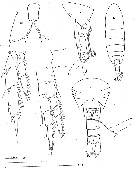 Issued from : C. Séret in Thesis UPMC, Paris 6. 1979 [Pl. IlI]. Female (from off N Kerguelen Is.): 6, habitus (dorsal); 7, last thoracic segment and urosome with spermatheca (lateral); 8, same (ventral); 9, P1; 10, P5.
|
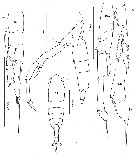 Issued from : C. Séret in Thesis UPMC, Paris 6. 1979 [Pl. IV]. Male (from off N Kerguelen Is.): 11, habitus (dorsal); 12, last thoracic segment and urosome (lateral); 13, P1; 14 a, P5 (G = left leg, D = right leg); 14 b, last segments of left leg.
|
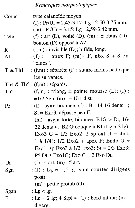 Issued from : C. Razouls in Ann. Inst. océanogr., Paris, 1994, 70 (1). [p.28]. Caractéristiques morphologiques de Calanus simillimus femelle et mâle adultes. Abbréviations: voir à Calanus propinquus.
| | | | | Compl. Ref.: | | | Hardy & Gunther, 1935 (1936) (p.122, Rem., distribution charts); Baker, 1954 (p.203, 211, fig.5); Bary, 1959 (p.14, Fig.5, Table 4, correlation T-S): Brodsky, 1964 (p.105, fig.1, spatial distribution); De Decker, 1968 (p.45); Björnberg, 1973 (p.283, 384); Heinrich, 1974 (fig.3); Vladimirskaya, 1978 (p.202, vertical distribution, age composition); Arashkevich, 1978 (p.118, Table: diets); Voronina & al., 1978 (p.512, distribution); De Decker, 1984 (p.315, 331: chart); Dearborn & al., 1986 (p.1, predation by benthic star); Zmijewska, 1987 (tab.2a); Ward, 1989 (tab.2); Ferrari & Dearborn, 1989 (p.1315, predator); Trofimov & al., 1989 (p.426); Perissinotto, 1989 (p.505, Table 2, 3, abundance, diurnal variation); Perissinotto & al., 1990 (p.296, grazing); Atkinson & al., 1990 (p.1213, tab.1); Atkinson, 1991 (p.79, antarctic zonation, seasonal change, vertical distribution, life history); Atkinson & al., 1992 (p.583, diel vertical migration, feeding); 1992 a (p.49, feeding rates, vertical migration); Voronina & Maslennikov, 1994 (p.631, fig.1); Atkinson, 1994 (p.551, feeding selectivity); Ward & Shreeve, 1995 (p.721, egg production); Ward & al., 1995 (p.195, abundance, biomass, vertical distribution); 1996 (p.1439, lipid storage); Atkinson, 1996 (p.85, feeding); Atkinson & al., 1996 (p.195, feeding vs. phytoplankton bloom); Atkinson & al., 1996, p.1387, diel periodicity feeding); Ward & al., 1996 (p.21, distribution and dynamic population); Razouls S. & al., 1996 (p.581); Pakhomov & McQuaid, 1996 (p.271, abundance, distribution, seabirds); Errhif & al., 1997 (p.422); Fransz & Gonzalez, 1997 (p.395, weight-length, biomass v.s. N-S transect); Ward & Shreeve, 1998 (p.142, fig.1, egg hatching vs temperature); Atkinson, 1998 (p.289, Table 1, biological data); Atkinson & al., 1999 (p.63, Krill-copepod interactions, fig.7: diel migration); Ansorge & al., 1999 (p.135, Table 2, abundance vs. TS diagram); Atkinson & Sinclair, 2000 (p.46, 50, 51, 53, 55, zonal distribution); Razouls & al., 2000 (p.343, tab. 3, 5, Appendix); Pakhomov & al., 2000 (p.1663, Table 1, 2, transect Cape Town-SANAE antarctic base); Viñas & al., 2002 (p.1031); Ward & al., 2002 (p.2183, tab.2); Labat & al., 2002 (p.741, tab.3); Takahashi & al., 2002 (p.97, Table 2, figs.5, 6); Cabal & al., 2002 (p.869, fig.4, Table 1, abundance); Ward & al., 2003 (p.121, tab.4); Hunt, 2004 (p.1, 47, 74, Table 3.2, 4.4, fig.4.7, 4.11, Rem.: p.94, 95, fig.5.10: seasonal abundance); Ward & al., 2005 (p.421, Table 6, abundance); Berasategui & al., 2005 (p.485, tab.1); Berasategui & al., 2005 (p.313, fig.2); Berasategui & al., 2006 (p.485: fig.2); Ward & al., 2006 (p.83: tab.4); Hunt & Hosie, 2006 (p.1203, tab.2,fig.8); Schultes & al., 2006 (p.16, fig.1); Fielding & al., 2007 (p.2106, tab.1); Kattner & al., 2007 (p.1628, Table 1); Ward & al., 2007 (p.1871, Table 2, fig.6, 7, abundance, egg production); Ward & al., 2008 (p.241, Tabl, Appendix II ); Klaas & al., 2008 (p.195, fig.2, grazing); Kruse & al., 2009 (p.301, gut content); Park & Ferrari, 2009 (p.143, Table 2, Appendix 1, biogeography from Southern Ocean); Takahashi & al., 2010 (p.317, Table 3, 4, figs.4, 5, 6, 7, 8); Schnack-Schiel & al., 2010 (p.2064, Table 2: E Atlantic subtropical); Takahashi & al., 2010 (p.235, Table 2); Swadling & al., 2010 (p.887, Table 2, 3, A1, fig.6, abundance, indicator species); Takahashi & al., 2011 (p.134, distribution); Guglielmo & al., 2012 (p.1301,Table 3); Ward & al., 2012 (p.78, fig.5, 6, Table A1, B1, C1, abundance, weight, depth); Pond, 2012 (p.443, Rem.: p.449, lipid storage); Tarling & al., 2012 (p.222, Table 1, 3, seasonal biomass); Thompson G.A. & al., 2012 (p.127, Table 2, 3, fig.5): Thompson G. & al., 2012 (p.367, fig.2, 3, Table 3, abundance vs. mesh selectivity); Sabatini & al., 2012 (p. 33, Table 3, abundance vs. stations transect); Lee D.B. & al., 2013 (p.1215, Table 1, abundance, composition); Ward & al., 2014 (p.305, Table 4, abundance in the ''Discovery'' Investigations in the 1930s); Kouwenberg & al., 2014 (p.290, biogeography, Map 4); Baumgartner & Tarrant, 2017 (p.387, diapause, Rem.); Record & al., 2018 (p.2238, Table 1: diapause); Acha & al., 2020 (p.1, Table 3: occurrence % vs ecoregions, Table 5: indicator ecoregions); Xavier & al., 2020 (p.15, fig.Rem.). | | | | NZ: | 5 | | |
|
Distribution map of Calanus simillimus by geographical zones
|
| | | | | | 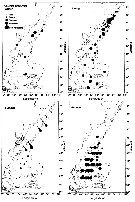 issued from : F.C. Ramirez & M.E. Sabatini in Hydrobiologia, 2000, 439. [p.33, Fig.9]. issued from : F.C. Ramirez & M.E. Sabatini in Hydrobiologia, 2000, 439. [p.33, Fig.9].
Seasonal relative abundance and distribution of adults in water off Argentina. |
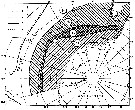 Issued from : K.A. Brodsky in Inf. Bull. Soviet antarct. Exped., 1. [p.108, Fig.1]. Issued from : K.A. Brodsky in Inf. Bull. Soviet antarct. Exped., 1. [p.108, Fig.1].
1 - Antarctic convergence; 2 - northern boundary of range of Calanus propinquus ; 3 - boundaries of range of Calanus simillimus; 4 - southern boundary of tropical zone.
Nota: A notalian, South temperate, or Australian zone (regions A and B), combining two subzones. One is characterized by a massive quantity of C. simillimus in the upper layers of the water; in the hydrological sense it appears to be a region where the west wind drift mixes with the antarctic surface waters. The other, more northerly subzone includes the current mentioned and waters situated somewhat farther north. Region C is an intermediate between the Notalian and Antractic zones, where these zones appear to overlap and must be differentiated on the basis of vertical separation of the waters: the surface layer to depths of 100-150 m should apparently be assigned to the Notalian zone according to plankton fauna, but the deeper water, to the Antarctic zone.
See Nota in Calanus propinquus. |
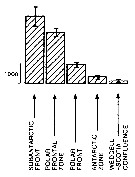 Issued from : A. Atkinson in Mar. Biol., 1991, 109. [p.82, Fig.2] Issued from : A. Atkinson in Mar. Biol., 1991, 109. [p.82, Fig.2]
Calanus simillimus. Mean abundance (nos./1000 m) of vertical haul) in top 1 000 m within five water types. bars represent standard errors of means, calculated from assumed Poisson distribution.
Estimated contributions to total copepod biomass in study area: 16 %.
Nota: Water types:
1- Either in sub-Antarctic zone or in vicinity of subantarctic front.
2- Within polar frontal zone.
3- In vicinity of polar front.
4- Within Antarctic zone.
5- Within Weddell Sea or in Weddell-Scotia confluence. |
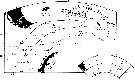 Issued from : A. Atkinson in Mar. Biol., 1991, 109. [p.80, Fig.1]. Issued from : A. Atkinson in Mar. Biol., 1991, 109. [p.80, Fig.1].
Positions of 72 stations sampled in Scotia Sea. The Scotia Sea, containing majority of stations, is bordered on east by a chain of oceanic islands and on west by Drake Passage (between South America and the Antarctic Peninsula.
Mean positions of oceanic fronts, and zones which they separate are drawn from Gordon (1967).
SAF: subantarctic front.
PFZ: polar frontal zone.
PF: polar front.
AZ: Antarctic zone.
WSC: Weddell-Scotia confluence. |
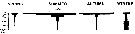 Issued from : A. Atkinson in Mar. Biol., 1991, 109. [p.82, Fig.3]. Issued from : A. Atkinson in Mar. Biol., 1991, 109. [p.82, Fig.3].
Calanus simillimus. Mean vertical distribution during four seasons. Values are numbers/250 m of vertical haul. |
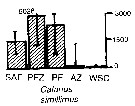 Issued from : A. Atkinson & J.D. Sinclair in Polar Biol., 2000, 23. [p.50, Fig.3] Issued from : A. Atkinson & J.D. Sinclair in Polar Biol., 2000, 23. [p.50, Fig.3]
Calanus simillimus from Scotia Sea.
Median and interquartile ranges of copepods (nos /m2) in the five water zones; from north to south these are SAF Subantractic Front area, PFZ Polar frontal Zone, PF Polar Front area, AZ Antarctic Zone, WSC Weddell-Scotia Confluence area/ East Wind Drift.
Numbers on the plots are upper interquartiles where these could not be scaled. |
 issued from A. de C. Baker in 'Discovery' Rep., 1954, 27. [p.215, Fig.5]. issued from A. de C. Baker in 'Discovery' Rep., 1954, 27. [p.215, Fig.5].
Occurrence of Calanus simillimus in all longitudes around Antarctic zone of the Southern Ocean.
The percentage frequency of occurrence in samples taken within every 20° of longitude.
Nota: During the 'Discovery' investigations some thousands of plankton samples have been taken from stations spread over the whole of the Southern Ocean at all seasons of the year, the majority south of the Antarctic Convergence. An arbitrary selection of samples has been made from hauls between the surface and a depth of 250 m, whibh means that they have been taken from within the limits of the Antarctic surface water.
Compare with Calanus propinquus. |
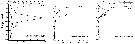 Issued from : P. Ward, A. Atkinson, A.W.A. Murray, A.G. Wood, R. Williams & S. Poulet in Polar Biol., 1995, 15. [p.200, Fig.3]. Issued from : P. Ward, A. Atkinson, A.W.A. Murray, A.G. Wood, R. Williams & S. Poulet in Polar Biol., 1995, 15. [p.200, Fig.3].
Abundance and biomass (g dry mass/m3) profiles for the shelf station (54°48'S, 38°15'W) in January 1990.
Values on the horizontal axes at the base represent abundance and the one above biomass. Solid line = midday haul; hatched line = midnight haul. |
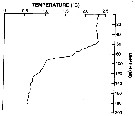 Issued from : P. Ward, A. Atkinson, A.W.A. Murray, A.G. Wood, R. Williams & S. Poulet in Polar Biol., 1995, 15. [p.198, Fig.1, A (modified C.R.)]. Issued from : P. Ward, A. Atkinson, A.W.A. Murray, A.G. Wood, R. Williams & S. Poulet in Polar Biol., 1995, 15. [p.198, Fig.1, A (modified C.R.)].
Temperature profile for the shelf station at Bird Island, South Georgia (54°48'S, 38°15'W) in January 1990. |
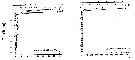 Issued from : P. Ward, A. Atkinson, A.W.A. Murray, A.G. Wood, R. Williams & S. Poulet in Polar Biol., 1995, 15. [p.202, Fig.4, A]. Issued from : P. Ward, A. Atkinson, A.W.A. Murray, A.G. Wood, R. Williams & S. Poulet in Polar Biol., 1995, 15. [p.202, Fig.4, A].
Abundance (10/m3) and biomass (g dry mass/m3) profiles at the oceanic station from the shelf break in water 4000 m deep off Bird Island, South Georgia (53°04'S, 39°51'W) in January 1990.
Values on the horizontal axes at the base of each profile represent abundance and the one above biomass. Solid line = midday haul; hatched line = midnight haul. |
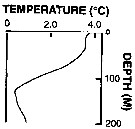 Issued from : P. Ward, A. Atkinson, A.W.A. Murray, A.G. Wood, R. Williams & S. Poulet in Polar Biol., 1995, 15. [p.198, Fig.1, B (modified C.R.)]. Issued from : P. Ward, A. Atkinson, A.W.A. Murray, A.G. Wood, R. Williams & S. Poulet in Polar Biol., 1995, 15. [p.198, Fig.1, B (modified C.R.)].
Profile temperature-depth at the oceanic stations from the shelf break in water 4000 m deep off Bird Island, South Georgia, in January 1990. |
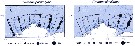 Issued from : K.M. Swadling, So. Kawaguchi & G.W. Hosie in Deep-Sea Research II, 2010, 57. [p.897, Fig.6 (continued)]. Issued from : K.M. Swadling, So. Kawaguchi & G.W. Hosie in Deep-Sea Research II, 2010, 57. [p.897, Fig.6 (continued)].
Distribution of indicator species Calanus propinquus and Calanus simillimus from the BROKE-West survey (southwest Indian Ocean) during January-February 2006.
Sampling with a RMT1 net (mesh aperture: 315 µm), oblque tow from the surface to 200 m.
The survey area was located predominantly within the seasonal ice zone, and in the month prior to the survey there was considerable ice coverage over the western section but none over the east.
See map showing sampling sites in Calanus propinquus. |
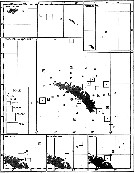 Issued from : A.C. Hardy & E.R. Gunther in Discovery Reports, 1935 (1936), 11. [p.126, Fig.57]. Issued from : A.C. Hardy & E.R. Gunther in Discovery Reports, 1935 (1936), 11. [p.126, Fig.57].
Charts showing the distribution of Calanus simillimus in the upper layers of waters at stations in the 1926-7 surveys around South Georgia.
The squares represent the average numbers per 50 m vertical haul from 250 m (or less at shallow-water stations) to the surface with N 70 V nets. |
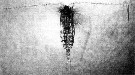 Issued from : D.W. Pond in J. Plankton Res., 2012, 34 (6). [p.450, Fig.7] Issued from : D.W. Pond in J. Plankton Res., 2012, 34 (6). [p.450, Fig.7]
The Southern Ocean copepod, Calanus simillimus indicating the typical head up, outstretched antennae orientation of filter-feeding calanoid.
Active, filter-feeding calanoid copepods have oil sacs that run the length of the body and utilizing extended antennae 'hang' head up in the water column. Lipids are stored anatomically according to the species with simple oil sac, multiple smaller vacuoles and/or intracellular storage. Lipids reserve are, generally, linked to locomotion and/or feeding behaviour.
Nota: The solid-liquid phase transitions of lipids are a factor regulating the buoancy of the copepods. These phase transitions are controlled in relation to the physical environment, through the selective accumulation of specific lipids with optimum levels of unsaturation. The necessity to control buoyancy and maintain an optimum depth is a fundamental evolutionary force, driving anatomical, biochemical and behavioural adaptations within the aquatic realm. It is hypothesized that each species adjusts the amount, composition and anatomical location of lipids, to maximize fitness according to the preferred habitat and life history traits. |
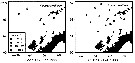 Issued from : J.A. Cabal & al. inDeep-Sea Res., 2002, 49. [p.876, Fig.4]. Issued from : J.A. Cabal & al. inDeep-Sea Res., 2002, 49. [p.876, Fig.4].
Spatial distribution of Calanus similllimus in the Northwest Antarctic Peninsula.
Nota: Geographical distribution of stations groups defined by cluster analysis included in the Antarctic Circumpolar Current area and in the coastal waters of the Peninsula, Bransfield and Gerlache Straits during the ''FRUELA'' cruises (December 1995 - February 1996).
Zoopklankton collected by WP2 net from 200-0 m. |
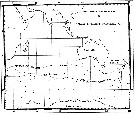 Issued from : C. Séret in Thesis 3ème Cycle, UPMC, Paris 6. 1979, Annexe. [p.22]. Issued from : C. Séret in Thesis 3ème Cycle, UPMC, Paris 6. 1979, Annexe. [p.22].
Geographical occurrences of Calanus simillimus in the Indian Ocean and Antarctic zone. [after publications from: Brady, 1883, 1918; Thompson, 1900; Wolfenden, 1908, 1911; With , 1915; Rosendorn, 1917; Farran, 1929; Sewell, 1929, 1947; Brady & Gunther, 1935; Steuer, 1929, 1392, 1933; Ommaney, 1936; Vervoort, 1957; Tanaka, 1960; Brodsky, 1964; Seno, 1966; Andrews, 1966; Grice & Hulsemann, 1967; Seno, 1966; Frost & Fleminger, 1968; Voronina, 1970; Zverva, 1972]. |
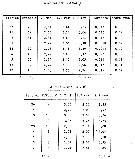 Issued from : C. Séret in Thesis 3ème Cycle, UPMC, Paris 6. 1979. [p.30, Tableau V]. Issued from : C. Séret in Thesis 3ème Cycle, UPMC, Paris 6. 1979. [p.30, Tableau V].
Body size female and male in Calanus simillimus from April 1974 at the stations 26; 15; 3; 1; 23; 4; 5; 13; 12.
L.T min = minimal body size; L.T max = maximal body size; Effectif = number of animals measured. |
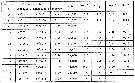 Issued from : C. Séret in Thesis 3ème Cycle, UPMC, Paris 6. 1979, Annexe. [p.11, Tableau II]. Issued from : C. Séret in Thesis 3ème Cycle, UPMC, Paris 6. 1979, Annexe. [p.11, Tableau II].
Hydrological data and stations during the MD03 Expedition around Kerguelen Islands in April 1974.
Chl : phytoplankton biomass in mg Chl. per m3; NO3 and SiO3 in µg per litre. Prod : primary productivity in mg. C per m3. |
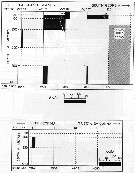 Issued from : A.C. Hardy & E.R. Gunther in Discovery Reports, 1935 (1936), 11. [p.130, Fig.59]. Issued from : A.C. Hardy & E.R. Gunther in Discovery Reports, 1935 (1936), 11. [p.130, Fig.59].
Vertical distribution of Calanus simillimus at stations between Falkland Islands and South Georgia February 1927 and between South Georgia and Tristan da Cunha February 1926.
The scale represents the numbers per 50 m vertical haul taken by a series of closing N 70 V nets.
Horizontal broke lines show the ranges of these vertical hauls. |
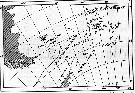 Issued from : A.C. Hardy & E.R. Gunther in Discovery Reports, 1935 (1936), 11. [p.7, Fig.4]. Issued from : A.C. Hardy & E.R. Gunther in Discovery Reports, 1935 (1936), 11. [p.7, Fig.4].
Chart showing the line of the Antarctic Convergence, separating the Antarctic and the sub-Antarctic Zones, and the course of the two surface currents with influence South Georgia within the Antartic Zone. |
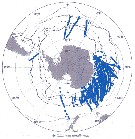 Issued from : J.H.M. Kouwenberg, C. Razouls & N. Desreumaux in Biogeographic Atlas of the Southern Ocean, Scient. Comm. Antarct. Res., Cambridge, 2014, 6.6. [p.291, Map 4]. Issued from : J.H.M. Kouwenberg, C. Razouls & N. Desreumaux in Biogeographic Atlas of the Southern Ocean, Scient. Comm. Antarct. Res., Cambridge, 2014, 6.6. [p.291, Map 4].
Distribution of Calanus simillimus. |
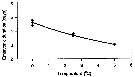 Issued from : P. Ward & R. Shreeve in Polar Biol., 1998, 19. [p.143, Fig.1]. Issued from : P. Ward & R. Shreeve in Polar Biol., 1998, 19. [p.143, Fig.1].
Time to 50% hatching versus temperature (Belehradek function relating embryonic duration: D : days; a = 2475; alpha = - 2142; b fixed as - 2.05) to temperature (T°C) fitted to the data for Calanus simillimus from South Georgia (53.5° S, 37° W).
Prosome length = 2.82 mm (± 0.14); egg diameter: inner membrane: 150 µm (± 5), outer membrane : 225 µm (± 10). |
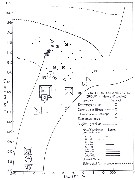 Issued from : B.M. Bary in Pacif. Sci., 1959, 13. [p.24, Fig.5]. Issued from : B.M. Bary in Pacif. Sci., 1959, 13. [p.24, Fig.5].
The distribution in the temperature-salinity-plankton (T-S-P) diagram of Southern Subantarctic species '(South East new Zealand) which show a lack of adaptability toward coastal water through a marked reduction in the numbers taken from it. Water envelop as in Figure 3 (see below). Plankton stations at which no specimens are shown by a point.
Eucalanus acus is synonym from Subeucalanus longiceps. |
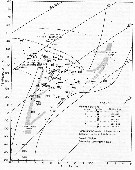 Issued from : B.M. Bary in Pacif. Sci., 1959, 13. [p.20, Fig.3]. Issued from : B.M. Bary in Pacif. Sci., 1959, 13. [p.20, Fig.3].
T-S diagram of surface waters, southern and eastern New Zealand.
Stations at which plankton was collected are differentiated from those where only salinities and temperatures were taken.
Stippled arrows indicate the direction of water movements within the diagram, as deduced from the distribution of properties and the form of the water envelope (and as later confirmed by the plannkton distribution)
An underlined station number, e.g. 212, indicates a night tow; an overlined station numner, e.g., 216, indicates q station occupied at dawn or dusk. An unmarked station is one occupied in daylight. |
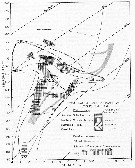 Issued from : B.M. Bary in Pacif. Sci., 1959, 13. [p.37, Fig.10]. Issued from : B.M. Bary in Pacif. Sci., 1959, 13. [p.37, Fig.10].
A generalised T-S-P- diagram in which the distributions and interrelationships of the 4 planktonic groups from the waters about aouthern New Zealand are shown.
Note the 3 areas where mixed plankton catches indicate that mixing of waters is taking place.
The water envelope is as in Figure 3; only plankton stations are entered. |
| | | | Loc: | | | Antarct. (Amundsen Sea, Peninsula, South Georgia, Drake Passage, Scotia Sea, SW & SE Atlant., Indian, S & SW Pacif.), Estrecho de Magallanes, sub-Antarct. (SW Atlant., NW South Georgia (Willis Is.), Marion Is. Prince Edward Is., Crozet Is., Kerguelen Is., Indian, SW & SE Pacif.), S Indian (subtropical convergence), S Pacif. (NPFZ), SE New Zealand, Chile, South Africa (W), Malvinas current, Patagonia, off Rio de la Plata, Atlantic (SW & SE) | | | | N: | 117 | | | | Lg.: | | | (10) F: 2,9; (25) F: 3,6-3,1; (31) F: 3,65-3,5; M: 3,42; (32) F: 2,9-2,5; M: (35) F: 3,6-3,2; [60°S] F: 3,2-2,8; (36) F: 3,97-2,93; M: 3,2-2,89; (47) F: 3,45; M: 3,4; (66) F: 2,95; M: 3,18; (114) F: 3,7-3,45; M: 3,4; (196) F: 3,8-2,65; M: 3,35-2,62; (254) F, M: 3,5; (818) F: 3,71-3,03; M: 3,39-3,21; (849) F: 3,03-3,71; M: 3,21-3,39; {F: 2,50-3,97; M: 2,62-3,42}
The mean female size is 3.277 mm (n = 22; SD = 0.4063), and the mean male size is 3.233 mm (n = 11; SD = 0.2642. The size ratio (male : female) is 0.97 (n = 8; SD = 0.0572).
(1204) Prpsome F: 2.82 mm (± 0.14). | | | | Rem.: | Sampling depth (Antarct., sub-Antarct.) : 0-600 m.
Very close to Calanus propinquus from which this species distinguishes by the size.
For Marshall & Orr (1972, p.8), the last metasome segment is the same as in C. propinquus. The A1 reach to about the end of the caudal rami and are faintly brick-red. The coxa of P5 has a rather convex internal margin and is toothed, with a group of 3 or 4 teeth at the distal end separated from the rest by a small break.
After Bradford-Grieve & al. (1999, p.907) the seta of A1 segment 23 female shorter than last 7 segments.
For Vervoort (1951, p.26) Calanus simillimus, together with C. propinquus and C. acutus, is a conspicuous component of the Southern epiplankton, which in importance can be compared to some extent with the Northern species of Calanus. After Vervoort this specuies is abundant in the area of the Antarctic Convergence and for Farran this form is most plentfully between 50° and 60° S.
According to Hardy & Gunther (1935, p.233) this species shows a distinct diurnal migration, which is carried out very quickly ; it comes to the surface from a depth greater than 50 m between 17.00 and 18.00 and remains there during the greater part of the evening and the night. The males are as abundantly present as the females, which leads to the conclusion that here the period of life of adult males is more protracted than in many other Copepods, where the males usually have much reduced oral parts and appear to be unable to feed in the adult stage.
After Arashkevich (1978) the diets of the species are pennate diatoms (mainly in the gut content), and centric diatoms (less frequent).
For Acha & al. (2020) this species is observed mainly on shelf and southern offshore in front of Patagonia (Argentina). | | | Last update : 17/06/2021 | |
|
|
 Any use of this site for a publication will be mentioned with the following reference : Any use of this site for a publication will be mentioned with the following reference :
Razouls C., Desreumaux N., Kouwenberg J. and de Bovée F., 2005-2025. - Biodiversity of Marine Planktonic Copepods (morphology, geographical distribution and biological data). Sorbonne University, CNRS. Available at http://copepodes.obs-banyuls.fr/en [Accessed August 23, 2025] © copyright 2005-2025 Sorbonne University, CNRS
|
|
|
|




;)
;)
;)
;)
;)
;)
;)
;)
;)
;)
;)
;)
;)
;)
;)
;)
;)
;)
;)
;)
;)
;)
;)
;)

;)
;)
;)
;)
;)
;)
;)
;)
;)
;)
;)
;)
;)
;)
;)
;)
;)
;)
;)
;)
;)
;)
;)
;)
;)