|
|
 |
|
Calanoida ( Ordre ) |
|
|
|
Arietelloidea ( Superfamille ) |
|
|
| |
| | | |
| Arietellidae Sars, 1902 ( Arietelloidea ) | | Ref.: | Sars, 1902 (1903) (p.123); Gurney, 1931 (p.85); Wilson, 1932 a (p.136); Rose, 1933 a (p.238); Brodsky, 1950 (1967) (p.393); Bradford, 1969 b (p.502, Table 3); Andronov, 1974 a (p.1005); Campaner, 1977 (p.811, Redef.); Björnberg & al., 1981 (p.650); Bowman & Abele, 1982 (p.9); Razouls, 1982 (p.526); Brodsky & al., 1983 (p.143, 145); Campaner, 1984 (p.102, 107, Rem.); Mauchline, 1988 (p.705, 706, 740: cuticular pores); Ohtsuka & Mitsuzumi, 1990 (p.96); Huys & Boxshall, 1991 (p.460); Razouls, 1993 (p.306); Ohtsuka & al., 1994 (p.105, Redef., diagnosis emended, Genera Key, cladistic analysis); Chihara & Murano, 1997 (p.719); Cuoc & al., 1997 (p.651, phylogeny); Bradford-Grieve & al., 1999 (p.881, 902, 903, 936, 937: Genera Key); Bradford-Grieve, 1999 b (p.27, Def.); Ohtsuka & Huys, 2001 (p.445, 461); Boxshall & Halsey, 2004 (p.13; 49; 62: Def.; p.64: Genera Key); Vives & Shmeleva, 2007 (p.146, part. Genera Key); Blanco-Bercial & al., 2011 (p.103, Table 1, Fig.2, 3, 4, Biol. mol, phylogeny); Laakmann & al., 2019 (p.330, fig. 2, 3, phylogenetic relationships)
Bradford-Grieve J.M., (2002 onwards). Key to calanoid copepod families. Version 1 : 2 oct 2002. http://www.crustacea.net/crustace/calanoida/index.htm  | | Rem.: | Ohtsuka, Boxshall & Roe (1994) redéfinissent la famille et établissent les relations phylétiques entre les genres (dont 3 nouveaux). Soit 12 genres: Arietellus, Campaneria, Crassarietellus, Metacalanalis, Metacalanus, Paramisophria, Paraugaptiloides, Paraugaptilus, Pilarella, Protoparamisophria, Sarsarietellus, Scutogerulus. Griceus est considéré comme incertae sedis et Rhapidophorus comme inquirendum. Ces auteurs ne retiennent pas les sous-familles mais montrent l'existence de 2 lignées. | 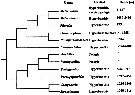 issued from : S. Ohtsuka, S. Nishida & R.J. Machida in J. Nat. Hist., 2005, 39 (27). [p.2510, Fig.14]. Cladogram of Arietellid genera. Main habitat and depth range provided only for hyperbenthic genera, exvluding two truly pelagic genera, Arietellus and Paraugaptilus. The phylogenetic relationship among arietellid genera two clades are recognized: the Metacalanus-group and the -group. |
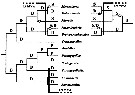 issued from : S. Ohtsuka, S. Nishida & R.J. Machida in J. Nat. Hist., 2005, 39 (27). [p.2512, Fig.15]. Cladogram depicting main habitats and colonization routes for arietellid genera and their presumed ancestrors. D: deep-water hyperbenthic: S: shallow-water hyperbenthic (including cavernicolous and epipelagic); P: deep-water planktonic. In the Metacalanus-Metacalanis-Pilarella-clade there are two possibilities for colonization routes (right: habitat transition from deep-sea to shallow-water hyperbenthos; left: habitat shift from deep-sea to shallow-water hyperbenthos occurred independently in Metacalanus and Pilarella. (o) Habitat shift from deep-sae hyperbenthic to shallow-sea hyperbenthos; (black o) habitat shift from shallow-water hyperbenthos to deep-sea hyperbenthos. |
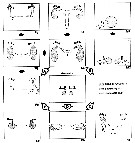 issued from : S. Ohtsuka, G.A. Boxshall & H.S.J. Roe in Bull. nat. Hist. Mus. Lond. (Zool.), 1994, 60 (2). [p.161, Fig.38]. Evolutionary trends in the structures of the female genital systems of the arietellid genera. A: Fusion of copulatory pores to form single pore, and anterolateral migration of both gonopores. B: Posterior migration of both gonopores and copulatory pores, and separation of copulatory pore from gonopore. C: Anterolateral migration of gonopores, and separation of copulatory pore from gonopore and their asymmetrical arrangement and enlargement. D: Lateral migration of both gonopores and copulatory pores, and separation of copulatory pore from gonopore. E: Lateral migration of both gonopores and copulatory pores. Pg: Paramisophria giselae; Pj: Paramisophria japonica; Pc: Paramisophria cluthae; Sa: Sarsarietellus abyssalis; Ap: Arietellus plumifer; M1: Metacalanus sp.1; M2: Metacalanus sp.2; Ps: Paraugaptilus similis; Ch: Crassarietellus huysi; Sp: Scutogerulus pelophilus. g : gonopore; c: copulatory pore. |
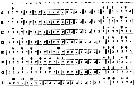 issued from : S. Ohtsuka, G.A. Boxshall & H.S.J. Roe in Bull. nat. Hist. Mus. Lond. (Zool.), 1994, 60 (2). [p.163, Fig.39]. Schematic illustration of segmental fusion patterns and armature of female antennules of the arietellid genera. A: Crassarietellus; B: Sarsarietellus; C: Scutogerulus; D: Paramisophria; E: Arietellus; F: Paraugaptilus; G: Metacalanus; H: Pilarella. The number indicates the number of setae on each segment. Asterisk indicates segment without aesthetasc. |
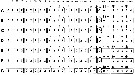 issued from : S. Ohtsuka, G.A. Boxshall & H.S.J. Roe in Bull. nat. Hist. Mus. Lond. (Zool.), 1994, 60 (2). [p.164, Fig.40]. Schematic illustration of segmental fusion patterns and armature of male antennules of the arietellid genera. A: Campaneria; B: Crassarietellus; C: Paramisophria; D: Arietellus; E: Paraugaptiloides; F: Paraugaptilus; G: Metacalanus. The number indicates the number of setae on each segment. Asterisk indicates a segment with no aesthetasc. |
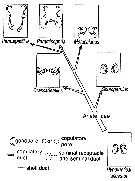 issued from :C. Cuoc, D. Defaye, M. Brunet, R. Notonier & J. Mazza in Mar. Biol., 1997, 129. [p.13, Fig.6]. Diagrammatic representation of main evolutionary trends in organization of female genital area in calanoïds for Arietellidae (modified after Huys & Boxshall, 1991 and Ohtsuka & al., 1994). |
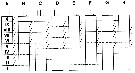 issued from : S. Ohtsuka, G.A. Boxshall & H.S.J. Roe in Bull. nat. Hist. Mus. Lond. (Zool.), 1994, 60 (2). [p.165, Fig.41]. Schematic illustration of fusion patterns and armature of antennary exopods of the arietellid genera. A, Hypothetical calanoid ancestor; B, Crassarietellus; C, Paramisophria giselae; D, Campaneria, Paraugaptiloides, Paramisophria japonica, Sarsarietellus, Scutogerulus; E, Metacalanus; F, Arietellus; G, Paraugaptilus similis, male; H, P. similis, female. Solid and dotted lines indicating complete separation between segments, and incomplete fusion or suture between segments, respectively. |
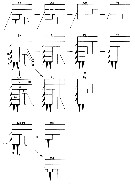 issued from : S. Ohtsuka, G.A. Boxshall & H.S.J. Roe in Bull. nat. Hist. Mus. Lond. (Zool.), 1994, 60 (2). [p.168, Fig.42]. Schematic comparison of patterns of segmentation and setation of female P5 in some arietellids. The arrows indicate possible derivation of setation and segmentation patterns and are not indicative of ancestor-descendant relationships between taxa. Ap: Aeietellus pavoninus; As: Arietellus sp.; Am: Arietellus mohri; Ps: Paraugaptilus similis; Sa: Sarsarietellus abyssalis; Pj: Paramisophria japonica; Pi: Paramisophria itoi; Pp: Paramisophria platysoma; Pg: Paramisophria giselae; Pr: Paramisophria reducta; Ch: Crassarietellus huysi; M1: Metacalanus sp.1; M2: Metacalanus sp.2; Ma: Metacalanus acutioperculum; Pl: Pilarella longicornis. C = coxa; B (in C. huysi) = basis; Is = intercoxal sclerite; Ex = exopod; En = endopod. A-D (in S. abyssalis): setae on endopod; a-f: spines on exopod. |
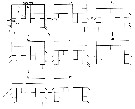 issued from : S. Ohtsuka, G.A. Boxshall & H.S.J. Roe in Bull. nat. Hist. Mus. Lond. (Zool.), 1994, 60 (2). [p.169, Fig.43]. Schematic comparison of segmentation and setation of male P5 in the Arietellidae. The arrows indicate possible derivations of setation and segmentation patterns and are not indicative of ancestor-descendant relationships between taxa. Ch: Crassarietellus huysi; Pp: Paramisophria platysoma; Pm: Paraugaptiloides magnus; Cl: Campaneria latipes; M1: Metacalanus sp.1; Ap: Arietellus plumifer; Pb: Paraugaptilus buchani. C = coxa; B = basis; Is = intercoxal sclerite; Ex = exopod; En = endopod. a-f, k: elements on exopod. Setae and spines are not distinguished here. |
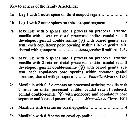 issued from : S. Ohtsuka, G.A. Boxshall & H.S.J. Roe in Bull. nat. Hist. Mus. Lond. (Zool.), 1994, 60 (2). [p.170]. Key to genera of the family Arietellidae (first part.) |
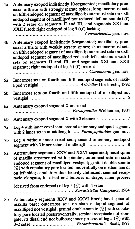 issued from : S. Ohtsuka, G.A. Boxshall & H.S.J. Roe in Bull. nat. Hist. Mus. Lond. (Zool.), 1994, 60 (2). [p.171]. Key to genera of the family Arietellidae (continued second part.) |
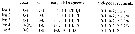 Issued from : G.A. Boxshall & S.H. Halsey in An Introduction to Copepod Diversity. The Ray Society, 2004, Part I, No 166. [p.62]. Armature of legs on the pedigerous somites. Nota: Swimming legs P1 to P4, with 3-segmented rami, except, very rarely, with endopodal segments of P1 incompletely fused. Inner seta on basis of P1 situated on anterior surface of basis and passing across face of endopod. Serarion sometimes reduced. - Female P5 variable but never natatory; almost symmetrical; coxae and intercoxal sclerite separate or fused; basis and endopod separate or fused; endopod primitively 1-segmented with up to 4 setae; exopod 1 to 3-segmented ot completely fused to basis, bearing 0 to 5 outer and terminal elements (setation formula above given for Sarsarietellus abyssalis Sars. - Male P5 variable, from almost symmetrical to strongly asymmetrical; coxae and intercoxal sclerite separate or fused to form common base. Right leg with basis sometimes fused to coxa; endopod 1-segmented lobate or absent; exopod distinctly or indistinctly 3-qzgmented; 1st segment typically with outer margin element, 2nd segment with outer element and inner patch of setules, 3rd segment with 0 to 3 elements. Left leg endopod 1 or 2-segmented, unarmed or completely absent; exopod distinctly or indistinctly 3-segmented, 1st and 2nd segments each with outer element, 3rd segment with 1 to 3 element terminally. - Eggs contained in paired, multiseriate sacs. |
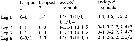 Issued from : J.M. Bradford-Grieve in NIWA Biodiv. Memoir 111, 1999. [p.27]. Armature of the swimming legs P1 to P4. (spines: Roman numerals; setae (Arabic numerals). | | | | | Arietellinae Brodsky, 1950 | | Ref.: | Brodsky, 1950 (1967) (p.394); Brodsky & al., 1983 (p.143) | | Rem.: | Brodsky crée cette sous-famille pour y inclure Arietellus, Paraugaptilus, Paramisophria et Scottula et considère Phyllopus comme le type d'une autre sous-famille (Phyllopinae ). Campaner (1977, p.811) considère celle-ci comme une famille : Phyllopidae (emend. Bowman & Abele, 1982, p.9 = Phyllopodidae = Nullosetigeridae ). Dans ces conditions la sous-famille établie par Brodsky n'a plus de raison d'être. | | | | (1) Arietellus Giesbrecht, 1892 | |
| | Ref.: | Giesbrecht, 1892 (p.66, 415); Giesbrecht & Schmeil, 1898 (p.124); Esterly, 1905 (p.189); Farran, 1908 b (p.81); Van Breemen, 1908 a (p.139, 238, 239); A. Scott, 1909 (p.142); Wolfenden, 1911 (p.329); Sewell, 1932 (p.329); Rose, 1933 a (p.238, spp. Key); Tanaka, 1964 c (p.231); Owre & Foyo, 1967 (p.90, spp. Key); Brodsky, 1950 (1967) (p.394, spp. Key); Razouls, 1982 (p.526); Gardner & Szabo, 1982 (p.395, Rem.); Mauchline, 1988 (p.705, 740); Razouls,1993 (p.306); Ohtsuka & al., 1994 (p.126, Redef.); Chihara Murano, 1997 (p.720); Mauchline, 1998 (p.71: F; p.74: M); Bradford-Grieve & al., 1999 (p.937: spp. key); Bradford-Grieve,1999 b (p.28, Def.); Boxshall & Halsey, 2004 (p.65); Vives & Shmeleva, 2007 (p.147, spp. key) | | Rem.: | type: Arietellus setosus . 15 spp. + 1 indet.: | | Remarques sur les dimensions et le sex-ratio: | | Le rapport des longueurs (Males/Femelles) est de 0,954 (n = 8; SD = 0,0427) pour les cas où l'on dispose de mâles et de femelles pour la même espèce., rapport très semblable à celui de la somme des femelles et des mâles sans considération de l'espèce. (0,951) | 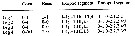 Issued from : S. Ohtsuka, G.A. Boxshall & H.S.J. Roe in Bull. nat. Hist. Mus. Lond (Zool), 1994, 60 (2). [p.108, Table 4]. Spine (Roman numerals) and seta (Arabic numerals) formula of legs P1 to P4. Numerals of spine and seta indicated from outer margin to inner margin. |
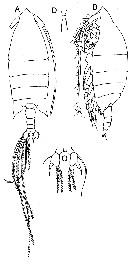 Issued from : J.M. Bradford-Grieve in NIWA Biodiv. Memoir 111, 1999. [p.29, Fig. 7, A, B, D, O]. Arietellus setosus Female. A-B, habitus (dorsal and lateral, respectively); D, rostrum; O, P5. |
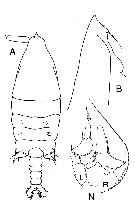 Issued from : J.M. Bradford-Grieve in NIWA Biodiv. Memoir 111, 1999. [p.30, Fig. 8, A, N]. Arietellus setosus Male. A, habitus (dorsal view); B, head (lateral view); N, P5 (L = left leg; R = right leg). | | | | | (2) Campaneria Ohtsuka, Boxshall & Roe, 1994 | |
| | Ref.: | Ohtsuka & al., 1994 (p.119); Mauchline, 1998 (p.74: M); Bradford-Grieve,1999 b (p.34, Def., Rem.); Bradford-Grieve, 2004 (p.287); Boxshall & Halsey, 2004 (p.64) | | Rem.: | 1 sp. | 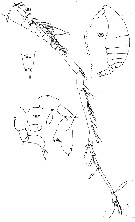 Issued from : J. Bradford in N. Z. J. Mar. Freshw. Res., 1969, 3 (4). [p.498, Figs. 186, 188, 189, 190]. As Scutogerulus pelophilus male (= Campaneria latipes male). Male: 186, A1; 188, habitus (lateral view); 189, P5; 190, rostrum. | | | | | (3) Crassarietellus Ohtsuka, Boxshall & Roe, 1994 | |
| | Ref.: | Ohtsuka & al., 1994 (p.109); Mauchline, 1998 (p.71: F); Bradford-Grieve,1999 b (p.34, Def.); Bradford-Grieve, 2004 (p.287); Boxshall & Halsey, 2004 (p.64) | | Rem.: | type: Crassarietellus huysi. 1 sp. + 1 indet. | | Remarques sur les dimensions et le sex-ratio: | | The mean female size is 3.865 mm (n =2; SD = 0.021), and for males 2.84 mm (n = 2; SD 0.0056). The size ratio (male: female) is 0.735, but the species male does not correspond to the female. | | | | (0) Griceus Ferrari & Markhaseva, 2000 | |
| | Ref.: | Ferrari & Markhaseva, 2000 (p.77); Bradford-Grieve, 2004 (p.287) | | Rem.: | Boxshall & Halsey, 2004 (p.64, Rem.: Genus incertae sedis). 1 sp. | | | | (4) Metacalanalis Ohtsuka, Nishida & Machida, 2005 | |
| | Ref.: | Ohtsuka & al., 2005 (p.2484 | | Rem.: | Type: Metacalanalis hakuhoae. 1 sp.
For Ohtsuka & al. (2005, p.2485) the genus is similar to the genera Metacalanus Cleve, 1901 and Pilarella Alvarez, 1985, and has mixed features of these two genera. Metacalanis is distinguishable from Metacalanus and Pilarella by the following features: (1) caudal rami about 1.2 times as long as wide; (2) left A1 reaching at most to the posterior margin of pediger 3: (3) A2 showing the most primitive condition in the family Arietellidae, with an indistinctly 3-segmented endopod and an indistinctly 10-segmented exopod with setal formula 0, 0, 1, 1, 1, 1, 1, 0, 2; (4) praecoxal arthrite of Mx1 with 1 short and 4 long spines; (5) coxal epipodite of Mx1 with 6 setae; (6) basal spine of Mx2 with a short row of minute spinules medially; (7) P5 female with a unisegmented exopod bearing 2 lateral and 2 terminal spines. Asymmetry of P1-P3 is unique to the new genus. | | | | (5) Metacalanus Cleve, 1901 | |
| | Syn.: | Scottula (part.) Sars, 1902 | | Ref.: | Cleve, 1901 (p.43); A. Scott, 1909 (p.146); Sewell, 1932 (p.329); Tanaka, 1964 c (p.236); Razouls, 1982 (p.531); Alvarez, 1985 (p.190, 194, Rem.); Ohtsuka, 1985 (p.305); Mauchline, 1988 (p.706); Razouls, 1993 (p.306); Ohtsuka & al., 1994 (p.138, Redef., diagnosis emended); Chihara & Murano, 1997 (p.719); Mauchline, 1998 (p.73: F; p.74: M); Bradford-Grieve,1999 b (p.35, Déf.); Bradford-Grieve, 2004 (p.287); Boxshall & Halsey, 2004 (p.64); Vives & Shmeleva, 2007 (p.155) | | Rem.: | type: Metacalanus aurivilli . 4 spp.+ 2 indet: | | Remarques sur les dimensions et le sex-ratio: | | Le rapport des longueurs male/femelle établi à partir des espèces présentant les deux sexes est de 0,871 (n = 5; SD = 0,1013. | 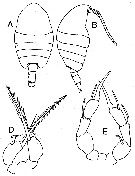 Issued from : J.M. Bradford-Grieve in NIWA Biodiv. Memoir 111, 1999. [p.36, Fig. 12, A, B, D, E]. Metacalanus aurivilli. Female: A-B, habitus (dorsal and leteral, respectively; D, P5. Male: E, P5. | | | | | (6) Paramisophria T. Scott, 1897 | |
| | Syn.: | Parapseudocyclops Campaner,1977 (p.812) | | Ref.: | T. Scott, 1897 f (p.147); Giesbrecht & Schmeil,1898 (p.123); Sars, 1902 (1903) (p.127); van Breemen, 1908 a (p.140); Rose, 1933 a (p.242); Brodsky, 1950 (1967) (p.394); Krishnaswamy, 1959 (p.546, Rem.: emend.); Tanaka, 1964 c (p.242); Razouls, 1982 (p.530); McKinnon & Kimmerer, 1985 (p.85, spp. Key); Ohtsuka, 1985 (p.296, 298, Rem.); Ohtsuka & Mitsuzumi, 1990 (p.97); Huys & Boxshall, 1991 (p.49, 325, 436); Ohtsuka & al.,1991 (p.793, 800, Rev.); Ohtsuka & al., 1993 (p.57, 65, Rem.: emend.); Ohtsuka & al., 1994 (p.158, figs., Rem.); Chihara & Murano, 1997 (p.719); Mauchline, 1998 (p.68); Bradford-Grieve,1999 b (p.36, Def.); Bradford-Grieve, 2004 (p.287); Boxshall & Halsey, 2004 (p.65); Vives & Shmeleva, 2007 (p.156, spp. Key); Lim & Min, 2014 (p.539, morphological phylogeny). | | Rem.: | type: Paramisophria cluthae . 19 spp. + 2 indet. : | | Remarques sur les dimensions et le sex-ratio: | | Le rapport des longueurs (M/F) est de 0,916 (n = 11; SD = 0,0613) si l'on ne prend en considération que les espèces comportant les deux sexes. |  issued from : M. Carola, C. Razouls & J.L. Pretus in Vie Milieu, 1995, 45 (2). [p.150, Table III B]. Distribution géographique des espèces du genre Paramisophria connues en 1995. |
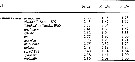 issued from : M. Carola, C. Razouls & J.L. Pretus in Vie Milieu, 1995, 45 (2). [p.150, Table III A]. Liste des rapports chez les adultes femelles du gentre connues en 1995.. Pr = prosome (mesuré du bord antérieur de la tête au bord postérieur du dernier segment thoracique; dans l'axe sagittal). Ur = urosome (mesuré du bord antérieur du segment génital à l'extrémité distale des rames caudales). L = longueur maximale; w = largeur maximale. |
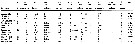 issued from : M. Carola, C. Razouls & J.L. Pretus in Vie Milieu, 1995, 45 (2). [p.150, Table IV]. Characteristics of some appendages of the Paramisophria |
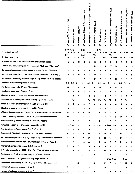 issued from : D. Jaume, J.E. Cartes & G.A. Boxshall in Contr. Zool., 2000, 68 (4). [p.220, Table III]. Caractères permettant de différencier les 13 espèces de Paramisophria. Tous les caractères se réfèrent aux adultes. A1: antennule; art: articulation; end-: endopod segment; exp-: exopod segment; seg.: segment. |
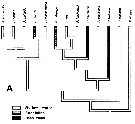 issued from : D. Jaume, J.E. Cartes & G.A. Boxshall in Contr. Zool., 2000, 68 (4). [p.24, A]. Cladogramme (l'un des plus parcimonieux) résultant d'une analyse cladistique pour les espècre de Paramisophria. A, arbre pour la valeur f = 516. Les branches ombrées se réfèrent à l'habitat ancestral. |
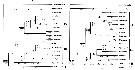 Issued from : B.-J. Lim & G.-S. Min in J. Nat. Hist., 2014, 48 (9-10). [p.540, Fig.12, A, B]. Two most parsimonius cladograms produced by the cladistic analysis of Paramisophria species. Nota: Paramisophria species fall broadly into 4 groups, which are essentially simolar to the grouping proposed by Jaume & al. (2000). The 1st group contains P. giselae, which differs from other species by the presence of a distal seta on the 1st praecoxal endite of Mx2. The 2nd group contains P. japonica, which differs from the other congeners by having basal seta on tMx1 and an inner subapical seta on the endopod of female P5. The 3rd group includes P. fosshageni, P. itoi0, P. galapagensis, P. intermedia, P. platysoma and P. bathyalis.
The 4th group includes P. ammophila, P. cluthae, P. variabilis, P. reducta, P. mediterranea and the two new species P. sinjinensis, P. koreana.
The topology of two parsimonius trees differed only in the positions of P. ammophila and P. cluthae relative to P. sinjinensis and P. koreana. P. ammophila clustered with two new species as a sister group (fig.12 A), by the absence of a seta on Mx1 coxal endite and the presence of a single copulatory pore ventrolaterally on the right side of the genital double-somite. This node is tentative, because there is no information on female P. sinjinensis.. However, the two new species also showed a sister-group relationship with P. cluthae (Fig.12 B), by the absence of a left endopod on male P5. The two new species appear to be relatively recent offshoots, because the male appendages exhibit a more apomorphic state (characters differing from an ancestral condition).
| | | | | Parapseudocyclops Campaner, 1977 | |
| | Ref.: | Campaner, 1977 (p.812); Razouls, 1982 (p.531); Campaner, 1984 (p.107, Rem.); Ohtsuka & al., 1991 (p.793, 800, Rem.) | | Rem.: | Cf. Paramisophria | | | | (7) Paraugaptiloides Ohtsuka, Boxshall & Roe, 1994 | |
| | Ref.: | Ohtsuka & al., 1994 (p.120); Mauchline, 1998 (p.74: M); Bradford-Grieve,1999 b (p.37, Def.); Bradford-Grieve, 2004 (p.287); Boxshall & Halsey, 2004 (p.65); Ohtsuka & al., 2005 (p.2497: emend part.) | | Rem.: | Type: Paraugaptiloides magnus (Bradford,1974). Total: 2 spp.: | | Remarques sur les dimensions et le sex-ratio: | | The mean male size is 4.930 mm (n = 3; SD = 0.2981.
The females are unknown at this date (2014/2015). | | | | (8) Paraugaptilus Wolfenden, 1904 | |
| | Ref.: | Wolfenden, 1904 (p.123); Van Breemen, 1908 a (p.138); A. Scott, 1909 (p.144); Wolfenden, 1911 (p.353); Sars, 1925 (p.335); Sewell, 1932 (p.329); Rose, 1933 a (p.241); Tanaka, 1964 c (p.234); Brodsky, 1950 (1967) (p.397); Deevey, 1973 (p.247, Rev, spp. Key); Razouls, 1982 (p.529); Campaner, 1984 (p.107); Razouls, 1993 (p.306); Ohtsuka & al., 1994 (p.143, 158, 160, Redef., diagnosis emended); Chihara & Murano, 1997 (p.721); Mauchline, 1998 (p.71: F; p.74: M); Bradford-Grieve,1999 b (p.38, Def.); Boxshall & Halsey, 2004 (p.65); Vives & Shmeleva, 2007 (p.166); Renz & Markhaseva, 2015 (p.96, Table 4, Fig.3, biogeography) | | Rem.: | type: Paraugaptilus buchani. Total: 6 spp.: | | Remarques sur les dimensions et le sex-ratio: | | Le rapport des longueurs (M/F) est de 0,907 en ne considérant que les espèces présentant les deux sexes à partir des mesures minimales et maximales. | | | | (9) Pilarella Alvarez, 1985 | |
| | Ref.: | Alvarez, 1985 (p.189); Razouls, 1993 (p.306); Ohtsuka & al., 1994 (p.156, Redef., diagnosis emended); Mauchline, 1998 (p.73: F); Bradford-Grieve,1999 b (p.40, déf.); Bradford-Grieve, 2004 (p.287); Boxshall & Halsey, 2004 (p.64) | | Rem.: |
Type: Pilarella longicornis Alvarez, 1985. Total: 1 sp. | 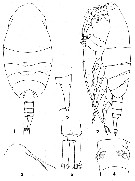 Issued from : M.P. Jimenez Alvarez in Revta bras. Zool., S. Paulo, 1985, 3 (4). [p.191, Figs. 1-6]. Pilarella longicornis Female 1-2, habitus (dorsal and lateral, respectively); 3, forehead with rostrum (lateral view); 4, Genital segment (ventral view); 5, Anal segment and caudal rami (lateral view); 6, same (dorsal view). | | | | | (10) Protoparamisophria Ohtsuka, Nishida & Machida, 2005 | |
| | Ref.: | Ohtsuka & al., 2005 (p.2491) | | Rem.: | Type: Protoparamisophria biforaminis. Total: 1 sp. | | | | (0) Rhapidophorus Edwards, 1891 | |
| | Ref.: | C.L. Edwards, 1891 (p.84); Giesbrecht, 1892 (p.423); Wilson, 1932 a (p.543, non M : 'F'); Fosshagen, 1968 a (p.61, 62, Rem.); Campaner, 1977 (p.817, Rem.); Razouls, 1982 (p.531); Campaner, 1984 (p.107, Rem.); Ohtsuka & al., 1991 (p.801, Rem.); Razouls, 1993 (p.306); Ohtsuka & al., 1994 (p.131, Rem.); Mauchline, 1998 (p.68: M); | | Rem.: | Pour Fosshagen (1968 a, p.62) la description de la (F) devrait permettre de savoir si le genre Paramisophria n'est pas un synonyme de ce genre. Boxshall & Halsey, 2004 (p.64: Genus inquirendum)
Total: 1 sp. | | | | (11) Sarsarietellus Campaner, 1984 | |
| | Syn.: | Scottula (part.) Sars, 1905 c (p.22); 1925 (p.338, figs.F,M) | | Ref.: | Campaner, 1984 (p.107, Rem.); Razouls, 1993 (p.306); Ohtsuka & al., 1994 (p.155, 158, 160, Redef., diagnosis emended); Mauchline, 1998 (p.68: F; p.76: M); Bradford-Grieve, 2004 (p.287); Boxshall & Halsey, 2004 (p.65); Ohtsuka & al., 2005 (p.2504, emend. part.) | | Rem.: | type: Scottula abyssalis Sars,1905. Total: 4 spp. | | Remarques sur les dimensions et le sex-ratio: | | The mean female size is 3.705 mm (n = 4, SD = 1.069). Only 1 male is known with a body length of 3.02 mm. The ratio male: female is 0.873 (from the same species) | | | | Scottula Sars, 1902 | | Ref.: | Sars, 1902 (1903) (p.124); Van Breemen, 1908 a (p.142); A. Scott, 1909 (p.146); Rose,1933 a (p.243); Tanaka, 1964 c (p.242); Brodsky, 1950 (1967) (p.394); Razouls, 1982 (p.532); Campaner, 1984 (p.102, 107, Rem.); Ohtsuka, 1985 (p.305); Mauchline, 1988 (p.706) | | Rem.: | Cf. Metacalanus (part.) & Sarsarietellus (part.) | | | | (12) Scutogerulus Bradford, 1969 | |
| | Ref.: | Bradford, 1969 b (p.495); Razouls, 1982 (p.531); Campaner, 1984 (p.107); Razouls, 1993 (p.306); Ohtsuka & al., 1994 (p.152, 160, Redef., diagnosis emended); Mauchline, 1998 (p.68: F); Bradford-Grieve,1999 b (p.39, Déf.); Bradford-Grieve, 2004 (p.287); Boxshall & Halsey, 2004 (p.64), Ohtsuka & Boxshall, 2004 (p.54: Rem.) | | Rem.: | Type: Scutogerulus pelophilus Bradford, 1969. Total: 2 spp. | | Remarques sur les dimensions et le sex-ratio: | | The mean female size is 3.225 mm (n = 4; SD = 0.3880. The males are unknown at this date (2014). | | | | | | | | |
|
|
 Toute utilisation de ce site pour une publication sera mentionnée avec la référence suivante : Toute utilisation de ce site pour une publication sera mentionnée avec la référence suivante :
Razouls C., Desreumaux N., Kouwenberg J. et de Bovée F., 2005-2025. - Biodiversité des Copépodes planctoniques marins (morphologie, répartition géographique et données biologiques). Sorbonne Université, CNRS. Disponible sur http://copepodes.obs-banyuls.fr [Accédé le 17 décembre 2025] © copyright 2005-2025 Sorbonne Université, CNRS
|
|
|
|



;)
;)
;)
;)
;)
;)
;)
;)
;)
;)
;)
;)
;)
;)
;)
;)
;)
;)
;)
;)
;)
;)
;)
;)
;)