|
|
 |
Fiche d'espèce de Copépode |
|
|
Calanoida ( Ordre ) |
|
|
|
Diaptomoidea ( Superfamille ) |
|
|
|
Pontellidae ( Famille ) |
|
|
|
Pontellopsis ( Genre ) |
|
|
| |
Pontellopsis regalis (Dana, 1849) (F,M) | |
| | | | | | | Syn.: | Pontella regalis Dana,1849;
Pontellina regalis : Dana,1853;
Monops regalis : Giesbrecht, 1892 (part., p.486, 496, 773, figs.F,M); Wheeler, 1901 (p.182, figs.M); Oliveira, 1945 (p.191); Crisafi, 1960 c (p.279, figs.F,M, juv.); Maiphae & Sa-ardrit, 2011 (p.641, Table 2, 3, Rem.)
no Monops grandis Lubbock, 1853 b (p.122);
Pontella strenua (part.) Brady,1883 (p.95, Pl.45, fig.18);
Monachops grandis : Wilson, 1924 (p.16)
Pontellopsis regalis : Tanaka, 1964 c (p.268, figs.240, F) | | | | Ref.: | | | Giesbrecht & Schmeil, 1898 (p.147, Rem. F,M); Thompson & Scott, 1903 (p.236, 253); A. Scott, 1909 (p.171, Rem.); Sharpe, 1910 (p.413); Wolfenden, 1911 (p.362); Pesta, 1920 (p.544); Sars, 1925 (p.354); Farran, 1929 (p.210, 280); Sewell, 1932 (p.388); Wilson, 1932 a (p.157, Rem.F,M, figs.M); Dakin & Colefax, 1933 (p.206); Rose, 1933 a (p.263, figs.264); Farran, 1936 a (p.118); Wilson, 1942 a (p.204, figs.F, juv.); Sewell, 1947 (p.251); Moore, 1949 (p.61); C.B. Wilson, 1950 (part., p.310, figs.F,M); Fagetti, 1962 (p.36); Voronina, 1962 a (p.68); Tanaka, 1964 c (p.266, figs.M, No F); Chen & Zhang, 1965 (p.107, figs.F); Vervoort, 1965 (p.193, Rem.); Owre & Foyo, 1967 (p.99, figs.F,M); Vidal, 1968 (p.44, figs.F,M); Park, 1968 (p.567, Redescr.F, figs.F, Rem.: 2 forms); Razouls, 1972 (p.95, Annexe: p.94); Chen & Shen, 1974 (p.130, figs.F,M); Silas & Pillai, 1973 (1976) (p.838, figs.F,M, Rem.); Pillai, 1975 (p.138, figs.F,M, Rem.); Björnberg & al., 1981 (p. 660, figs.F,M); Zheng & al., 1982 [p.90, Figs.F,M); Ohtsuka & Onbé, 1991 (p.214); Baessa-de-Aguiar, 1991 (1993) (p.98, figs.M); Ianora & al., 1992 (p.401, fig.); Chihara & Murano, 1997 (p.872, Pl.158,160: F,M); Bradford-Grieve & al., 1999 (p.885, 961, figs.F,M); Mulyadi, 2002 (p.141, figs.F,M, Rem.); Othman & Toda, 2006 (p.317, figs.M); Vives & Shmeleva, 2007 (p.518, figs.F,M, Rem.); Suarez-Morales & Kozak, 2012 (p.1, key F,M: p.14, fig.F,M). | 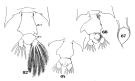 iIssued from : W. Giesbrecht in Systematik und Faunistik der Pelagischen Copepoden des Golfes von Neapel und der angrenzenden Meeres-Abschnitte. – Fauna Flora Golf. Neapel, 1892. Atlas von 54 Tafeln. [Taf.41, Figs.62, 64, 66, 67]. As Monops regalis. Female: 62, last thoracic segment and urosome (dorsal); 64, idem (different specimen); 66, idem (different specimen); 67, rostrum (frontal view).
|
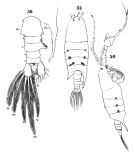 iIssued from : W. Giesbrecht in Systematik und Faunistik der Pelagischen Copepoden des Golfes von Neapel und der angrenzenden Meeres-Abschnitte. – Fauna Flora Golf. Neapel, 1892. Atlas von 54 Tafeln. [Taf.41, Figs.50, 54,5 6]. As Monops regalis. Male: 50, last thoracic segment (right) and urosome (dorsal); 54, habitus (dorsal); 56, habitus (right lateral side).
|
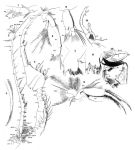 Issued from : W. Giesbrecht in Systematik und Faunistik der Pelagischen Copepoden des Golfes von Neapel und der angrenzenden Meeres-Abschnitte. – Fauna Flora Golf. Neapel, 1892. Atlas von 54 Tafeln. [Taf.26, Figs.1, 2, 3, 4, 5, 6, 7, 8, 9, 13]. As Monops regalis. Female: 2, A1 (ventral view); 4, distal part of the seta on lobe 4 of Mx2; 5, A2 (anterior view); 6 Md (mandibular palp, posterior view); 7, Md (masticatory edge, posterior view); 8, idem (anterior view); 9, Mx1 (distal part, anterior view); 14, P5 (anterior view). Male: 1, left A1, anterior view (median segments 13-15); 3, right A1; 13, P5 (anterior view).
|
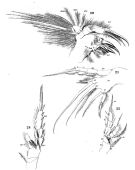 Issued from : W. Giesbrecht in Systematik und Faunistik der Pelagischen Copepoden des Golfes von Neapel und der angrenzenden Meeres-Abschnitte. – Fauna Flora Golf. Neapel, 1892. Atlas von 54 Tafeln. [Taf.26, Figs.20, 21, 22, 24]. As Monops regalis. Female: 20, Mx1 (posterior view); 21, Mxp (posterior view). Male: 22, P1 (anterior view); 24, P4 (posterior view).
|
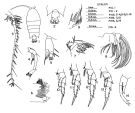 Issued from : T.S. Park in Fishery Bull. Fish Wild. Serv. U.S., 1968, 66 (3). [p.568, Pl.13, Figs.1-14]. Female: 1, habitus (dorsal); 2, last thoracic segment and urosome (dorsal); 3, A1; 4, A2; 5, Md (mandibular palp); 6, Md (masticatory edge); 7, Mx1; 8, Mx2; 9, Mxp; 10, P1; 11, P2; 12, P3; 13, P4; 14, P5. Nota: In the shape of the urosome the present specimen is not in full agreement with the description given by Giesbrecht (1892, tafel 41). According to Fleminger, however, it is not outside the variability shown by the species
|
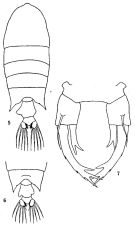 issued from: Q.-c Chen & S.-z. Zhang in Studia Marina Sinica, 1965, 7. [Pl.47, 5-7]. Female (from E China Sea): 5, habitus (dorsal); 6, urosome (another specimen), dorsal; 7, P5 (posterior).
|
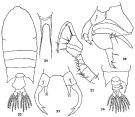 issued from : Q.-c Chen & C.-j. Shen in Studia Marina Sinica, 1974, 9. [p.130, Figs.23-28]. Female (from South China Sea): 23, habitus (dorsal); 24, rostrum (frontal view); 25, P5. Male: 26, last thoracic segment and urosome (dorsal); 27, right A1; 28, P5.
|
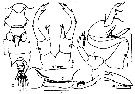 issued from : E.G. Silas & P.P. Pillai in J. mar. biol. Ass. India, 1973 (1976), 15 (2). [p.839, Fig.29]. Female (from Indian Ocean): a, urosome (dorsal); b, P5. Nota: Genital segment enlarged and asymmetrically produced on left side into a distinct lobe; right lateral margin with no such modification, ventrally a median spine present near genital opening; a pair of short spinules present at base of genital segment and with a few short setae along its lateral margin. Outer lateral margin of exopod of P5 with 3 minute spuines and inner margin with 1 long spine; apically it is bifid subequally with outer branch being smaller. Male: c, urosome (dorsal); d, right A1 (geniculate part); e, P5 (terminal part of thumb, enlarged); f, P5. Nota: Right P5 chelate, with a broad hand and an elongated thumb; latter with a seta on its inner base; finger with bent tip and 2 marginal setae; it carries a conical process at its mid inner margin; 2 subequal setae prsent on basipod 2; left P5 with distal segments with 2 outer lateral spines and 2 subequal spines apically of which outer one is longest; penultimate drawn into a spine at outer distal margin; inner margin with a tuft of setae. Scale as in Calanopia minor.
|
 issued from : E.G. Silas & P.P. Pillai in J. mar. biol. Ass. India, 1973 (1976), 15 (2). [p.840]. The combination of characters in the modification of the female genital segment and P5 in both sexes agree to suggest two main types of infra-specific variations in P. regalis. Park (1968) has remarked that according to Fleminger (pers. comm.) this variation is not outside the usual variability shown by the species. However in view of the consistant differences shown by the two \"varieties\", the possibility of recognising Type-II as a distinct species from the former Type-I cannot be ruled out.
|
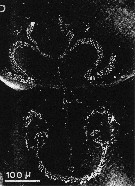 issued from : A. Ianora, A. Miralto & S. Vanucci in Mar Biol., 1992, 113. [p.403, Fig.2, D]. SEM micrographs. Female & Male: D, surface attachment structure (mass of fine setules arranged in three semicircles on a flattened area of the anterodorsal surface of the cephalosome).
|
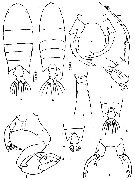 issued from : Z. Zheng, S. Li, S.J. Li & B. Chen in Marine planktonic copepods in Chinese waters. Shanghai Sc. Techn. Press, 1982 [p.91, Fig.51]. Female: a, habitus (dorsal); b, rostrum (frontal view); c, P5; d, urosme (dorsal, another specimen); e, urosome (dorsal, same individual); f, P5 (same individual). Male: g, habitus (dorsal); h, A1; i, P5. Scale bars in mm.
|
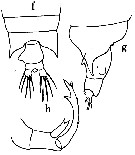 issued from : O. Tanaka in Publ. Seyo Mar. Biol. Lab., 1964, 12 (3). [p.268, Fig.240, f-h]. As Pontellopsis villosa. Female (from Izu Region, Japan): f-g, last thoracic segment and urosome (dorsal and lateral, respectively); h, P5)
|
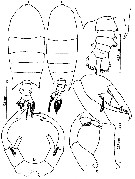 issued from : Mulyadi in Treubia, 2002, 32; [p.143, Fig.52]. Female (from Flores Sea): a, habitus (dorsal); b, P5. Male: c, habitus (dorsal); d, metasomal somite 5 and urosome (dorsal); e, P5.
|
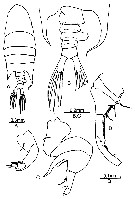 issued from : B.H.R. Othman & T. Toda in Coastal Mar. Sc., 2006, 30 (1). [p.317, Fig.22]. Male (from Sister's Island, Singapore): A, habitus (dorsal); B, posterior part of prosome and urosome (dorsal); C, P5; D, A1. Nota: Prosome to urosome length ratio 3.05 : 1. - Cephalon and 1st pedigerous somite separated, 4th and 5th pedigerous solites fused. Posterior thoracic corners asymmetrical, produced into acuminate processes, left extends betond genital segment, right directed posteriorly and curved inwards apically, reaching anal segment. - Urosome 5-segmented. - Genital segment broader than long. - Urosomal segment 3 with a prominent lobe on right margin, crowned with spinules at apex. - A1 geniculate, segment 13-17 enlarged, serrated plates present on anterior margins of segment 17 and 18, base of fused segments 19-21 with serially arranged spines. - P5 asymmetrical, right leg basis with 1 seta on inner margin; exopodal segment 1 (chela) short and broad with an elongated thumb, inner base of chela with 1 long seta; exopodal segment 2 (finger) with bent tip and 2 inner setae. Left leg, exopodal segment 1 with 1 strong distolateral spine; exopodal segment 2 with 2 outer and 2 unequal apical spines of which inner one shortest; inner margin hirsute. Remarks: There have been reports of small variations in the P5 of both sexes (see Silas & Pillai, 1973).
|
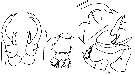 issued from : P.P. Pillai in J. mar. biol. Ass. India, 1975, 17 (2). [p.136, Fig.3, i-L]. Female (from Indian Ocean): i, urosome (dorsal); j, P5. Male: k, P5; L, terminal portion of finger (enlarged). Scale: Single bars: 0.3 mm, double bars: 0.05 mm..
|
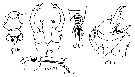 Issued from : J.M. Bradford-Grieve, E.L. Markhaseva, C.E.F. Rocha & B. Abiahy in South Atlantic Zooplankton, edit. D. Boltovskoy. 1999, Vol. 2, Copepoda; [p.1073, Fig. 7.402: Pontellopsis regalis ]. Ur = urosome; r = right leg; l = left leg.; r P5= right fifth swimming leg. Female characters (from key, p.960): - Urosome distinctly of 2 somites. - Genital segment asymmetrical swollen on each side, each swelling bearing 3 spines; anal somite not projecting posteriorly. Male characters (from key, p.961): - Posterior prosome corners asymmetrical. - Left posterior prosome corner extending to posterior border of urosomal segment 2; right corner extending to posterior border of anal somite; urosomal segment 3 asymmetrically developed on right. - Urosomal segment 3 with spinulose swelling on right.
| | | | | Ref. compl.: | | | Sewell, 1912 (p.376); 1914 a (p.239); 1948 (p.322, 357, 461); Demir, 1959 (p.176); Ganapati & Shanthakumari, 1962 (p.9, 16); Giron-Reguer, 1963 (p.54); V.N. Greze, 1963 a (tabl.2); Shmeleva, 1963 (p.141); Sherman, 1963 (p.216: fig.2, p.220: fig.9, p.223: fig.13, p.224: fig.14); Grice, 1963 a (p.496); De Decker & Mombeck, 1964 (p.13); Heinrich, 1964 (p.86: fig.4, p.89: fig.6); Anraku & Azeta, 1965 (p.13, Table 2, fish predator); Shmeleva, 1965 b (p.1350, lengths-volume-weight relation); Pavlova, 1966 (p.44); Mazza, 1966 (p.72); 1967 (p.326, 367, fig.65); Fleminger, 1967 a (tabl.1); Evans, 1968 (p.14); Champalbert, 1969 a (p.601); Sherman & Schaner, 1968 (p.583, fig.2); Apostolopoulou, 1972 (p.328, 369); Heinrich, 1974 (p.43, fig.1); Weikert, 1975 (p.139, carte); Carter, 1977 (1978) (p.36); Grice & Gibson, 1978 (p.23, tab.8, Rem.:?); Vives, 1982 (p.295); Kovalev & Shmeleva, 1982 (p.85); Dessier, 1983 (p.89, Tableau 1, Rem., %); Scotto di Carlo & al., 1984 (1045); Guangshan & Honglin, 1984 (p.118, tab.); Regner, 1985 (p.11, Rem.: p.38); Brinton & al., 1986 (p.228, Table 1); Madhupratap & Haridas, 1986 (p.105, tab.1); Lozano Soldevilla & al., 1988 (p.60); Hernandez-Trujillo, 1989 (tab.1); 1989 a (tab.1); Cervantes-Duarte & Hernandez-Trujillo, 1989 (tab.3); Heinrich, 1990 (p.19); Suarez & al., 1990 (tab.2); Baessa De Aguiar, 1991 (1993) (p.107); Suarez, 1992 (App.1); Hernandez-Trujillo, 1994 (tab.1); Shih & Young, 1995 (p.72); Hure & Krsinic, 1998 (p.103); Suarez-Morales & Gasca, 1998 a (p.111); Wong & al, 1998 (tab.2); Lavaniegos & Gonzalez-Navarro, 1999 (p.239, Appx.1); Fernandez-Alamo & al., 2000 (p.1139, Appendix); Suarez-Morales & al., 2000 (p.751, tab.1); El-Serehy & al., 2001 (p.116, Table 1: abundance vs transect in Suez Canal); Vukanic, 2003 (p.139, tab.1); Alvarez-Silva & al., 2005 (p.39); Hwang & al., 2006 (p.943, tabl. I); Dur & al., 2007 (p.197, Table IV); Neumann-Leitao & al., 2008 (p.799: Tab.II, fig.6, as P. regalis); Ayon & al., 2008 (p.238, Table 4: Peruvian samples); Mazzocchi & Di Capua, 2010 (p.427); Medellin-Mora & Navas S., 2010 (p.265, Tab. 2), Maiphae & Sa-ardrit, 2011 (p.641, Table 2, 3, Rem.); Tutasi & al., 2011 (p.791, Table 2, abundance distribution vs La Niña event); Lavaniegos & al., 2012 (p. 11, Appendix); in CalCOFI regional list (MDO, Nov. 2013; M. Ohman, comm. pers.); Tseng & al., 2013 (p.507, seasonal abundance); Lidvanov & al., 2013 (p.290, Table 2, % composition); Jerez-Guerrero & al., 2017 (p.1046, Table 1: temporal occurrence); El Arraj & al., 2017 (p.272, table 2); Palomares-Garcia & al., 2018 (p.178, Table 1: occurrence); Belmonte, 2018 (p.273, Table I: Italian zones) | | | | NZ: | 16 | | |
|
Carte de distribution de Pontellopsis regalis par zones géographiques
|
| | | | | | | | | | | | 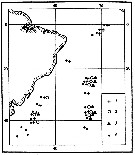 Issued from : A.K. Heinrich inTrudy Inst. Okeanol., 1974, 98 [p.44, Fig.1]. Issued from : A.K. Heinrich inTrudy Inst. Okeanol., 1974, 98 [p.44, Fig.1].
Distibution of three species of Pontellidae from SW Atlantic (Cruise of the R/V 'Akademik Kurchatov', 1971 and 1972).
Points = stations; cross = Labidocera acutifrons ; circle= Pontellopsis regalis ; triangle= Pontellopsis villosa . |
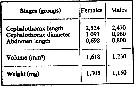 issued from : A.A. Shmeleva in Bull. Inst. Oceanogr., Monaco, 1965, 65 (n°1351). [Table 6: 36]. Pontellopsis regalis (from South Adriatic). issued from : A.A. Shmeleva in Bull. Inst. Oceanogr., Monaco, 1965, 65 (n°1351). [Table 6: 36]. Pontellopsis regalis (from South Adriatic).
Dimensions, volume and Weight wet. Means for 50-60 specimens. Volume and weight calculated by geometrical method. Assumed that the specific gravity of the Copepod body is equal to 1, then the volume will correspond to the weight. |
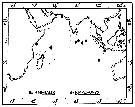 issued from : P. Pillai in J. mar. biol. Ass. India, 1975, 17 (2). [p.142, Fig.8]. issued from : P. Pillai in J. mar. biol. Ass. India, 1975, 17 (2). [p.142, Fig.8].
Occurrence of Pontellopsis regalis and P. macronyx collected from 32 stations in the Indian Ocean (See in Hand Book to the International Zooplankton Collections, volume I, 1969). |
| | | | Loc: | | | South Africa (E), off Angola, Tristan da Cunha Is., off Ascension Is., Brazil, off Trinidad Is., Cape Verde Is., off Morocco-Mauritania, Canary Is., off Azores (W & S), Barbados Is., Caribbean Colombia, G. of Mexico, Cuba, Florida, Bermuda, Woods Hole, Georges Bank, Medit. (Banyuls, G. of Lion, Ligurian Sea, Napoli, Strait of Messina, Adriatic Sea, Malta, Ionian Sea, Aegean Sea, Port Said), Suez Canal, Arabian Sea, ? Arabian Gulf, Is. Maldive Is., Sri Lanka, Natal, Indian, India (Lawson's Bay), G. of Bengal, Burma, Andaman Is., Nicobar Is., Nankauri Harbour, Straits of Malacca (Singapore), G. of Thailand, Indonesia (N Java : Lombok , Banda Sea, Eastern Indonesian waters, Philippines, Viet-Nam (Cauda Bay), Taiwan, NE Taiwan, China Seas (East China Sea, South China Sea), Nagasaki, Japan, Pacif. (W equatorial), Australia (Great Barrier, New South Wales), Pacif. (N central), Hawaii, off E Tuamotu, Galapagos, off NE Easter Is., off California, W Baja California, La Paz, Gulf of California, Bahia de los Angeles, Zihuatanejo Bay, G. of Tehuantepec, W Mexico, Central America, Bahia Cupica (Colombia), Galapagos-Ecuador, off Peru, Pacif. (SE tropical), Chile
Type locality: Sulu Sea | | | | N: | 108 ? | | | | Lg.: | | | (16) F: 4,08-3,75; (34) F: 3,47; (35) F: 3,6; (45) F: 4,5-4; M: 3,5-3,25; (46) F: 4,4-4; M: 3,5-3,4; (72) F: 3,2; (120) F: 3,65-3,37; M: 3,22-3,08; (187) F: 3,84-3,7; M: 3,35; (256) F: 4,22-3,39; M: 3,58-3,25; (290) F: 2,65-2,75; (394) F: 2,98-2,85; M: 2,76-2,72; (449) F: 4,4-4; M: 3,5-3,4; (485) F: 3,847-3,464; M: 3,379-3,123; (806) M: 3,3; 3,28; (1023) F: 3,26-3,56; 2,74-2,85; M: 2,67-3,37; (1086) M: 1,64; (1087) F: 3,40; M: 3,20; (1115) F: 2,74-3,16; M: 2,64-3,01; {F: 2,65-4,50; M: 1,64-3,58} | | | | Rem.: | épipélagique.
Une grande confusion règne entre l'espèce décrite par Dana (1849) et Pontellopsis grandis Lubbock (1853), du fait de la synonymie établie par Giesbrecht (1892). Pour Bradford-Grieve (1999 b, p.207) les espèces sont distinctes. Les localisations pour les deux espèces sont alors difficiles à préciser, d'autant plus que leur présence semble largement distribuée dans les trois océans.
Voir aussi les remarques en anglais | | | Dernière mise à jour : 24/10/2022 | |
|
|
 Toute utilisation de ce site pour une publication sera mentionnée avec la référence suivante : Toute utilisation de ce site pour une publication sera mentionnée avec la référence suivante :
Razouls C., Desreumaux N., Kouwenberg J. et de Bovée F., 2005-2025. - Biodiversité des Copépodes planctoniques marins (morphologie, répartition géographique et données biologiques). Sorbonne Université, CNRS. Disponible sur http://copepodes.obs-banyuls.fr [Accédé le 08 octobre 2025] © copyright 2005-2025 Sorbonne Université, CNRS
|
|
|
|




;)
;)
;)
;)
;)
;)
;)
;)
;)
;)
;)
;)
;)
;)
;)
;)

;)
;)
;)