|
|
 |
Fiche d'espèce de Copépode |
|
|
Calanoida ( Ordre ) |
|
|
|
Clausocalanoidea ( Superfamille ) |
|
|
|
Aetideidae ( Famille ) |
|
|
|
Euchirella ( Genre ) |
|
|
| |
Euchirella rostrata (Claus, 1866) (F,M) | |
| | | | | | | Syn.: | Undina rostrata Claus, 1866 (p.11);
? Euchaeta hessei Brady, 1883 (p.63) | | | | Ref.: | | | Giesbrecht, 1892 (p.232, 245, figs.F); Giesbrecht & Schmeil, 1898 (p.36); Cleve, 1901 c (p.4, figs.M); Thompson & Scott, 1903 (p.233, 244); Esterly, 1905 (p.152, figs.F, Rem.F,M); Farran, 1908 b (p.38); Esterly, 1911 (p.321, figs.M); Wolfenden, 1911 (p.235); With, 1915 (p.113, figs.F,M); Lysholm & Nordgaard, 1921 (p.15); Sars, 1925 (p.69, figs.F,M); Farran, 1926 (p.251: juv.); 1929 (p.208, 234); Campbell, 1929 (p.312, Rem.); Sewell, 1929 (p.107, 109: Rem.); Rose, 1929 (p.20); Wilson, 1932 a (p.55, figs.F,M); Rose, 1933 a (p.p.104, figs.F,M); Jespersen, 1934 (p.64); Jespersen, 1940 (p.23, fig.4); Lysholm & al., 1945 (p.17); Davis, 1949 (p.30, figs.F, Rem.F,M); Brodsky, 1950 (1967) (p.174, figs.F,M); Vervoort, 1952 f (n°47, p.3, figs.F,M); Tanaka, 1957 b (p.177, figs.F,M); Vervoort, 1957 (p.63, Rem.); Björnberg, 1963 (p.37); Paiva, 1963 (p.35, fig.F); Vervoort, 1963 b (p.149); Gaudy, 1963 (p.22); Owre & Foyo, 1967 (p.48, figs.F,M); Mazza, 1967 (p.128, 139, figs. juv., F,M); Park, 1968 (p.551); Tanaka & Omori, 1969 (p.56); Ramirez, 1969 (p.59, figs.F, Rem.); Bradford, 1970 a (p.354, fig.M); Shih & al., 1971 (p.32, 143); Kos, 1972 (Vol. I, figs.F, M, Rem.); Vaupel Klein, 1972 (p.502, 505, fig.F); Bradford, 1972 (p.38, figs.F); Razouls, 1972 (p.94, Annexe: p.45, figs.F,M); Park, 1976 a (p.117, figs.F,M); 1978 (p.147, figs.F); Séret, 1979 (p.77, 84, figs.F); Bradford & Jillett, 1980 (p.39, figs.F,M, fig. 73, distribution chart); Björnberg & al., 1981 (p.605, 632, figs.F); Gardner & Szabo, 1982 (p.240, figs.F,M); Vaupel Klein, 1984 a (p.44, figs.F, Table II: characters); Markhaseva, 1996 (p.167, figs.F,M); Chihara & Murano, 1997 (p.686, Pl.36,40: F,M); Vaupel Klein, 1998 a (p.386: Table 2, fig.F, fig.5); Bradford-Grieve & al., 1999 (p.879, 921, figs.F,M); G. Harding, 2004 (p.56, figs.F,M); Vives & Shmeleva, 2007 (p.569, figs.F,M, Rem.) | 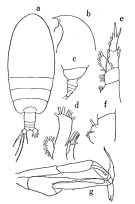 issued from : O. Tanaka in Publ. Seto Mar. Biol. Lab., 1957, 6 (2). [Fig.44, p.177]. Female (from Izu region): habitus (dorsal aspect); b, head (lateral aspect); c, last thoracic segment and urosome (lateral aspect); d, exopodite and endopodite and lobes of Mx1; e, P1; f, first basal joint (= coxa) of P4. Male: g, P5. Nota Female: - Cephalothorax about 4.58 times the length of abdomen (2.95 : 0.63) - Rostrum long and pointed - Abdomen 4-segmented; segments and caudal rami in the proportional lengths 43 : 16 : 14 : 5 : 19 = 100. - Genital segment with a small ventral process. - Caudal rami about as long as wide. - A1 23-segmented, extends to distal end of 3rd andominal segment; 2nd segment much shorter yjan segments 8-9. - A2 exopod 2 times as lo,g as endopod. - Mx1 with 3 setae on 2nd inner lobe; 2 setae and a conical process on 3rd inner lobe; 9 setae on outer lobe; 10 setae on exopod; 4 setae on endopod; 2setae on 2nd basal segment. - P4 with a triangular lamellous plates on coxa. Nota Male: Cephalothorax about 4 times the length of abdomen (2.38 : 0.68). - Head incompletely separates from the 1st pedigerous segment. - Abdomen 5-segmented; segments and caudal ramiin the proportional lengths 26 : 20 : 17 : 13 : 7 : 17 = 100. - Caudal rami about as long as wide. - ,A1 extends to distal end of 4th abdominal segment; segments 9-10 and 12-13 partially fused. - A2 endopod about 3/4 times as long as exopod; setae on basis well developed. - right P5 does not form a complete prehensile organ; left leg well developed.
|
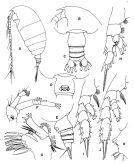 issued from : T. Park in Antarctic Res. Ser. Washington, 1978, 27. [p.148, Fig.29]. Female: A, habitus (left lateral side); B, forehead (left lateral); C, posterior part of metasome and urosome (dorsal view); D, genital segment (ventral view); E, posterior part of metasome and urosome (left lateral); F, A2; G, Mx1; H, P1; I, P2; J, P4; K, medial part of coxa of P4 (posterior view); P1-P4: legs (anterior view).
|
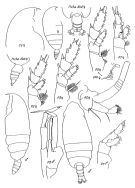 issued from : E.L. Markhaseva in Proc. Zool. Inst. RAN, St. Petersburg, 1996, 268. [p.168, Fig.129]. Female (specimen from NW Pacif.); Male (specimen from N Atlant.). Ce: forehead (lateral); CP4: coxopod of P4. Nota: Mx1 gnathobase with 4 setae on posterior surface; 2nd and 3rd internal lobes with 3 (2 long and 1 short) and 2 setae respectively; protopodite near endopod base with 3 setae; exopod with 10 (after Park, 1978, with 10-11) setae; external lobe with 9 setae. P4 coxopodite with 7-9 denticles (9 after Von Vaupel Klein, 1984).
|
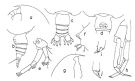 issued from : T. Park in Contr. Mar. Sci., 1976, 20. [p.117, Fig.8]. Female: a, forehead (lateral); b, c, posterior part of metasome and urosome (lateral, dorsal, respectively): d, genital segment (ventral); e, A2; f, medial side of coxa of fourth leg (posterior). Male: g, forehead (lateral); h, fifth pair of legs (anterior); i, distal part of exopod of left fifth leg (anterior); j, idem (posterior).
|
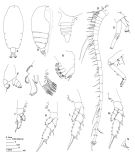 issued from : J.M. Bradford & J.B. Jillett in Mem. N.Z. Oceanogr. Inst., 86, 1980. [p.12, Fig.3]. Female: A, habitus (ventral); B, idem (lateral right side); C, urosome (lateral right side); D, A1; E, A2; F, Md (mandibular palp); G, Mx1; H, Mx2; I, Mxp; J, P1; K, P2; L, P3; M, M, P4; N, inner part of basipod 1 of P4.
|
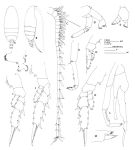 issued from : J.M. Bradford & J.B. Jillett in Mem. N.Z. Oceanogr. Inst., 86, 1980. [p.13, Fig.4]. Male: A, habitus (dorsal); B, idem (lateral right side); C, A1; D, A2; E, Md (mandibular palp); F, Mx1; G, Mxp; H, P1; I, P2; J, P3; K, P4; L, P5; M, terminal part of left P5 exopod.
|
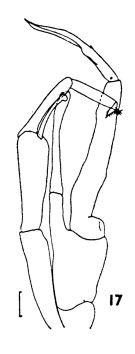 issued from : J.M. Bradford in N.Z. Jl Mar. Freshw. Res., 1970, 4 (4). [p.354, Fig. 17]. male (off Kaikoura, New Zealand): 17, P5. Scale bar represents 0.1 mm.
|
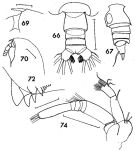 issued from : F.C. Ramirez in Contr. Inst. Biol. mar., Buenos Aires, 1969, 98. [p.60, Lam. X, figs.66, 67, 69, 70, 72, 74 ]. Female (from off Mar del Plata): 66, urosome (dorsal); 67, idem (lateral left side); 69, forehead (lateral); 70, idem (lateral); 72, P4 (detail of basipodite 1); 74, A2 Scale bars in mm: 0.4 (66, 67); 0.2 (69); 0.5 (70); 0.3 (74).
|
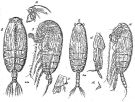 Issued from : G.O. Sars in Résult. Camp. Scient. Prince Albert I, 69, pls.1-127 (1924). [Pl.XX, figs.8-15]. Female: 8, habitus (dorsal); 9, idem (lateral left side); 10, forehead (lateral); 11, basipodal segment of P4; 12, denticulate edge of 1st basipodal segment of P4 (enlarged). Male: 13, habitus (dorsal); 14, idem (lateral left side); 15, P5.
|
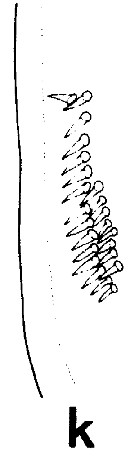 issued from : J.C. von Vaupel Klein in Crustaceana, Supplt 9, Studies on Copepoda, III, 1984. [p.75, Fig.13, k]. Female: k, arrangement of spinules on the proximal part of the medial face of basipodite 2 of Mxp (right appendage in medial view). Nota: 23 stout, cone-shaped spinules in a partlly single, partly double row.
|
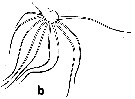 issued from : J.C. von Vaupel Klein in Crustaceana, Supplt 9, Studies on Copepoda, III, 1984. [p.74, Fig.12, b]. Female: b, setal armature of exopod of Mx1 (left one in posterior aspect; all setae are plumose). Nota: 10 setae-condition (see E. formosa p.74, fig.12 a).
|
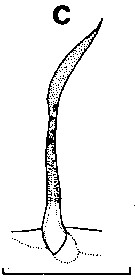 issued from : J.C. von Vaupel Klein in Crustaceana, Supplt 9, Studies on Copepoda, III, 1984. [p.63, Fig.5, b]. Female: b, condition of the distal small seta on A1 segment 5. Nota: modified, type II seta, with wide, flattened distal part. (see Pseudochirella obesa p.63, fig.5,a) Scale bar 0.05 mm.
|
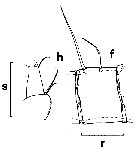 issued from : J.C. von Vaupel Klein in Crustaceana, Supplt 9, Studies on Copepoda, III, 1984. [p.63, Fig.5, f, h]. Female: f, setal armature of A1 segment 10 (note: normal type I small seta present in proximal position); h, setal armature of basipodite 2 of A2 (note: 2 setae, at least one of which is long). Scale bars: r = 0.1 mm for f; s = 0.2 mm for h.
|
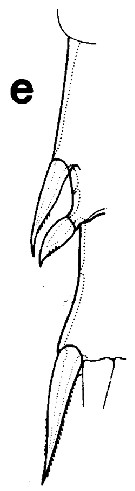 issued from : J.C. von Vaupel Klein in Crustaceana, Supplt 9, Studies on Copepoda, III, 1984. [p.84, Fig.18, e]. Female: a, number and structure of spines among the lateral margin of exopodal segments 1, 2 and 3 of P1 (left appendage, posteriotr view) (note: the spine on former exopodal segment 2 is flat and leaf-shaped).
|
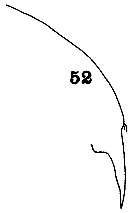 issued from : C.O. Esterly in Univ. Calif. Publs Zool., 1911, 6 (14). [Pl.29, Fig.52]. Male (from San Diego Region): 52, forehead (lateral).
|
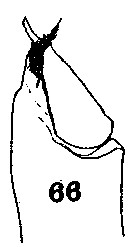 issued from : C.O. Esterly in Univ. Calif. Publs Zool., 1911, 6 (14). [Pl.30, Fig.66]. Male: 66, tip of left P5.
|
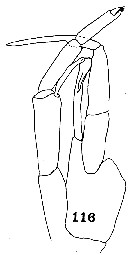 issued from : C.O. Esterly in Univ. Calif. Publs Zool., 1911, 6 (14). [Pl.32, Fig.116]. Male: P5 (left leg is at the left).
|
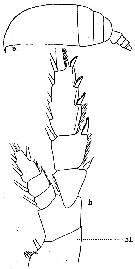 issued from : C.O. Esterly in Univ. Calif. Publs Zool., 1905, 2 (4). [p153., Fig.19]. Female (from San Diego Region): a, habitus (lateral); b, P4 (b1 = 1st basal segment, showing lamellar processes).
|
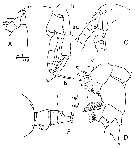 issued from : C. Razouls in Th. Doc. Etat Fac. Sc. Paris VI, 1972, Annexe. [Fig.44, A-D, F]. Female (from Banyuls, G. of Lion): A, forehead (lateral); D, basipodal segment 1 of P4, D', detail of inner margin od basipodal segment 1 (enlarged); F, urosome (lateral). Male: B, P5; C, forehead (lateral).
|
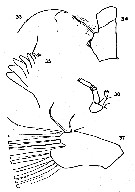 issued from : C.C. Davis in Univ. Wash. Publs Biol., 1949, 14. [Pl.3, Figs.33-37]. Female (from NE Pacific): 33, forehead (lateral); 34, basipod of P4; 35, spines on inner border of 1st basal segment of P4; 36, A2; 37, 2nd endopodal segment of A2. Nota : Forehead without crest. Rostrum very prominent. A1 reaching to the anal segment. Endopod of A2 about ½ the length of the exopod ; terminal segment of endopod with 14 setae (8 + 6). Urosome symmetrical ; genital segment as long as the other three urosomal segments combined. Caudal rami as wide as long and divergent, with tufts of hair on the inner margins. Basal segment of P4 with a row of 6 to 7 flat, triangular spines on the inner border.
|
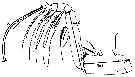 issued from : J.C. von Vaupel Klein in Zool. Verh. Leiden, 1998, 323. [p.387, Fig.2]. Measurements taken from maxilliped: Ba1 = length of basipodal segment 1; Ba2 = length of Ba2; S = length of the longest seta of the only ramus (endopodite). measurements used to compare with other species (tables 1 and 2) in view of the speciation (see discussion after Von Vaupel Klein (1998, pp.389-397) in the genus Euchirella.
|
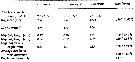 issued from : J.C. von Vaupel Klein in Zool. Verh. Leiden, 1998, 323. [p.386, Table 2]. Dimensions of adult females of E. rostrata, E. rostromagna, and E. latirostris, presumably relevant in the separation of niches. 1/ See Material and methods (Von Vaupel Klein, 1998, pp.385-385); 2/ Present collections: 2.7-3.85 mm; 3/ Present collections: 5.3-6.2 mm; 4/ Present collections: 5.4-6.2 mm; 5/ Of E. rostrata vs the average of the two larger spp.; 6/ Of E. rostromagna vs E. latirostris; 7/ From Von Vaupel Klein 1984, p.93); 8/ Of E. rostrata vs E. rostromagna and of E. rostrata vs E. latirostris, respectively.
|
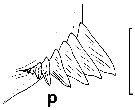 issued from : J.C. von Vaupel Klein in Crustaceana, Supplt 9, Studies on Copepoda, III, 1984. [p.80, Fig.16, p]. Female: p, arrangement of medial spines on the posterior face of basal segment 1 of left P4 . Scale bar 0.067 mm. Nota: flat, leaf-shaped, decreasing spines, separately inserted.
|
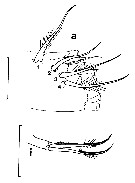 issued from : J.C. von Vaupel Klein in Crustaceana, Supplt 9, Studies on Copepoda, III, 1984. [p.69, Fig.9, a, i]. Female: a, setal armature on the posterior face of the 1st inner lobe of basipodal segment 1 of left Mx1 (4 setae, numbered 1 to 4 in a proximal to distal order to compare other species).; i, complement of terminal setae on the 2nd inner lobe of basipodal segment 1 of right Mx1 (details of right appendages in anterior view; to the posterior side 2 relatively stout setae are always present, which are combined bipectinate and spinulose; with only 1 anterior seta present which is feebly developed, and sparsely spinulose only - according to its position, this seta is tentatively referred to as the distal one). Scale bars: 0.1 mm (a); 0.2 mm (i).
|
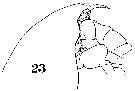 Issued from : W. Giesbrecht in Systematik und Faunistik der Pelagischen Copepoden des Golfes von Neapel und der angrenzenden Meeres-Abschnitte. – Fauna Flora Golf. Neapel, 1892, 19 , Atlas von 54 Tafeln. [Taf.36, Fig.23]. Female: 23, forehead (lateral).
|
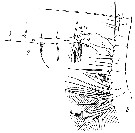 Issued from : W. Giesbrecht in Systematik und Faunistik der Pelagischen Copepoden des Golfes von Neapel und der angrenzenden Meeres-Abschnitte. – Fauna Flora Golf. Neapel, 1892, 19 , Atlas von 54 Tafeln. [Taf.15, Figs.7, 8]. Female: 7, A1 (distal segments); 8, A1 (proximal segments; ventral view).
|
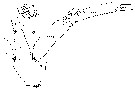 Issued from : W. Giesbrecht in Systematik und Faunistik der Pelagischen Copepoden des Golfes von Neapel und der angrenzenden Meeres-Abschnitte. – Fauna Flora Golf. Neapel, 1892, 19 , Atlas von 54 Tafeln. [Taf.15, Fig.6]. Female: A2 (posterior view).
|
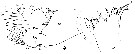 Issued from : W. Giesbrecht in Systematik und Faunistik der Pelagischen Copepoden des Golfes von Neapel und der angrenzenden Meeres-Abschnitte. – Fauna Flora Golf. Neapel, 1892, 19 , Atlas von 54 Tafeln. [Taf.15, Figs.4, 5]. Female: 4, Md (mandibular palp; posterior view); 5, Md (cutting egge of the gnathobase).
|
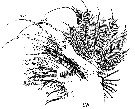 Issued from : W. Giesbrecht in Systematik und Faunistik der Pelagischen Copepoden des Golfes von Neapel und der angrenzenden Meeres-Abschnitte. – Fauna Flora Golf. Neapel, 1892, 19 , Atlas von 54 Tafeln. [Taf.15, Fig.28]. Female: 28, Mx1 (anterior view).
|
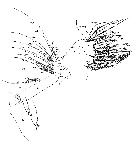 Issued from : W. Giesbrecht in Systematik und Faunistik der Pelagischen Copepoden des Golfes von Neapel und der angrenzenden Meeres-Abschnitte. – Fauna Flora Golf. Neapel, 1892, 19 , Atlas von 54 Tafeln. [Taf.15, Figs.9, 10]. Female: 9, Mx2 (posterior view); 10, Mxp. B1 (posterior view); rest (anterior view).
|
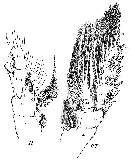 Issued from : W. Giesbrecht in Systematik und Faunistik der Pelagischen Copepoden des Golfes von Neapel und der angrenzenden Meeres-Abschnitte. – Fauna Flora Golf. Neapel, 1892, 19 , Atlas von 54 Tafeln. [Taf.15, Figs.11, 27]. Female: 11, P1 (anterior view); 27, P4 (posterior view).
|
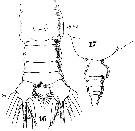 Issued from : W. Giesbrecht in Systematik und Faunistik der Pelagischen Copepoden des Golfes von Neapel und der angrenzenden Meeres-Abschnitte. – Fauna Flora Golf. Neapel, 1892, 19 , Atlas von 54 Tafeln. [Taf.36, Figs.16-17]. Female: 16, Urosome ventral); 17, same (lateral).
|
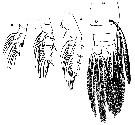 Issued from : G.S. Brady in Rep. Scient. Results Voy. Challenger, Zool., 1883, 8 (23). [Pl.XXIII, Figs.11-14]. With doubt as Euchaeta hessei. Female: 11, P1; 12, P2; 13, P4; 14, urosome with attached spermatophores.
|
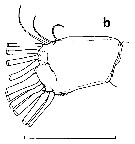 issued from : J.C. von Vaupel Klein in Crustaceana, Supplt 9, Studies on Copepoda, III, 1984. [p.65, Fig.6 b]. Euchirella rostrata: a, Setal armature of endopodte 2+3 of A2. Conditions are expressed are expressed in formulae as follows: number of setae in regular row on proximal lobe / relative development of seta in position no. 9 on this lobe / number of setae in approximately linear row on terminal lobe / relative development of appendicular seta no. 7 and its supporting pedestral (absent, vestigial, moderate or well developed: see Table I, p.87 and Table II, p.93). upper and lower lobes = proximal and terminal lobes (details of right appendage shown in medial aspect). Scale bar = 0.133 mm. Nota: Condition 8/1/6/2 in the rostrata-group.
|
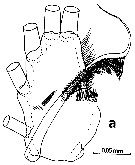 Issued from : J.C. von Vaupel-Klein in Zool. Meded., Leiden, 19972, 47 (41). [p.511, Fig.5, a]. Female (from 37°05'N, 160°08'E): a, endopodite of right P1 (anterior view). Nota: 'organ of Vaupel Klein' (see explanation to Euchirella curticauda.)
|
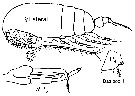 issued from : G. Harding in Key to the adullt pelagic calanoid copepods found over the continental shelf of the Canadian Atlantic coast. Bedford Inst. Oceanogr., Dartmouth, Nova Scotia, 2004. [p.56]. Female & Male. Nota: Forehead broadly rounded, without crest.
|
 Euchirella rostrata Euchirella rostrata female: 1 - Genital segment symmetrical. 2 - Crest absent. Rostrum not rudimentary. 3 - Md palp base without chitinous projection. Coxopodite of P4 with 8-9 clearly recognizable spines. Endopodal segment 2 of A2 with 6 setae on external and 8 setae on internal lobes. Rostrum large.
|
 Euchirella rostrata Euchirella rostrata male: 1 - P5 always biramous. Endopod of left P5 well developed, nearly as long as exopodal segment 1. Exopodal segment 2 and endopod of right P5 are not elongated and not sharpened into their distal parts; do not form tongs. Endopod of right P5 not exceeding distal border of exopodal segment 1. 2 - Crest absent. Rostrum large.
|
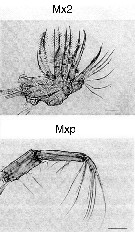 Issued from : M. Sano, K. Maki, Y. Nishibe, T. Nagata & S. Nishida in Progr. Oceanogr., 2013, 110. [p.19, Figs. 8 b, 9 b]. Second maxilla (Mx2) and maxilliped (Mxp) of Euchirella rostrata from Sagami Bay (Japan) in April 2009. Scale bars: Mx2 = 100µm, Mxp = 200 µm. Compare appendage structure and setal armement with Chirundina streetsii, Undeuchaeta major, Pleuromamma xiphia, Scaphocalanus echinatus, Scottocalanus helenae, Scottocalanus securifrons, Spinocalanus magnus and calanus sinicus for interpreted particles catching.
|
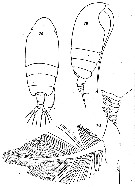 Issued from : C. Séret inThesis 3ème Cycle UPMC, Paris VI, 1979. [Pl. XII, Figs.74-76]. Female (from off Kerguelen Is.): 74-75, habitus (dorsal and lateral, respectively); 76, coxa of P4.
|
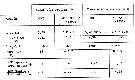 Issued from : C. Séret inThesis 3ème Cycle UPMC, Paris VI, 1979. [p. 84, Tableau VIII]. Female: Comparison of any characters of E. rostrata Giesbrecht (1892), Euchirella rostromagna Vervoort (1951) and samples from ''MD03 Expedition'' around Kerguelen Islands.
|
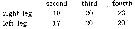 issued from : O. Tanaka in Publ. Seto Mar. Biol. Lab., 1957, 6 (2). [p.178]. Female P2 to P4: number of teeth on terminal spine of exopodite.
|
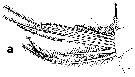 Issued from : J.C. von Vaupel Klein in Crustaceana, Supplt 9, Studies on Copepoda, III, 1984. [p.70, Fig.10, a]. Euchirella rostrata: Structure and setal complement on the outer lobe of basis 1 of Mx1 (detail of left appendage in posterior aspect). Regular row of 9 setae, consecutively increasing and next deacreasing in length.
|
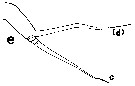 Issued from : J.C. von Vaupel Klein in Crustaceana, Supplt 9, Studies on Copepoda, III, 1984. [p.72, Fig.11, e]. Euchirella rostrata. Structure of Mx1, terminal configuration of setae plus the 'blunt tooth (= tubular pore) on the endite of basis (Ba2) (plumosity and/or spinules on setae, as well as hairs on lobe, omitted, right appendage in anterior view). Showing the usual Euchirella complement of, from anterior to posterior: short proximal seta (p), long central seta (c), blunt tooth (dotted outline) and shortest, distal seta (d). Contrary to E. curticauda with 2 equally developed setae, one of which probably corresponds to the central seta (c), while the other is tentatively referred to as the distal one ( (d) in E. rostrata.
|
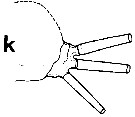 Issued from : J.C. von Vaupel Klein in Crustaceana, Supplt 9, Studies on Copepoda, III, 1984. [p.70, Fig.11, i]. Euchirella rostrata: Setal armature of the endopod of Mx1 (detail of left appendage in posterior aspect; setules/spinules omitted). 3-setae condition (compare with E. formosa Fig.11, i; and E. truncata Fig.11, J).
|
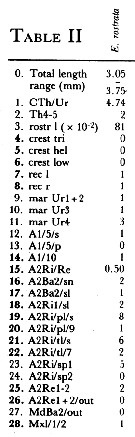 Issued from : J.C. von Vaupel Klein in Crustaceana, (Supplement) 9, 1984. [p.93, Table II]. Euchirella rostrata Female: Datamatrix stating observed states of characters from Table I (p.87-90) presently examined; nos. refer to the input nos. used in Table I (see to the family Aetideidae).
|
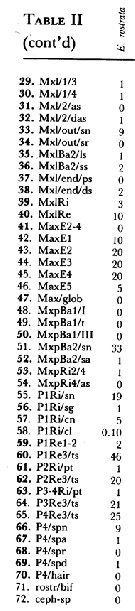 Issued from : J.C. von Vaupel Klein in Crustaceana, (Supplement) 9, 1984. [p.94, Table II (cont' d) ]. Euchirella rostrata Female: Datamatrix stating observed states of characters from Table I (p.87-90) presently examined; nos. refer to the input nos. used in Table I (see to the family Aetideidae).
|
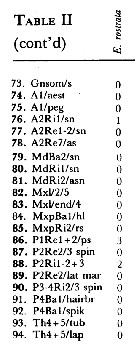 Issued from : J.C. von Vaupel Klein in Crustaceana, (Supplement) 9, 1984. [p.95, Table II (cont' d) ]. Euchirella rostrata Female: Datamatrix stating observed states of characters from Table I (p.87-90) presently examined; nos. refer to the input nos. used in Table I (see to the family Aetideidae).
| | | | | Ref. compl.: | | | Pearson, 1906 (p.15); Rose, 1924 (p.4, 6), 1925 (p.152); Hardy & Gunther, 1935 (1936) (p.159, Rem.); Jespersen, 1939 (p.49, Rem.); Massuti Alzamora, 1942 (p.90); Wilson, 1942 a (p.186); Sewell, 1948 (p.348, 500, 508, 526, 545, 556, 566, 568); C.B. Wilson, 1950 (p.226); Østvedt, 1955 (p.15: Table 3, p.63); Yamazi, 1958 (p.148, Rem.); Conover, 1960 (p.399, Table I, respiratory rate); Fagetti, 1962 (p.20); Marshall & Orr, 1962 (tab.3); Grice & Hart, 1962 (p.287, 295: Rem.); Gaudy, 1962 (p.93, 99, Rem.: p.106); V.N. Greze, 1963 a (tabl.2); Grice, 1963 a (p.495); Gaudy, 1963 (p.22, Rem.); Björnberg, 1963 (p.37, Rem.); Unterüberbacher, 1964 (p.22); De Decker & Mombeck, 1964 (p.12); Mazza, 1966 (p.70); 1967 (p.355: Rem.); Furuhashi, 1966 a (p.295, vertical distribution in Oyashio/Kuroshio transitional area, Table 7, 10); Fleminger, 1967 a (tabl.1); De Decker, 1968 (p.45); Evans, 1968 (p.13); Morris, 1970 (p.2300); Dowidar & El-Maghraby, 1970 (p.268); Itoh, 1970 a (p.8: tab. 2); Park, 1970 (p.475); Deevey, 1971 (p.224); Lee & al., 1971 (p.1150); Nival & al., 1972 (p.63, respiration); Razouls S., 1972 b (p.1, respiration); Boucher & Thiriot, 1972 (p.47, Tableau 4); Ibanez & Seguin, 1972 (p.81, annual cycle, multivarite analysis); Apostolopoulou, 1972 (p.327, 347); Björnberg, 1973 (p.324, 386); Nival & al., 1973 (p.123, respiration); Razouls S., 1974 (147, oxygen rate); de Bovée, 1974 (p.109, 124); Vives & al., 1975 (tab.II, III); Deevey & Brooks, 1977 (p.256, tab.2, Station "S"); Carter, 1977 (1978) (p.35); Arashkevich, 1978 (p.118, Table: diets, as robusta ?); Dessier, 1979 (p.204); Pipe & Coombs, 1980 (p.223, Table II, vertical occurrence); Herman & Mitchell, 1981 (p.739, Table 1, 3, length-volume); Vives, 1982 (p.291); Kovalev & Schmeleva, 1982 (p.83); Brenning, 1983 (p.3, 5, spatial distribution, T-S diagram, Rem.); De Decker, 1984 (p.316, 350: chart); Roe, 1984 (p.357); Tremblay & Anderson, 1984 (p.3); Sameoto, 1984 (p.767, vertical migration); Scotto di Carlo & al., 1984 (p.1043); Boucher, 1984 (p.469, spatial distribution/hydrological front); Bamstedt & Tande, 1985 (p.259, Table 2: literature data respiration & excretion); Petipa & Borichenko, 1985 (tab.1); Brenning, 1985 a (p.24, Table 2); Ibanez & Boucher, 1987 (p.205, Tableau, fig.7, hydrological fronts); Lozano Soldevilla & al., 1988 (p.58); Madhupratap & Haridas, 1990 (p.305, fig.5: vertical distribution night/day; fig.7: cluster); Pancucci-Papadopoulou & al., 1990 (p.199); Suarez & Gasca, 1991 (tab.2); Samba Diouf, 1991 (p.103, tableau 1); Suarez, 1992 (App.1); Seguin & al., 1993 (p.23); Hays & al., 1994 (tab.1); Kouwenberg, 1994 (tab.1); Hure & Krsinic, 1998 (p.101); Mauchline, 1998 (tab.26, 30, 63, 65); Gilabert & Moreno, 1998 (tab.1, 2); Suarez-Morales & Gasca, 1998 a (p108); Voronina & Kolosova, 1999 (p.71); Onishchik, 1999 (p.76); Lapernat, 2000 (tabl. 3, 4); Razouls & al., 2000 (p.343, Appendix); d'Elbée, 2001(tabl. 1); Holmes, 2001 (p.48); Sameoto & al., 2002 (p.12); Beaugrand & al., 2002 (p.1692); Beaugrand & al., 2002 (p.179, figs.5, 6); Yamaguchi & al., 2002 (p.1007, tab.1); Vukanic, 2003 (139, tab.1); CPR, 2004 (p.54, fig.156); Zervoudaki & al., 2006 (p.149, Table I); Ikeda & al., 2006 (p.1791, Table 2); Hooff & Peterson, 2006 (p.2610); Khelifi-Touhami & al., 2007 (p.327, Table 1);Valdés & al., 2007 (p.103: tab.1); Cabal & al., 2008 (289, Table 1); Neumann-Leitao & al., 2008 (p.799: Tab.II, fig.6); Morales-Ramirez & Suarez-Morales, 2008 (p.513); Fernandes, 2008 (p.465, Tabl.2); Gaard & al., 2008 (p.59, Table 1, N Mid-Atlantic Ridge); Galbraith, 2009 (pers. comm.); Park & Ferrari, 2009 (p.143, Table 5, fig.1, Appendix 1, biogeography); Labat & al., 2009 (p.1747, Table 2); C.E. Morales & al., 2010 (p.158, Table 1); Schnack-Schiel & al., 2010 (p.2064, Table 2: E Atlantic subtropical/tropical); Mazzocchi & Di Capua, 2010 (p.423); Medellin-Mora & Navas S., 2010 (p.265, Tab. 2); Pepin & al., 2011 (p.273, Table 2, seasonal abundance); Batten & Walne, 2011 (p.1643, Table I, abundance vs temperature interannual variability); Salah S. & al., 2012 (p.155, Tableau 1); Hidalgo & al., 2012 (p.134, Table 2); Takahashi M. & al., 2012 (p.393, Table 2, water type index); Teuber & al., 2013 (p.1, Table 1, 2, 3, abundance vs oxygen minimum zone, respiration rates, enzyme activity); in CalCOFI regional list (MDO, Nov. 2013; M. Ohman, comm. pers.); Bode M. & al., 2013 (p.1, Table1, 3, respiration rate & ETS activity); Schukat & al., 2013 (p.1, Table 1, 2, fig.2, respiration, ingestion); Sano & al., 2013 (p.11, Table 2, 5, A1, figs.5, 8, 9, Rem.: p.22, feeding habits, vertical distribution); Lidvanov & al., 2013 (p.290, Table 2, % composition); Chiba S. & al., 2015 (p.968, Table 1: length vs climate); Benedetti & al., 2016 (p.159, Table I, fig.1, functional characters); El Arraj & al., 2017 (p.272, table 2, spatial distribution); Benedetti & al., 2018 (p.1, Fig.2: ecological functional group); Belmonte, 2018 (p.273, Table I: Italian zones); Chaouadi & Hafferssas, 2018 (p.913, Table II: occurrence); Bode & al., 2018 (p.840, Table 1, respiration & ingestion rates); Acha & al., 2020 (p.1, Table 3: occurrence % vs ecoregions). | | | | NZ: | 24 | | |
|
Carte de distribution de Euchirella rostrata par zones géographiques
|
| | | | | | | | | | | | | | | | | | 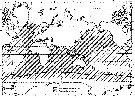 issued from : J.C. von Vaupel Klein in Zool. Verh. Leiden, 1998, 323. [p.392, Fig.5]. issued from : J.C. von Vaupel Klein in Zool. Verh. Leiden, 1998, 323. [p.392, Fig.5].
Map showing the distributional areas of E. rostrata (Claus, 1866), E. rostromagna Wolfenden, 1911, and E. latirostris Farran, 1929 , respectively; note the considerable overlap in range of E. rostrata and the other two species which, in their turn, are virtually coinciding in a strictly geographic sense. Antarctic convergence i(AC). |
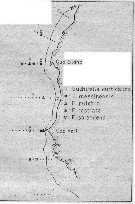 issued from : U. Brenning in Wiss. Z. Wilhelm-Pieck-Univ. Rostock - 32. Jahrgang 1983. Mat.-nat. wiss. Reihe, 5. [p.1, Fig.1]. issued from : U. Brenning in Wiss. Z. Wilhelm-Pieck-Univ. Rostock - 32. Jahrgang 1983. Mat.-nat. wiss. Reihe, 5. [p.1, Fig.1].
Spatial distribution for Euchirella curticauda, E. messinensis, E. pulchra, E. rostrata, E. splendens from 8° S - 26° N; 16°- 20° W. |
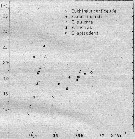 issued from : U. Brenning in Wiss. Z. Wilhelm-Pieck-Univ. Rostock - 32. Jahrgang 1983. Mat.-nat. wiss. Reihe, 5. [p.3, Fig.3]. issued from : U. Brenning in Wiss. Z. Wilhelm-Pieck-Univ. Rostock - 32. Jahrgang 1983. Mat.-nat. wiss. Reihe, 5. [p.3, Fig.3].
T-S Diagram for Euchirella curticauda, E. messinensis, E. pulchra, E. rostrata, E. splendens from 8° S - 26° N; 16°- 20° W. |
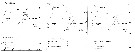 Issued from : J.M. Bradford & J.B. Jillett in New Zealand Ocean. Inst. Memoir, 86, 1980. [p.88-89, Figs.65-67]. Issued from : J.M. Bradford & J.B. Jillett in New Zealand Ocean. Inst. Memoir, 86, 1980. [p.88-89, Figs.65-67].
Distribution of several species of Euchirella in the Tasman Sea and around New Zealand.
Nota: Euchirella indica (= Euchirella massinensis indica). |
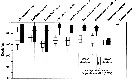 Issued from : M. Sano, K. Maki, Y. Nishibe, T. Nagata & S. Nishida in Progr. Oceanogr., 2013, 110. [p.20, Fig.10]. Issued from : M. Sano, K. Maki, Y. Nishibe, T. Nagata & S. Nishida in Progr. Oceanogr., 2013, 110. [p.20, Fig.10].
Vertical distribution of eight copepod species across 0-1000 m in Sagami bay in 21-27 April 2009.
White and black boxes denote daytime and nighttime distributions. Scaphocalanus echinatus is taken from Kuriyama & Nishida (2006).
Plankton and water samples collected from a fixed station (35°00'N, 139°20'E) using MTD horizontal closing nets (0.33 mm mesh aperture) at 15 depths (0, 50, 95, 100, 150, 195, 200, 295, 300, 395, 400, 500, 600, 800, 1000 m) during both day and night.
Atomic C:N ratio (mean ±SD) = 5.8 ±0.6, n = 9. |
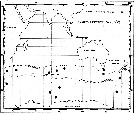 Issued from : C. Séret in Thesis 3ème Cycle, UPMC, Paris 6. 1979, Annexe. [p.32]. Issued from : C. Séret in Thesis 3ème Cycle, UPMC, Paris 6. 1979, Annexe. [p.32].
Geographical occurrences of Euchirella rostrata in the Indian Ocean and Antarctic zone. [after publications from: Brady, 1883, 1918; Thompson, 1900; Wolfenden, 1908, 1911; With , 1915; Rosendorn, 1917; Farran, 1929; Sewell, 1929, 1947; Brady & Gunther, 1935; Steuer, 1929, 1392, 1933; Ommaney, 1936; Vervoort, 1957; Tanaka, 1960; Brodsky, 1964; Seno, 1966; Andrews, 1966; Grice & Hulsemann, 1967; Seno, 1966; Frost & Fleminger, 1968; Voronina, 1970; Zverva, 1972].
C. Séret notes the occurrence at station 46°S, 64°E. |
 Issued from S. Razouls in XXIII rd Congress of Athens, 3-11 November 1972. [p.2]. Oxygen consumed by individual (adult) in the Banyuls Bay and equivalent carbon asked. Issued from S. Razouls in XXIII rd Congress of Athens, 3-11 November 1972. [p.2]. Oxygen consumed by individual (adult) in the Banyuls Bay and equivalent carbon asked.
(1) Hydrological season in the stability period: Eté = Summer: 18-20 °C; Hiver = Winter: 13-10°C.
Espèces = species; Saison = Season; Lg céph.= cephalothoracic length; an = individual. |
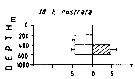 Issued from : M. Madhupratap & P. Haridas in J. Plankton Res., 12 (2). [p.312, Fig.5]. Issued from : M. Madhupratap & P. Haridas in J. Plankton Res., 12 (2). [p.312, Fig.5].
Vertical distribution of calanoid copepod (mean +1 SE), abundance No/100 m3. 38- Euchirella rostrata.
Night: shaded, day: unshaded.
Samples collected from 6 stations located off Cochin (India), SE Arabian Sea, November 1983, with a Multiple Closing Plankton Net (mesh aperture 300 µm), in vertical hauls at 4 depth intervalls (0-200, 200-400, 400-600, 600-1000 m). |
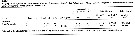 Issued from : M. Bode, R. Koppelmann, L. Teuber, W. Hagen & H. Auel inGlobal Biogeochemical Cycles, 2018, 32. [p.844, Table 1). Issued from : M. Bode, R. Koppelmann, L. Teuber, W. Hagen & H. Auel inGlobal Biogeochemical Cycles, 2018, 32. [p.844, Table 1).
Cf. explanations of these measures in Calanoides natalis from the same authors.
Compare with Euchirella curticauda, E. pulchra, E. splendens. |
 Issued from : M. Bode, A. Schukat, W. Hagen & H. Auel in J. Exp. Mar. Biol. Ecol., 2013, 444. [p.3, Table 1]. Issued from : M. Bode, A. Schukat, W. Hagen & H. Auel in J. Exp. Mar. Biol. Ecol., 2013, 444. [p.3, Table 1].
Dry mass, individual respiration rate and ETS activity from the northern Benguela Current upwelling system along transects at 23°S and 26°40'S, off Walvisbay and Lüderitz (Namibia).
For Conover (1960) the female respiration rate at 7°C was 6.90 µl O2 h ind-1 (DM: 820-947 µg) in the North Atlantic. |
| | | | Loc: | | | Antarct. (Weddell Sea, SW Atlant., Indian, S Pacif.), South Georgia, sub-Antarct. (Indian, SW & SE Pacif.), South Africa (E , W), Namibia, off E Tristan da Cunha, Angola, Congo, off N St. Helena is., G. of Guinea, Abidjan, Dakar, off S Cape Verde Is., off NW Cape Verde Is., off Morocco-Mauritania, Cap Ghir, Canary Is., off Madeira, off S Portugal , off W Cabo Finisterre, Patagonia, Brazil, off Amazon, Caribbean Colombia, E Costa Rica, G. of Mexico, Florida, Sargasso Sea, off Bermuda: Station "S" (32°10'N, 64°30'W), off Cape Hatteras, off New Jersey, off Woods Hole, G. of Maine, Bay of Fundy, off SE Nova Scotia, G. of St. Lawrence, Labrador Sea, Strait of Davis S, Newfoundland, Iceland, Wyville Thomson Ridge, Norwegian Sea, off W Ireland, Porcupine Bank, North Sea, Bay of Biscay, Ibero-moroccan Bay, Medit. (Alboran Sea, Habibas Is., Algiers, Gulf of Annaba, Banyuls, G. of Lion, Marseille, Ligurian Sea, Napoli, Strait of Messina, Malta, Adriatic Sea, Ionian Sea, Aegean Sea, Lebanon Basin, Alexandria), Indian, Bay of Bengal, Philippines, China Seas (South China Sea), Japan (Izu, Sagami Bay), off SE Hokkaido, Station Knot, Kurile-Kamchatka Trench, British Columbia, off Washington coast, Oregon (off Newport), California, Pacif. (tropical, N central subtropical), New Zealand (Kaikoura), S Pacif. (NPFZ), off Galapagos, off Peru, Chile (., off Santiago, Concepcion).
Type locality: Mediterranean Sea (western part) | | | | N: | 184 | | | | Lg.: | | | (1) F: 3,6; M: 3,1; (7) F: 4,07; M: 2,99; (10) F: 3-2,75; (14) F: 2,9-2,5; (35) F: 3,4-3,15; (37) F: 3,95-2,95; M: 3,1-2,5; (45) F: 3,25-2,75; (47) F: 3,1-2,95; (56) F: 3,58; M: 3,01; (59) F: 4-2; M: 3-2,5; (72) F: 4-3,26; M: 3-2,97; (73) F: 3,23; 3,15; (110) F: 3,9-2,85; (116) F: 3,5; (142) F: 3,1-2,97; (143) M: 3; (201) F: 4-3,1; M: 3,1-3; (202) F: 2,96-3,22; M: 2,6-2,12; (207) F: 3,04-2,96; M: 2,7-2,66; (231) M: 3,05-2,8; (235) F: 3,22-2,96; M: 2,6; (237) F: 3,5-3; (244) F: 3; (246) F: 3,29; (313) M: 2,8-3,05; (413) F: 3,95-2; (432) F: 3,42-3,27; (1109) F: 2,89-3,42; (1257) F: 3,05-3,75; {F: 2,00-4,07; M: 2,12-3,10}
The mean female size is 3.208 mm (n = 44; SD = 0.4697), and the mean male size is 2.855 mm. (n = 20; SD = 0.3029). The size ratio is 0.84 (n = 10; SD = 0.0549).
Chiba S. & al., 2015 (p.971, Table 1: Total length female (June-July) = 2.8 mm [optimal SST (°C) = 7.9]
| | | | Rem.: | épi-bathypélagique.
Sampling depth (Antarct., sub-Antarct.) : 0-1000 m.
W. Zhang confirme la présence de cette sepèce dans les mers de Chine (comm. pers., 2006).
Voir aussi les remarques en anglais | | | Dernière mise à jour : 28/10/2022 | |
|
|
 Toute utilisation de ce site pour une publication sera mentionnée avec la référence suivante : Toute utilisation de ce site pour une publication sera mentionnée avec la référence suivante :
Razouls C., Desreumaux N., Kouwenberg J. et de Bovée F., 2005-2026. - Biodiversité des Copépodes planctoniques marins (morphologie, répartition géographique et données biologiques). Sorbonne Université, CNRS. Disponible sur http://copepodes.obs-banyuls.fr [Accédé le 04 mars 2026] © copyright 2005-2026 Sorbonne Université, CNRS
|
|
|
|




;)
;)
;)
;)
;)
;)
;)
;)
;)
;)
;)
;)
;)
;)
;)
;)
;)
;)
;)
;)
;)
;)
;)
;)
;)
;)
;)
;)
;)
;)
;)
;)
;)
;)
;)
;)
;)
;)
;)
;)
;)
;)
;)
;)
;)
;)
;)
;)

;)
;)
;)
;)
;)
;)
;)
;)
;)
;)