|
|
 |
Fiche d'espèce de Copépode |
|
|
Calanoida ( Ordre ) |
|
|
|
Calanoidea ( Superfamille ) |
|
|
|
Megacalanidae ( Famille ) |
|
|
|
Megacalanus ( Genre ) |
|
|
| |
Megacalanus longicornis (Sars, 1905) (F,M) | |
| | | | | | | Syn.: | Macrocalanus longicornis Sars, 1905 b (p.7); Paulsen, 1909; no Megacalanus bradyi Wolfenden,1905 a (p.1, figs.F); ? Pseudolovenula magna Marukawa, 1921 (p.13, figs.F); ? Megacalanus princeps Wolfenden, 1904 (p.112, figs.F); A. Scott, 1909 (p.13, figs.F, Rem.); Wolfenden, 1911 (p.196, figs.F,M); With, 1915 (p.41, figs.F, Rem.); Lysholm & Nordgaard, 1921 (p.8); Farran, 1926 (p.230); Jespersen, 1934 (p.45); Farran, 1939 (p.360); Jespersen, 1940 (p.9); Vervoort, 1946 (p.49, figs. juv., Rem.); Sewell, 1947 (p.25, Rem.: abnormality, fig.F); 1948 (p.555, Rem.); Tanaka, 1956 (p.262, figs.F); Vervoort, 1957 (p.32, Rem.); 1963 b (p.86, Rem.); Paiva, 1963 (p.16, figs.F); Grice, 1963 a (p.495); Mazza, 1966 (p.69); Tanaka & Omori, 1967 (p.241); Owre & Foyo, 1967 (p.34, figs.F,M); Vinogradov, 1968 (1970) (p.268); Guérédrat, 1969 (p.65, Rem.); Lee & al., 1971 (p.1151); Silas, 1972 (p.645); Brodsky & al., 1983 (p.191, figs.F, M, Rem.F); Roe, 1984 (p.356); Guangshan & Honglin, 1984 (p.118, tab.); Fleminger, 1985 (p.276, 284, Table 1, fig.M)); Michel, 1994 (p.177, Rem.); Bradfod-Grieve, 1994 (fig.98); Chihara & Murano, 1997 (p.834, Pl.126: F,M); Bradford-Grieve & al., 1999 (p.877, 905, figs.F,M); Boxshall & Halsey, 2004 (p.141: figs.); Vives & Shmeleva, 2007 (p.912, figs.F,M, Rem.); Ref. compl.: De Decker & Mombeck, 1964 (p.13); Mazza, 1966 (p.69); Grice & Hulsemann, 1967 (p.13); 1968 (tab.2); Gueredrat & Friess, 1971 (p.187, fig.2); Roe, 1972 (p.277, tabl.1, tabl.2); Björnberg, 1973 (p.303, ); Deevey & Brooks, 1977 (p.256, Table 2, Station "S"); Kovalev & Shmeleva, 1982 (p.82); Vives, 1982 (p.290); Guangshan & Honglin, 1984 (p.118, tab.); Petipa & Borichenko, 1985 (tab.2); Heinrich, 1990 (p.16); Suarez-Morales & Gasca, 1998 a (p.110); Barthélémy, 1999 a (p.10); Lapernat, 2000 (tabl.3, 4); Razouls & al., 2000 (p.343, tab. 5, Appendix); Holmes, 2001 (p.35); Hsiao & al., 2004 (p.326, tab.1); G. Harding, 2004 (p.10, figs.F); Ikeda & al., 2006 (p.1791,Table 2); Fernandes, 2008 (p.465, Tabl.2); Gaard & al., 2008 (p.59, Table 1, N Mid-Atlantic Ridge); Drira & al., 2010 (p.145, Tanl.2) | | | | Ref.: | | | Pearson, 1906 (p.6, Rem.); Van Breemen, 1908 a (p.13, fig.F); Farran, 1908 b (p.21); Sars, 1912; 1925 (p.11, figs.F,M); Sewell, 1929 (p.27, Rem.); Rose, 1929; 1933 a (p.64, figs.F,M); Jespersen, 1934 (p.45); Wilson, 1936 c (p.89); Wilson, 1942 a (p.193); Lysholm & al., 1945 (p.7); Vervoort, 1946 (p.49); C.B. 1950 (p.262); Tanaka, 1953 (p.129); Mazza, 1966 (p.69); Dowidar & El-Maghraby, 1970 (p.268); Shih & al., 1971 (p.37); Lee & al., 1971 (p.1151); Morioka, 1972 a (p.314); Vives & al., 1975 (p.35, tab.II); Vaissière & Séguin, 1980 (p.23, tab.2); Kovalev & Shmeleva, 1982 (p.82); Baessia de Aguiar, 1987 (p.40, fig.F, Rem.F,M); Lozano Soldevilla & al., 1988 (p.57); Baessa De Aguiar, 1991 (1993) (p.102); Miller, 2002 (p.129, figs.F,M, Rem.: variability) |  issued from : J.M. Bradford-Grieve in The Marine Fauna of New Zealand: Pelagic Calanoid Copepoda. National Institute of Water and Atmospheric Research (NIWA). New Zealand Oceanographic Institute Memoir, 102, 1994. [p.19, Fig.4]. As Megacalanus princeps. Female: A, habitus (dorsal); B, idem (right lateral side); C, A1; D, A2; E, Md (mandibular palp); F, Md (mandibular blade); G, Mx1; H, Mx2; I, Mxp.
|
 issued from : J.M. Bradford-Grieve in The Marine Fauna of New Zealand: Pelagic Calanoid Copepoda. National Institute of Water and Atmospheric Research (NIWA). New Zealand Oceanographic Institute Memoir, 102, 1994. [p.20, Fig.4 (overleaf)]. As Megacalanus princeps. Female: J, P1; K, P2; L, P3; M, P4; N, P5.
|
 issued from : J.M. Bradford-Grieve in The Marine Fauna of New Zealand: Pelagic Calanoid Copepoda. National Institute of Water and Atmospheric Research (NIWA). New Zealand Oceanographic Institute Memoir, 102, 1994. [p.21, Fig.5]. As Megacalanus princeps. Male: A, habitus (dorsal); B, idem (left lateral side); C, C', right A1; D, left A1; E, A2; F, Md; G, Mx1; H, Mx2; I, Mxp.
|
 issued from : J.M. Bradford-Grieve in The Marine Fauna of New Zealand: Pelagic Calanoid Copepoda. National Institute of Water and Atmospheric Research (NIWA). New Zealand Oceanographic Institute Memoir, 102, 1994. [p.22, Fig.5 (overleaf)]. As Megacalanus princeps. Male: J, P1; K, P2; L, P3; M, P4; N, right P5; O, left P5.
|
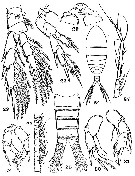
 issued from : O. Tanaka in Publs Seto Mar. Biol. Lab., 1956, V (2). [p.263, Fig.3]. Female: a, habitus (dorsal); b, forehead (lateral); c, last thoracic segment and urosome (lateral right side); d, basipods and endopod of P1. Rostrum consists of two strong spines. Proportional lengths of urosomites and furca 41:20:15:7:17 = 100. A1 (25-segmented) exceeds end of the furca by 9 segments.Mxp is furnished with stiff hairs on the middle part of the basipod 1. Proeminent hook on the basipod 2 of P1 at the junction with the endopod., and on the proximal half on the basipod 2
|
 Issued from: G.O. Sars in Résult. Camp. Scient. Prince Albert I, 69, pls.1-127 (1924). [Pl.I, figs. 1-12]. Female: 1, habitus (dorsal); 2, idem (lateral left side); 3, anterior part of the head (lateral); 4, rostrum; 5, dorsal prominence with sensory hairs; 6, distal partion of A1; 7, A2; 8, labrum (ventral view); 9, labium; 10, Md; 11, Mx1; 12, Mx2.
|
 Issued from: G.O. Sars in Résult. Camp. Scient. Prince Albert I, 69, pls.1-127 (1924). [Pl.II, figs. 1-11]. Female: 1, Mxp; 2, P1; P3; 4, P5. Male: 5, habitus (lateral left side); 6, forehead (lateral); 7, rostrum; 8, spermatophore; 9, segment of A1 showing two aesthetascs; 10, P5; 11, exopod of P5 (enlarged).
|
 issued from : R.B.S. Sewell in The John Murray Expedition, 1933-34, Scientific Reports, VIII (1), 1947. [p.26, Fig.2]. As Megacalanus princeps var. inermis. Female (fromArabian Sea): A, habitus (lateral right side); B, Mx1; C, mx2; D, Mxp; E, P1; F, basal part of P2; G, P5. Nota: Proportional lengths of prosome and abdomen as 75 to 25. The posterior thoracic margin on each side is produced backwards and ends in a blunty rounded prominence, that on the left side being more acutely than on the right. Urosome 4-segmented, having the proportional lengths 41:17:13:12, caudal rami 17. Mxp with a line of simple spines along the base of this patch, and the remainder of the spinules all bifurcate (With, 1915, p.42, has called attention to the hairs (spinules) on the 2nd basal segment as bifurcate or divided into three branches). The P1 differs from that of the typical form by the absence of the characteristic spine on the anterior aspect of the 2nd basal segment. A single specimen among a majotity of normal forms.
|
 issued frm : A. Scott in Siboga-Expedition, 1909, XIX a. [Plate I, Figs.12-18]. As Megacalanus princeps. Female (from Indonesia-Malaysia): 12, habitus (dorsal); 13, last thoracic and genital segments (left side); 14, Mx2; 15, P1; 16, P2; 17, P3; 18, P5.
|
 issued from : R.N. Wolfenden in J. mar.biol. Ass. U.K., 1904, VII (N.S.).[Pl.IX, Figs.1-2]. As Megacalanus princeps. Female 51°-60° N, 6°-12° W): 1, P1 (basipodite 2); 2, P3. Nota: Head and 1st pedigerous segment separate, 4th and 5th separate. A1 25-segmented, much longer than the body. P1 with an extraordinary double-hooked process on the dorsal surface of the basipod 2, an upper and lower hook placed vertically.
|
 issued from : C.B. Miller in Hydrobiologia, 2002, 480. [p.132, Fig.2]. Female: A, habitus (lateral) and dorsal view of cephalic crest of specimen collected offshore from California (34°50'N, 123°E; B, same for an uncrested specimen collected near Hawaiian Islands. Scale bar: 4,0 mm. Nota: A1 symmetrical, 25-segmented, estend past the caudal furcae by 5-6 segments. Detailed examination of A2 and Md showed no distinctions between specimens with and without crests. Mx1 of author's specimens have setal counts agreeing with Sars (1924), not with those of Sewell's (1947); however, the two maculae cribrosae shown by Sewell are present. Since Sewell was describing a variant form ( inermis) without hooks on the basis of P1, possibly his slightly variant counts are part of a character complex. P1 are armed with a stout, antero-dorsally directed spine at the anterior, medial, distal corner of the basis; they appear to be suitable to assist wit holding prey against the mouthparts; a central lumen passes through each spine, emerging at the side just short of the tip. For the author this canal does not deliver toxin into impaled prey. A simple, singly curved seta with 2 rows of short setules arises from the base of the spine and extends along the anterior, medial edge of the endopod. It does not resemble the doubly curved seta with bottle-brush setules common at this position in a number of Calanoid families. In many calanoids (for example , this seta lies adjacent to a row of long, flexible denticles along the distal, anterior edge of dendopdal segment 1. Ferrari & Steinberg (1993) have described this structure in Scolecitrichidae, terming it Von Vaupel Klein's organ (because Vaupel Klein, 1972) discussed its value as a character in Euchirella. Neither denticles nor pores were observed at the distal end of endopodal segment 1 in M. longicornis. The articulation between the cephalosome and 1st pedigerous segment is deep and flexible. In fact, these copepods are so large that it is possible to place a blunt needle into the arthropodial fold of this joint and show that it runs right around the body from the ventral edge of the pleuron to the prominence at the dorsal midline.
|
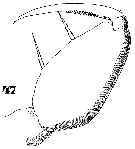
 issued from : C.B. Miller in Hydrobiologia, 2002, 480. [p.135, Fig.4]. Female: left picture, anterior surface of basis, exopodite 1 and endopodite 1 of P1, illustrating the position and form of the basis spine and seta, a macula cribrosa is located on the basis beside the articulation of exopodite 1 (little circle). Right picture, lateral view of P1 basis hook. Scale bars: left picture = 0.1 mm; right picture = 0.2 mm. Nota: The small, presumably sensory, organs termed laminae cribrosae, or maculae cribrosae, by With (1915) were found on the anterior surface of P1 at the positions (one each on basipodite 1, endopodite 2, exopodites 1 and 2) by Sewell (1947); the term translates as 'sieve plates' or 'sieve spots', but the actual structure is an oval neural nexus (clearly the swollen end of a nerve, visible proximally) in the epidermis, attached by thin tubules (axons, dendrites ?) to a ring of spherules embedded at the surface of the chitin (fig.5, b,-c); the patterns are not consistently different between crested and uncrested forms (maculae cribrosae are also reported for Bathycalanus by Sewell, 1947).
|
 issued from : C.B. Miller in Hydrobiologia, 2002, 480. [p.136, Fig.5]. Female: A, neural nexis that is the interior section of a macula cribrosa on the proximal surface of the mandibular gnathobase: B, surface spherules of the same macula cribrosa. Male: C, macula cribrosa with fewer spherules, one of them located centrally, on exopodite 3 of P5
|
 issued from : C.B. Miller in Hydrobiologia, 2002, 480. [p.139, Fig.8]. Male P5 (posterior: left legs are on the left sides). A, crested forms from California; B, uncrested forms from North Atlantic. Note : Maculae cribrosae indicated by little circles of dots (only on the posterior surface surface, not the anterior). Scale bar : 0.4 mm. Nota: The male P5 is somewhat assymetrical, the right exopodal segment 3 being longer and somewhat different in shape from the left. Exopodal segment 2 left bears a medial, domed projection emerging from an attachment collar and terminating in a hair-covered filament. This is possibly a modified seta; it is located a little proximal to the position of the medial seta on exopodal segment 3 in the female. The collar could derive from the setular arthropodial membrane
|
 issued from : C.B. Miller in Hydrobiologia, 2002, 480. [p.137, Fig.6]. Male: Left picture, left A1 (dorsal aspect; left divided, repeating segment 15); Right picture, right A1 (arrow indicates seta flattened against segment 17. Segments 12 and 13 from each picture are also shown in ventral aspect where they bear patches of acuminate denticles (20 to 30 per segment). Scale bar: 1.0 mm. Nota: The A1 are slightly asymmetrical, the right 24-segmented, the left 25-segmented. On both sides, segments 7-9 are fused, but with remnants of articulation, and there is similar stiffening between 12 and 13. Segment 9 on both sides bears a clavate seta, the bulb (unusually elongate) of which shows an internal structure of droplets. In most male specimens the right A1 is prserved with segments 15-21 in a tight semicircle with one or more segments in that sequence bending sharply, reminiscent of the geniculate male antennules of the 'heterarthrandria' and of Bathycalanus. However, the position of this bend was no consistent. It was between segments 17 and 18 in most specimens, but between 20 and 21 in one specimen. None of these bends has a obvious special segment, special musculature, the teeth typical of male geniculate antennae or the blade-like setae seen in Bathycalanus, although as noted , the setae of segments 17 and 18 are modified. Dorsal antennular surfaces show two maculosae cribrosae on segment 2; the ventral surfaces have maculae cribrosae very close to or on the bases of all or most aesthetascs on segments 1 through 12
|
 issued from : C.B. Miller in Hydrobiologia, 2002, 480. [p.138, Fig.7]. Male: Segments 7, 8 and 9 of right A1 (segment 9 bearing a clavate seta: indicated by an arrow). Scale bar: 0.4 mm. Nota: The clavate setae are absent in females, they are likely to have a part in the male sexual function.
|
 issued from : C.B. Miller in Hydrobiologia, 2002, 480. [p.141, Fig.10]. Female: Left picture, large gland with external opening just below the lateral spine og exopodal segment 3 of P2; right picture, similar gland on exopodal segment 1 of P2. Scale bars: 0.2 mm. Nota: With (1915) noted the very large glands in the exopodite segments of the swimming legs, glands which open at external pores. The product of the gland is secreted externally. In collected specimens the vase-shaped reservoirs of these glands are filled with very large secretion granules (similar glands are found on the thoracic legs of may calanoids). No function has been identified for this secretion. The function of swimming legs of all free-living copepod is propulsion during predator escape dashes (kerfoot & al., 1980; Verity & Smetacek, 1996). It seems likely that these glands have some role in that general function. A large copepod dashing away from a fish (at speeds of order 1 m/sec) might leave behind some distracting odor, or like the ink decoy left by a squid. The gland pores are at the ideal spot for dropping such a misleading signal, being posterior and posteriorly directed at the end of the power stroke. The secretion could also be toxic. It is also possible the secretion has a hydrodynamic function. In some way the lateral spines adjacent to and down-stream from these glands are part of the adaptation for escape propulsion; they may modify the shedding of wake vortices, which are probably important to approaching predators as a cue to prey location (Yen & Strickler, 1996). Perhaps the secretion acts to increase viscosity in the eddies, reducing their longevity. Perhaps it is a surfactant reducing surface tension between water and the spines, thus modifying the eddies.
|
 issued from : J. Mauchline in J. mar. biol. Ass, U.K., 1977, 57 (4). [p.979, Fig.3]. As Megacalanus princeps. Female: A, General distribution of normal pores (dots) and groups of pores (small dots) in treated integuments; B, a group of glands openings, responsible for a group of pores in a treated integument, with the associated gland; C, the peculiar structure of the group of gland openings at the site indicated in the 5th thoracic segment; the heavy line is the posterior border of the segment.
|
 issued from : J. Mauchline in J. mar. biol. Ass, U.K., 1977, 57 (4). [p.980, Fig.4, H]. As Megacalanus princeps. Integumental organs. H, compound seta.
|
 issued from : K.A. Brodsky, N. V. Vyshkvartzeva, M.S. Kos & E.L. Markhaseva in Opred. Faune SSSR, 1983, 135 (1). [p.192, Fig.84]. As Megacalanus princeps. Female & Male. Ce = cephalon; bP1 = basis of P1; l = left leg; r = right leg. Ce, Mx1 and Mx2 after Sars, 1924); remaining figures: Pacific specimens.
|
 issued from : R.-M. Barthélémy in These Doct. Univ. Provence (Aix-Marseille I), 1999. [Fig.20, B]. Female (from 41°47'S, 175°01'E): B, external ventral view genital double-somite. go = genital operculum. Scale bar: 0.200 mm.
|
 issued from : A. Fleminger in Mar. Biol., 1985, 88. [p.284, Fig.6, E ]. As Megacalanus princepsMale: Left A1 proximal segments (ventral view); Nota: see remarks in Calanus s.l. pacificus californicus (Fleminger, 1985, p.275) concerning the dimorphism in the female A1.
|
 issued from : G. A. Boxshall & S. H. Halsey in An Introduction to Copepod Diversity. The Ray Society, 2004, N° 166. [p.141, Fig.29, E]. Female: E, P1. Nota: Large hook-like process present on anterior surface of basis of P1.
|
 issued from : G; Harding in Key to the adullt pelagic calanoid copepods found over the continental shelf of the Canadian Atlantic coast. Bedford Inst. Oceanogr., Dartmouth, Nova Scotia, 2004. [p.10]. As Megacalanus princeps. Female (lateral view)
|
 issued from : G. Harding in Key to the adullt pelagic calanoid copepods found over the continental shelf of the Canadian Atlantic coast. Bedford Inst. Oceanogr., Dartmouth, Nova Scotia, 2004. [p.10]. As . Female: A, P1 (non P5 as indicated by error); B, Mx2.
|
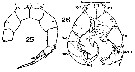
 issued from : H.B. Owre & M. Foyo in Fauna Caribaea, 1967, 1, Part 1: Copepoda. [p.33, Figs.162-164]. As Megacalanus princeps. Female (from Florida Current): 162, P1; 163, spine on basis of P1; 164, P5.
| | | | | Ref. compl.: | | | Macdonald & al., 1972 (p.213, fig.4, hydrostatic pressure effect); Galbraith, 2009 (pers. comm.); Mazzocchi & Di Capua, 2010 (p.426) | | | | NZ: | 21 | | | | | | | | | | | | | | | issued from : W. Vervoort in B.A.N.Z. Antarctic Reseach Expedition, Reports - Ser. B, Vol. III, 1957 [Fig.7]. As Megacalanus princeps. Chart showing the geographical distribution (white circle) in the seas surrounding the Antarctic continent. Nota: In this chart the area frequented by whaling vessels has been hatched. The Antarctic circle (66°.5 S) has been drawn as a broken line. The numbers I to VI refer to the sectors into which the Antarctic seas are divided according to Mackintosh (1942) (after Vervoort, 1951). |
issued from : C.B. Miller in Hydrobiologia, 2002, 480. [p.131, Fig.1]. Collection sites for specimens examined in the study. Sites producing crested specimens shown as circles aroud crosses, sites specimens with rounded heads shown as open circles. Nota: Pending development of molecular genetic analyses of observed morphotypes, the author has declined to apply a new name to the crested form. |
| | | | Loc: | | | Antarct. (Indien, Pacif. SE), sub-Antarct. (Pacif. SW, SE), Afr. S (E), off Ste Hélène S, off I. St. Paul E, off Is. Sao Tomé E, Is. du Cap Vert, off Mauritanie-Is. du Cap Vert NW, Maroc-Mauritanie, Canaries, off Madère, Azores, G. de Gascogne, Mer des Antilles, G. du Mexique, Floride, Mer des Sargasses, Station "S" (32°10'N, 64°30'W), , off Cap Finisterre W, Woods Hole, off Terre-Neuve E, Groenland, Islande W, Irlande S & W, Féroé, Baie Ibéro-marocaine, Médit. (Ligurian Sea, Tyrrhénienne, G. of Gabès, Ionienne, Alexandrie), Mer Arabe, indien (équatorial), Indien SW, Bay of Bengal, Indonésie-Malaisie, Philippines, Pacif. W (équatorial), mers de Chine (East China Sea, South China Sea), Taiwan E, Japon, off Hokkaido SE, G. d'Alaska, Colombie Britannique, off Californie, Nouvelle-Zélande, Pacif. (tropical), Hawaii, off Is. de Pâques E, off Pérou, Pacif. SE (tropic.), off Is. Juan Fernandez, Chili N & S (Drake passage) | | | | N: | 67 | | | | Lg.: | | | (1) F: 10- 9,5; (5) F: 9,5; (7) F: 10,5; M: 10,6; (10) F: 10; (14) F: 11,5-8,7; M: 12-9; (28) F: 11,5-8,75; M: 10,15-7,9; (29) M: 9,5; (38) F: 9,2-9; (49) F: 10,3-9,8; (70) F: 11,9-10,2; M: 10,8-10; (73) F: 10,68-10; (125) F: 10,34; (131) F: 11,9-8,7; M: 10,8-7,9; (140) F: 11-9,2; M: 9,5-9,3; (199) F: 9,92-9,44; (787) F: 13-10; M: 10; (865) F: 10,6; (904) M: 10,9-11,2; (1089) F: 12-13,5; M: 9,3-9,5; {F: 8,70-13,50; M: 7,90-12,00} | | | | Rem.: | méso-bathypélagique. Sampling depth (Antarct., sub-Antarct.) : 2000 m. Des différences existent entre les formes du Pacifique SW (Bradford-Grieve, 1994, p.18) et les figures de Sars (1924) et Wolfenden (1905 a). Voir aussi les remarques en anglais | | | Dernière mise à jour : 17/04/2013 | |
|
|
Toute utilisation de ce site pour une publication sera mentionnée avec la référence suivante : Razouls C., de Bovée F., Kouwenberg J. et Desreumaux N., 2005-2012. - Diversité et répartition géographique chez les Copépodes planctoniques marins. Disponible sur http://copepodes.obs-banyuls.fr [Accédé le 20 mai 2013] © copyright 2005-2012 CNRS, UPMC
|
|
 |
 |