issued from : H.S.J. Roe
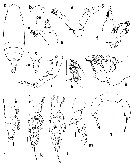
in Bull. British Mus. (Natural History) Zool., London, 1975, 28 (7). [p.324, Fig.14]. As
Scolecithricella canariensis.
Female (from NE Atlantic): a, habitus (dorsal); b, forehead and rostrum (right lateral side); c, last thoracic segment and urosome (right lateral side); d, A2; e, mandibular palp; f, Mx1; g, Mx2 (exopod); h, Mx2 (endopod); i, Mxp; j, P1; k, P2; l, P3; m, P4; n, P5.
Bar scale 0.1 mm unless indicated.
Nota: Cephalothorax 5.1 times as long as the 4-segmented abdomen.
Head and 1st thoracic segment fused, 4th and 5th fused.
Forehead somewhat angular in dorsal view.
Rostrum with 2 fairly long filaments.
A123-segmented, the terminal segment extends past the caudal rami.
Endopod of Mx2 has 3 ribbon-like setae and 4 brush-like setae.
Basal segment of Mxp with 2 worm-like and 1 brush-like seta.
The hind margin of the cephalothorax is indented laterally.
Genital segment a litthe longer than the subsequent segment.
Caudal rami slightly longer than wide.





;)
 Any use of this site for a publication will be mentioned with the following reference :