|
|
 |
|
Calanoida ( Order ) |
|
|
|
Spinocalanoidea ( Superfamily ) |
|
|
|
Spinocalanidae ( Family ) |
|
|
|
Spinocalanus ( Genus ) |
|
|
| |
Spinocalanus hoplites Park, 1970 (F) | |
| | | | | | | Ref.: | | | Park, 1970 (p.475, 489, Descr.F, figs.F); Damkaer, 1975 (p.59, Rem.F); Bode & al., 2017 (p.600, Table I, fig. 2, 3, 4, morphology vs genetic). | 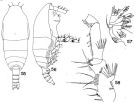 Issued from : T. S. Park in Bull. Mar. Sc., 1970, 20 (2). [p.490, Figs.55-58]; Female (from Caribbean Sea): 55, habitus (dorsal); 56, idem (lateral right side); 57, Mx2; 58, basipod of Mxp. Nota: Prosome slightly more than 3 times length of urosome. Ventrolateral edges of cephalosome inconspicuous. lateral side of metasome with spinules. Coxa of Mxp with a very large tubercle bearing a comb of strong spines; basis with a comb of strong spines which are slightly shorter than those of the coxa.
|
 Issued from : M. Bode, S. Laakmann, P. Kaiser, W. Hagen, H. Auel & A. Cornils in J. Plankton Res., 2017, 39 (4). [p.604, Table I]. Species identified via morphological and molecular analyses, including the number of specimens used for each identification method (MI: morphological identification, COI: cytochrome c oxydase subunit I gene fragment, MS: MALDI-TOF analysis, 18 S: ribosomal 18 S gene fragment). Cryptic lineages were revealed only after molecular analysis. Sampling depth, latitude, total length (TL) and Prosome/Urosome ratio (Pr:Ur) of taxon were recorded. morphological characters are only listed here, if the identification was ambiguous due to missing body parts or if cryptic or pseudocryptic lineages were revealed during molecular analyses. For diagnostic character of species refer to the references: Park, 1970; Grice, 1971; Damkaer, 1975; Schulz, 1989, 1996. C = coxa; B = basis; P = swimming legs.
|
 Issued from : M. Bode, S. Laakmann, P. Kaiser, W. Hagen, H. Auel & A. Cornils in J. Plankton Res., 2017, 39 (4). [p.604, Table I]. As S. neospinosus/hoplites female from Atlantic ocean). Specific molecular identification. Nota: This form bears morphological characteristics of both species
| | | | | NZ: | 2 | | |
|
Distribution map of Spinocalanus hoplites by geographical zones
|
| | | | Loc: | | | Caribbean Sea, SW Africa (25°S). | | | | N: | 2 | | | | Lg.: | | | (13) F: 1,78-1,52; (88) F: 1,78-1,68; (1252) F: 1,53-1,98; {F: 1,52-1,98}.
(1252) F: Pr/Ur = 3,1-4,5. | | | | Rem.: | bathypelagic (980-2800 m). 2000-5000 m (in Bode & al., 2017) | | | Last update : 27/03/2020 | |
|
|
 Any use of this site for a publication will be mentioned with the following reference : Any use of this site for a publication will be mentioned with the following reference :
Razouls C., Desreumaux N., Kouwenberg J. and de Bovée F., 2005-2025. - Biodiversity of Marine Planktonic Copepods (morphology, geographical distribution and biological data). Sorbonne University, CNRS. Available at http://copepodes.obs-banyuls.fr/en [Accessed November 30, 2025] © copyright 2005-2025 Sorbonne University, CNRS
|
|
|
|




;)
;)
;)