|
|
 |
|
Monstrilloida ( Order ) |
|
|
|
Monstrillidae ( Family ) |
|
|
|
Monstrilla ( Genus ) |
|
|
| |
Monstrilla longa (Isaac, 1974) (F) | |
| | | | | | | Syn.: | Strilloma longa : Isaac, 1974 a (p.134, Descr.F, figs.F); Grygier, 1995 a (p.69) | | | | Ref.: | | | Suarez-Morales & Gasca, 2004 (p. 293, figs.F, p.298: Rem. tab.1) | 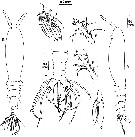 issued from : M.J. Isaac in Mitt. Zool. Mus., Berlin, 1974, 50 (1). [p.134, Fig.3]. As Strilloma longa. Female (from Island of Dry Tortugas, Florida): A-B, habitus (lateral and dorsal, respectively); C, abdomen (dorsal); D, P4 (omitting the base of the basipodite); E, right A1 (ventral); F, left A1 (lateral); G, P5. A-B: same scale; E-F, G same scale as D.
|
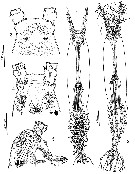 Issued from : E. Suarez-Morales & R. Gasca in Zool. Studies, 2004, 43 (2). [p.294, Figs.1-5] Female (holotype): 1-2, habitus (ventral and dorsal; 3, head (dorsal); 4, head (ventral), showing 3rd pair of nipple-like protuberances (arro); 5, head (lateral; A1 cut short). Nota: - Cephalothorax accounting for 66% of total body length (measured from anterior end of cephalic somite to posterior margin of anal somite). - Oral papilla protuberant, located close to anteriormost part of body, midventrally 0.13 of way back along cephalothorax. - Nauplius eye present, weakly developed, ocelli rematively small, widely separated, slightly pigmented, with oblong shape, eyes separated by almost 5 eye diameters. - A1 relatively long, 4-segmented (intersegmental divisions well defined), slender, slightly longer than 20% of total body length, and about 1/3 of length of cephalothorax.
|
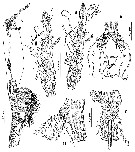 Issued from : E. Suarez-Morales & R. Gasca in Zool. Studies, 2004, 43 (2). [p.295, Figs.6-11] Female (holotype): 6, habitus (lateral; antennular setae omitted); 7, left A1 (dorsal); 8, left A1 (ventral); 9, 1st free abdominal, anal somite, and caudal rami with setae (lateral pair of caudal setae cut short); 10, 5th pedigerous somite, genital double-somite, 1st free abdominal somite, and anal somite plus P5 (setae of right leg cut short), and bases of ovigerous spines (ventral); 11, same (lateral). Nota: P5 moderately long, 1-segmented, fused medially, each represented by a cylindrical rod armed with 4 long, lightly plumose setae, all subequal in length and breadth, innermost slightly longer. Setae reaching distal margin of anal somite; left ramus of P5 partially broken and folded upwards in this specimen.
|
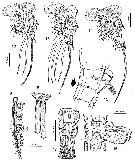 Issued from : E. Suarez-Morales & R. Gasca in Zool. Studies, 2004, 43 (2). [p.296, Figs.12-19] Female (holotype): 12, P1 (anterior), protopods greatly foreshortened due to viewing angle; 13, P2 (anterior), same protopods view; 14, P4 (anterior), same protopods view; 15, genital double-somite with base of ovigerous spine, showing incomplete suture (arrow); 16, 4th pedigerous somite with protopods of legs, showing broken ventrakl surface forming protuberance artifact; 17, urosome (dorsal); 18, base of ocigerous spines; 19, distal part of ovigerous spines with attached eggs.
|
 Issued from : E. Suarez-Morales & R. Gasca in Zool. Studies, 2004, 43 (2). [p.297] Female (holotype): Armature of swimming legs P1 to P4. Nota: Outer spine on 3rd exopodal segment of P1-P4 between 52.6% and 90.9% as long as bearing segment.
|
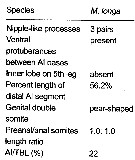 Issued from : E. Suarez-Morales & R. Gasca in Zool. Studies, 2004, 43 (2). [p.298, Table 1] Female (holotype): Characteristic of morphological features in M. longa. Distal antennular segment comprising over 50% of A1 length and 4 setae on P5. A1: antennule; TBL: total body length. Compare with M. careli and M. careloides.
| | | | | NZ: | 1 | | |
|
Distribution map of Monstrilla longa by geographical zones
|
| | | | Loc: | | | Florida (Dry Tortugas Is.)
Type locality: 24°48' N, 81°34' W. | | | | N: | 2 | | | | Lg.: | | | (739) F: 3,19; (1176) F: 3,7*; {F: 3,19-3,7}
*: body length without caudal rami. | | | | Rem.: | Suarez-Morales & Gasca (2004) give for the holotype a total length (excluded caudal rami) of 3.7 mm. | | | Last update : 02/06/2015 | |
|
|
 Any use of this site for a publication will be mentioned with the following reference : Any use of this site for a publication will be mentioned with the following reference :
Razouls C., Desreumaux N., Kouwenberg J. and de Bovée F., 2005-2025. - Biodiversity of Marine Planktonic Copepods (morphology, geographical distribution and biological data). Sorbonne University, CNRS. Available at http://copepodes.obs-banyuls.fr/en [Accessed June 04, 2025] © copyright 2005-2025 Sorbonne University, CNRS
|
|
|
|




;)
;)
;)
;)
;)
;)