|
|
 |
|
Calanoida ( Order ) |
|
|
|
Diaptomoidea ( Superfamily ) |
|
|
|
Pseudodiaptomidae ( Family ) |
|
|
|
Pseudodiaptomus ( Genus ) |
|
|
| |
Pseudodiaptomus aurivilli Cleve, 1901 (F,M) | |
| | | | | | | Syn.: | non Pseudodiaptomus aurivilli : Sewell, 1932 (240, fig.M); ? 1933 (p.27); Kasturirangan, 1963 (p.36); Ummerkutty, 1964 (p.48); Bayly, 1966 (p.54, figs.); Wellershaus, 1969 (p.254, 257, figs.F,M); Pillai, 1976 (1980) (p.247, figs.F, M) | | | | Ref.: | | | Cleve, 1901 (p.48, figs.); Thompson & Scott, 1903 (p.234, 248, figs.F,M); A. Scott, 1909 (p.116, Rem.); Sewell, 1912 (p.363); 1914 a (p.224); Früchtl, 1924 b (p.50, 51, Rem.); Marsh, 1933 (p.30, Figs.F,M); Greenwood, 1977 (Rem., p.64); Goswami & Goswami, 1978 (p.111, figs.); Dussart & Defaye, 1983 (p.33); Li & Huang, 1984 (p.388, Rem.); Walter, 1984 (p.372, M, Descr.F, figs.F, Rem;); 1986 (p.132); 1986 a (p.503); 1987 (p.367, 368); Mulyadi, 2004 (p.154, figs.F,M, Rem.); Ferrari & Dahms, 2007 (p.22, Rem. N); Phukham, 2008 (p.103, figs.F,M) | 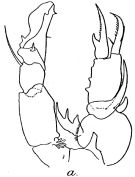 Issued from : R.B.S. Sewell in Mem. Indian Mus., 1932, X (continued). [p.241, Fig.85, a]. Male (from NE Indian): a, P5.
|
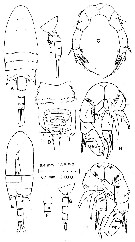 issued from : T.C. Walter in Proc. Biol . Soc. Wash., 1984, 97 (2). [p.376, Fig.2]. Female (from Philippines): A, habitus (dorsal); B, last thoracic segment and urosome (lateral left side); C, P5 (posterior view); D, genital segment (ventral). Male: E, habitus (dorsal); E, urosomal segments 1, and 2 showing spinules (ventral); G, last thoracic segment and urosome (lateral left side); H, P5 (posterior view); I, idem (anterior view). Sp = spermatophore; Hyp = hyaline membrane
|
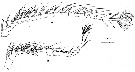 issued from : T.C. Walter in Proc. Biol . Soc. Wash., 1984, 97 (2). [p.371, Fig.1]. Female (from Philippines): A, right A1 (medial view). Male: B, right A1 (medial view).
|
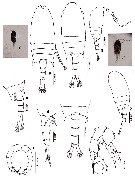 issued from : N. Phukham in Species diversity of calanoid copepods in Thai waters, Andaman Sea (Master of Science, Univ. Bangkok). 2008. [p.187, Fig.61]. Female (from W Malay Peninsula): a-b, habitus (dorsal and lateral, respectively); c-d, urosome (lateral left and right sides, respectively); e, P5. Male: f-g, habitus (dorsal and lateral, respectively); h, urosome (dorsal); i, P5. Body length after the drawings: F = 1.160 mm; M = 0.988 mm.
|
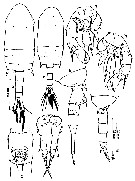 issued from : Mulyadi in Published by Res. Center Biol., Indonesia Inst. Sci. Bogor, 2004. [p.155, Fig.87]. Female (from 06°10'S, 106°00'E): a, habitus (dorsal); b, posterior thoracic segment and urosome (lateral right side); c, genital complex (ventral); d, P5. Male: e, habitus (dorsal); f, posterior thoracic segment and urosome (lateral left side); g, P5 (posterior view); h, same (anterior view).
|
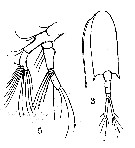 Issued from : C.D. Marsh in Proc. U.S. natn. Mus., 1933, 82 (18) (2959). [Pl. 15, figs.3, 5]. After Cleve, 1901. Female: 3, habitus (dorsal); 5, A2.
|
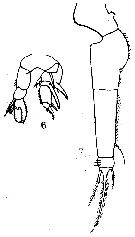 Issued from : C.D. Marsh in Proc. U.S. natn. Mus., 1933, 82 (18) (2959). [Pl. 15, figs.6-7]. After Thompson & Scott, 1903. Male: 6, P5. Nota: The right P5 has a short endopod armed with 3 spines. From the 1st basipodal segment, the 2nd, and the 1st exopodal segment there are elongated linguiform projections; the one from the 1st exopodal segment exceeds in length the 2nd. The terminal hook is rather short and falciform. The left P5 has no endopod; the 1st exopodal segment has a long, slender spine at its outer distal angle; the 2nd segment is oval in outline and has a lateral spine at about 1/3 of its length. Female: 7, P5. Nota: Rostrum bifid, with long filaments. Last thracic segment terminates in lateral spines. Urosome 4-segmented; there are spines on the distal margins of the first three segments. Caudal rami 7 or 8 times as long as broad. A1 20-segmented, extending to the 2nd urosomal segment. Exopod of A2 7-segmented. In the P5, 1st exopodal segment elongated; 2nd segment (according to Cleve) terminates in 3 plumose setae, the central being about twice as long as the inner
|
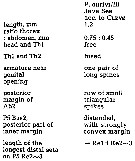 Issued from : S. Wellershaus in Veröff. Inst. Meeresforsch. Bremerh., 1969, 11 (2). [p.257, Table 2]. List of characters for Pseudodiaptomus aurivilli female according to Ckeve, 1901, after Wellershaus.
| | | | | Compl. Ref.: | | | Krishnaswamy, 1953 (p.122); ? Ganapati & Shanthakumari, 1962 (p.8, 16); Subbaraju & Krishnamurphy, 1972 (p.25, 26, Table 1: abundance vs India localities ); Patel, 1975 (p.659); Madhupratap & Haridas, 1986 (p.105, tab.2); Sarkar & al., 1986 (p.178); Mauchline, 1998 (tab.8); Dalal & Goswami, 2001 (p.22, fig.2); Greenwood & al., 2002 (p.17, Table 2); Rezai & al., 2004 (p.490, tab.2); Rezai & al., 2005 (p.157, Table 5: spatial & temporal variations); Madhu & al., 2007 (p.54, Table 4, abundance vs monsoon); Cornils & al., 2010 (p.2076, Table 3); Maiphae & Sa-ardrit, 2011 (p.641, Table 2, 3, Rem.); Rakhesh & al., 2013 (p.7, Table 1, abundance vs stations); Jagadeesan & al., 2013 (p.27, Table 3, 4, 5, 6, fig.11, seasonal variation); Anjusha & al., 2013 (p.40, Table 3, abundance & feeding behavior) | | | | NZ: | 3 | | |
|
Distribution map of Pseudodiaptomus aurivilli by geographical zones
|
| | | | | | | Loc: | | | Sri Lanka, India (Saurashtra coast, Kerala, ? Lawson's Bay, Madras, Porto Novo: East coast, Mandapam, Visakhapatnam, Gulf of Mannar, Palk Bay, Hooghly estuary, Godavari estuary), Andaman Is., Nicobar Is., W Malay Peninsula, Straits of Malacca, G. of Thailand, Indonesia-Malaysia, off Labuan (W Java), Thailand, SW Celebes, Philippines, E Australia (Brisbane River estuary, Moreton Bay, Townsville) | | | | N: | 28 | | | | Lg.: | | | (77) F: 1,2; M: 0,93; (82) M: 1,1; (795) F: 1,2; M: 1; (802) F: 1,2-1,3; M: 0,94-1; (1122) F: 1,25; M: 0,95; {F: 1,20-1,30: M: 0,94-1,10} | | | | Rem.: | littoral, estuary, brackish.
Incomplete data.
In Hyalinus species group (aurivilli subgroup) after Walter & al. 2006, p.203. | | | Last update : 07/02/2020 | |
|
|
 Any use of this site for a publication will be mentioned with the following reference : Any use of this site for a publication will be mentioned with the following reference :
Razouls C., Desreumaux N., Kouwenberg J. and de Bovée F., 2005-2026. - Biodiversity of Marine Planktonic Copepods (morphology, geographical distribution and biological data). Sorbonne University, CNRS. Available at http://copepodes.obs-banyuls.fr/en [Accessed June 15, 2026] © copyright 2005-2026 Sorbonne University, CNRS
|
|
|
|




;)
;)
;)
;)
;)
;)
;)
;)