|
|
 |
|
Calanoida ( Order ) |
|
|
|
Diaptomoidea ( Superfamily ) |
|
|
|
Acartiidae ( Family ) |
|
|
|
Acartia ( Genus ) |
|
|
|
Acartiura ( Sub-Genus ) |
|
|
| |
Acartia (Acartiura) fancetti McKinnon, Kimmerer & Benzie, 1992 (F,M) | |
| | | | | | | Syn.: | Acartia clausi Giesbrecht,1889 (part.);
Acartia tranteri : Bradford, 1976 (part.); Kimmerer & McKinnon, 1985; 1987 a, b, c; 1989. | | | | Ref.: | | | McKinnon & al.,1992 (p.254, figs.F,M); Bradford-Grieve, 1999 b (p.222, figs.F,M, Rem., figs.187, 195). | 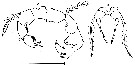 issued from : A.D. McKinnon, W.J. Kimmerer & J.A.H. Benzie in J. Crustacean Biol., 1992, 12 (2). [p.250, Fig.6, c-d]. Female (from Western Bay, Melbourne): d, P5. Male: c, P5. Scale bar: 0.100 mm.
|
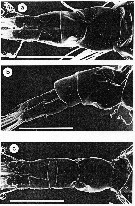 issued from : A.D. McKinnon, W.J. Kimmerer & J.A.H. Benzie in J. Crustacean Biol., 1992, 12 (2). [p.255, Fig.10]. Female: a, urosome (dorsal); b, idem (dorsolateral). Nota: Distinct brown pigment patch at base of maxillae. Last thoracic segment (Th6) with 0-7 dorsal spines (average 4), posteroventral margin of segment without hairs. Mean length : width ratio of genital complex in dorsal view 1.04. Lateral faces of genital complex with rows of denticles on anterior half of segment, never extending on posterior half. Posterodorsal margin of genital complex usually (95% of cases) without denticles. Length : width ratio of caudal rami in dorsal view 2.00. Male: c, urosome (dorsal). Nota: Distinct brown pigment patch at base of maxillae. Last thoracic segment (Th6) with 8 dorsal spines (average 4). Length : width ratio of caudal ramus 1.56. Most specimens (81%) with row of denticles onposterodorsal margin of 2nd urosome segment; only 17% with denticles on posterodorsal margin of 3rd urosome segment. Scale bars: 0.100 mm.
| | | | | NZ: | 1 | | |
|
Distribution map of Acartia (Acartiura) fancetti by geographical zones
|
| | | | Loc: | | | SE Australia (Westernport Bay & Port Philip Bays). | | | | N: | 6 | | | | Lg.: | | | (176) F: 1,08-0,72; M: 0,96-0,75; {F: 0,72-1,08; M: 0,75-0,96} | | | | Rem.: | epipelagic. | | | Last update : 22/09/2014 | |
|
|
 Any use of this site for a publication will be mentioned with the following reference : Any use of this site for a publication will be mentioned with the following reference :
Razouls C., Desreumaux N., Kouwenberg J. and de Bovée F., 2005-2026. - Biodiversity of Marine Planktonic Copepods (morphology, geographical distribution and biological data). Sorbonne University, CNRS. Available at http://copepodes.obs-banyuls.fr/en [Accessed June 01, 2026] © copyright 2005-2026 Sorbonne University, CNRS
|
|
|
|




 fancetti - Plate 1 of morphological figures',750,500);)
 fancetti - Plate 2 of morphological figures',750,500);)








 fancetti - Plate 1 of morphological figures)
 fancetti - Plate 2 of morphological figures)