|
|
 |
|
Calanoida ( Order ) |
|
|
|
Diaptomoidea ( Superfamily ) |
|
|
|
Pseudodiaptomidae ( Family ) |
|
|
|
Pseudodiaptomus ( Genus ) |
|
|
| |
Pseudodiaptomus lobipes Gurney, 1907 (F,M) | |
| | | | | | | Syn.: | Schmackeria lobipes : Marsh, 1933 (p.45, figs.F,M) | | | | Ref.: | | | Sewell, 1912 (p.338, Rem.); 1924 (p.786, 787, figs.M); 1948 (p.429); Dussart & Defaye, 1983 (p.31); Walter, 1986 (p.132); 1986 a (p.503); 1987 (p.367); Walter, 1994 (p.124, figs.F,M) | 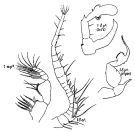 issued from : R.B.S. Sewell in Fauna of the Chilka Lake, 1924, 12. [Pl. XLV, Fig.1]. Male.
|
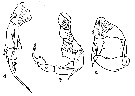 Issued from : C.D. Marsh in Proc. U.S. natn. Mus., 1933, 82 (18) (2959). [Pl. 22, figs.4, 7-8]. As Schmackeria lobipes. After Gurney, 1907. Female: 4, P5. Male: 7, right P5; 8, left P5.
|
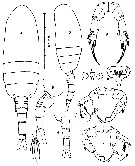 Issued from : T. C. Walter in Hydrobiologia, 1994, 292/293. [p.125, Fig.1]. Female (from Calcutta, India): A, habitus (dorsal view); B, pedigerous somite 5 and urosome (right lateral view); C, forehead with rostrum (ventral view); D, urosome segment 1 genitalfield (ventral view); E, tip of left caudal ramus showing narrow normal setae; F, P5 (anterior view). Male: G, habitus (left lateral view); H, urosome (ventral view); I, P5 (posterior view); J, P5 (anterior view).
|
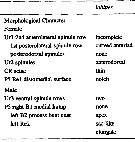 Issued from : T. C. Walter in Hydrobiologia, 1994, 292/293. [p.128, Table 2]. Morphological features of Pseudodiaptomus lobipes from India. Compare with the two species P. binghami and mixtus.
|
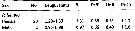 Issued from : T. C. Walter in Hydrobiologia, 1994, 292/293. [p.128, Table 1]. Pseudodiaptomus lobipes from India: Sex, number of specimens measured, total body length range, mean total body length, mean prosome length, mean urosome length and prosome/urosome ratio of lengths. Compare with the three species in India P. binghami and mixtus.
| | | | | Compl. Ref.: | | | Madhupratap & Haridas, 1986 (p.105, tab.2) | | | | NZ: | 1 | | |
|
Distribution map of Pseudodiaptomus lobipes by geographical zones
|
| | | | | | | Loc: | | | India (Calcutta) | | | | N: | 3 | | | | Lg.: | | | () F: 0,35 *; M: 0,95; (1190) F: 1,29-1,33; M: 0,95-0,98; {F: 1,29-1,33; M: 0,95-0,98}
* Measurement for the female given by Gurney probably incorrect (possibly 1.35 mm). | | | | Rem.: | freshwater, estuary.
Incomplete data.
In Lobus species group (forbesi subgroup) after Walter & al. 2006, p.203.
Walter (1994, p.124) notes the confusion about the identity of P. lobipes and P. binghami discussed by Reddy & Radhakrishna (1982). The original illustrations of P. lobipes lack many details. | | | Last update : 23/02/2016 | |
|
|
 Any use of this site for a publication will be mentioned with the following reference : Any use of this site for a publication will be mentioned with the following reference :
Razouls C., Desreumaux N., Kouwenberg J. and de Bovée F., 2005-2026. - Biodiversity of Marine Planktonic Copepods (morphology, geographical distribution and biological data). Sorbonne University, CNRS. Available at http://copepodes.obs-banyuls.fr/en [Accessed June 06, 2026] © copyright 2005-2026 Sorbonne University, CNRS
|
|
|
|




;)
;)
;)
;)
;)