|
|
 |
|
Calanoida ( Order ) |
|
|
|
Diaptomoidea ( Superfamily ) |
|
|
|
Pseudodiaptomidae ( Family ) |
|
|
|
Pseudodiaptomus ( Genus ) |
|
|
| |
Pseudodiaptomus nihonkaiensis Hirakawa, 1983 (F,M) | |
| | | | | | | Syn.: | Pseudodiaptomus cornutus : Tanaka, 1966 (p.40, figs.F) | | | | Ref.: | | | Hirakawa, 1983 (p.65, figs.F,M, Rem.); Walter, 1986 (p.133); 1986 a (p.503); 1987 (p.368); Chihara & Murano, 1997 (p.894, Pl.166: F,M); Soh & al., 2001 (p.206, figs.F,M); Eyun & al., 2007 (p.265, molecular biology) | 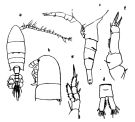 issued from : O. Tanaka in Proceedings Symposium on Crustacea. Symp. Ser. mar. biol. Ass. India, 1966, (2) 1. [p.41, Fig.2]. As Pseudodiaptomus cornutus. Female: a, habitus (dorsal); b, head (lateral); c, last thoracic segment and urosome (lateral left side); d, anal segment and furca (dorsal); e, P2; f, P5. Nota: The urosome segments and furca are in the proportional lengths as 31:14:17:16:22 = 100. Prosome and urosome are in the proportional lengths as 70:30. P5 is symmetrical.
|
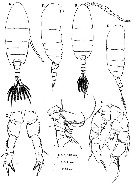 issued from : H.Y. Soh, H.-L Suh, O.H. Yu & S. Ohtsuka in Hydrobiologia, 2001, 448. [p.212, Fig.7]. Female: A, habitus (dorsal); B, idem (lateral right side); C, P5 (posterior view). Male: D, habitus (dorsal); E, idem (lateral right side); F, right A1 (segments VIII-XV); G, P5 (posterior view).
|
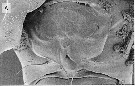 issued from : H.Y. Soh, H.-L Suh, O.H. Yu & S. Ohtsuka in Hydrobiologia, 2001, 448. [p.213, Fig.8, A]. Female: A, scanning electron micrographs of the genital area.
|
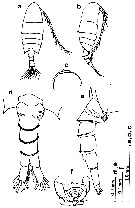 issued from : K. Hirakawa in Bull. Plankton Soc. Japan, 1983, 30 (1). [p.66, Fig.1]. Female (from Izumozaki harbour, Japan): a-b, habitus (dorsal and lateral, respectively); c, cross section of 2nd thoracic somite; d-e, urosome (dorsal and lateral, respectively); f, genital somite (ventral).
|
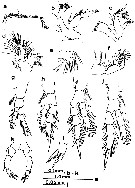 issued from : K. Hirakawa in Bull. Plankton Soc. Japan, 1983, 30 (1). [p.67, Fig.2]. Female: a, A1; b, A2; c, Md; d, Mx1; e, Mx2; f, Mxp; g-k, P1 to P5; l, terminal segment of P5.
|
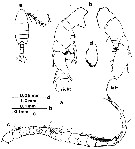 issued from : K. Hirakawa in Bull. Plankton Soc. Japan, 1983, 30 (1). [p.68, Fig.3]. Male: a, habitus (dorsal); b, P5; c, right A1; d, outer lamelliform plate of rightb endopod of P5.
|
 issued from : K. Hirakawa in Bull. Plankton Soc. Japan, 1983, 30 (1). [p.68, Table 1]. Female & Male: Comparison of the morphological characters in P. nihonkaiensis and P. cornutus Nicholls, 1944.
| | | | | Compl. Ref.: | | | Shimode & Shirayama, 2004 (p.607, tab.1, 2); Ohtsuka & al., 2008 (p.115, Table 5); | | | | NZ: | 1 | | |
|
Distribution map of Pseudodiaptomus nihonkaiensis by geographical zones
|
| | | 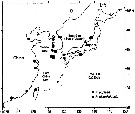 issued from : H.Y. Soh, H.-L Suh, O.H. Yu & S. Ohtsuka in Hydrobiologia, 2001, 448. [p.214, Fig.9]. issued from : H.Y. Soh, H.-L Suh, O.H. Yu & S. Ohtsuka in Hydrobiologia, 2001, 448. [p.214, Fig.9].
Zoogeography of P. poplesia and P. nihonkaiensis in eastern Asia. |
| | | | Loc: | | | Japan (Kyushu, Tanabe Bay), S Korea (Dolsan Is., Cheju Is.) | | | | N: | 5 | | | | Lg.: | | | (97) F: 1,14; (866) F: 1,08-1,26; M: 0,85-1,05; (922) F: 1,2-1,3; M: 1,1-1,28; {F: 1,08-1,3; M: 0,85-1,28} | | | | Rem.: | brackish - marine.
In Ramosus species group (serricaudatus subgroup) after Walter & al. 2006, p.203. | | | Last update : 28/06/2013 | |
|
|
 Any use of this site for a publication will be mentioned with the following reference : Any use of this site for a publication will be mentioned with the following reference :
Razouls C., Desreumaux N., Kouwenberg J. and de Bovée F., 2005-2026. - Biodiversity of Marine Planktonic Copepods (morphology, geographical distribution and biological data). Sorbonne University, CNRS. Available at http://copepodes.obs-banyuls.fr/en [Accessed June 15, 2026] © copyright 2005-2026 Sorbonne University, CNRS
|
|
|
|




;)
;)
;)
;)
;)
;)
;)
;)