|
|
 |
|
Calanoida ( Order ) |
|
|
|
Arietelloidea ( Superfamily ) |
|
|
|
Arietellidae ( Family ) |
|
|
|
Metacalanus ( Genus ) |
|
|
| |
Metacalanus aurivilli Cleve, 1901 (F,M) | |
| | | | | | | Syn.: | Metacalanus aurivillii Cleve, 1901 (p.43, figs.F,M); Sewell, 1914 a (p.228);
Scottula ambariakae Binet & Dessier, 1968 (p.21); Frontier, 1977 a (p.15) | | | | Ref.: | | | Thompson & Scott, 1903 (p.243, figs.F,M); A. Scott, 1909 (p.146, Rem.F,M); Sewell, 1932 (p.330); 1948 (p.345); Kasturirangan, 1963 (p.37, 42, figs.F,M); Chen & Zhang, 1965 (p.87, figs.F,M); Saraswathy, 1966 (1967) (p.80, fig.F, Rem.); Greenwood, 1978 (p.5, figs.F,M, Rem.); Zheng & al., 1982 (p.60, figs.F,M); Campaner, 1984 (p.102, 104, 107, figs.F,M, Rem); Ohtsuka, 1984 (p.364, Rem.); 1985 (p.305, Rem.); Bradford-Grieve,1999 b (p.36, figs.F,M, Rem., fig. 189); Conway & al., 2003 (p.179, figs.F,M, Rem.) | 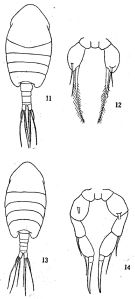 issued from: Q.-c Chen & S.-z. Zhang in Studia Marina Sinica, 1965, 7. [Pl.34, 11-14]. Female (from E China Sea): 11, habitus (dorsal); 12, P5 (posterior). Male: 13, habitus (dorsal); 14, P5 (posterior).
|
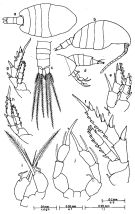 issued from : J.G. Greenwood in Proc. R. Soc. Qd, 1978, 89. [p.6, Fig.2]. Female (from Moreton Bay, E Australia): a, habitus (dorsal); b, idem (lateral right side); e-h, P1-P4 respectively; i, P5. Male: c, urosome (dorsal); d, posterior part of prosome with P5 in situ and urosome (lateral left side); j, P5.
|
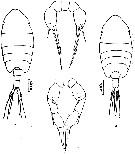 issued from : Z. Zheng, S.J. Li & B. Chen in Marine planktonic copepods in Chinese waters. Shanghai Sc. & Techn. Press. [p.61, Fig.34]. Female: a, habitus (dorsal); b, P5.
Male: c, habitus (dorsal); d, P5.
Scale bars in mm.
|
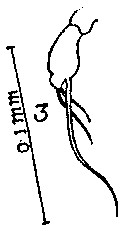 issued from : M. Saraswathy in Proc. Symp. Crustacea.- Symp. Ser. mar. biol. Ass. India, 1966, 2 (1). [p.82, Fig.1 (3)]. Female (from Trivandrum coast, SW India): 3, P5.
| | | | | Compl. Ref.: | | | Krishnaswamy, 1953 (p.127); Ganapati & Shanthakumari, 1962 (p.9, 15); Subbaraju & Krishnamurphy, 1972 (p.25, Table 1: periods of abundance vs India localities); );Patel, 1975 (p.659); Madhupratap & Haridas, 1986 (p.105, tab.1); Othman & al., 1990 (p.561, 564, Table 1); Godhantaraman, 1994 (tab.7); Shih & Young, 1995 (p.67); Achuthankutty & al., 1998 (p.1, Table 2, seasonal abundance vs monsoon); Satapoomin & al., 2004 (p.107, tab.4); Dur & al., 2007 (p.197, Table IV); Ohtsuka & al., 2008 (p.115, Table 6); Cornils & al., 2010 (p.2076, Table 3); Maiphae & Sa-ardrit, 2011 (p.641, Table 2); Chew & Chong, 2011 (p.127, Table 3, abundance vs location); Tseng L.-C. & al., 2011 (p.47, Table 2, occurrences vs mesh sizes); Jagadeesan & al., 2013 (p.27, Table 3, 5, fig.11, seasonal variation); | | | | NZ: | 4 | | |
|
Distribution map of Metacalanus aurivilli by geographical zones
|
| | | | | | | | | | Loc: | | | India (Goa, Saurashtra coast, Trivandrum coast, South, Cochin, Sri Lanka, Gulf of Mannar, Palk Bay, Lawson's Bay, Madras, Mandapam, Visakhapatnam), Madagascar, Nosy Bé, Nicobar Is., Straits of Malacca (Sangga estuary, mainly nearshore), off Phuket, Indonesia-Malaysia, SW Celebes, Viet Nam, China Seas (East China Sea, South China Sea), Taiwan (SW), Australia (E, G. of Carpentaria) | | | | N: | 26 | | | | Lg.: | | | (5) F: 0,65; M: 0,5; (290) F: 0,6-0,55; M: 0,5; (530) F: 0,6; M: 0,5; (795) F: 0,6; M: 0,5; (991) F: 0,55-0,64; M: 0,53-0,56; (1023) F: 0,53-0,56; M: 0,66-0,69; {F: 0,53-0,65; M: 0,50-0,69} | | | | Rem.: | euryhaline, epipelagic.
For Ohtsuka (1984, p.364) the comparison between the figures from Ceymon by Thompson & Scott (1903) and from the East China Sea by Chen & Zhang (1965), there are a few differences (presence of setae on the 2nd segments of P5 in male, and the characteristics of setae on terminal segments of P5 female). It is probable that Thompson & Scott overlooked the presence of setae on the 2nd segments of P5 male.
According to Greenwood (1978, p.5) because of its small size, the geographical distribution is perhaps under-estimated.
See in DVP Conway & al., 2003 (version 1) | | | Last update : 07/02/2020 | |
|
|
 Any use of this site for a publication will be mentioned with the following reference : Any use of this site for a publication will be mentioned with the following reference :
Razouls C., Desreumaux N., Kouwenberg J. and de Bovée F., 2005-2026. - Biodiversity of Marine Planktonic Copepods (morphology, geographical distribution and biological data). Sorbonne University, CNRS. Available at http://copepodes.obs-banyuls.fr/en [Accessed March 14, 2026] © copyright 2005-2026 Sorbonne University, CNRS
|
|
|
|




;)
;)
;)
;)