|
|
 |
|
Calanoida ( Order ) |
|
|
|
Arietelloidea ( Superfamily ) |
|
|
|
Augaptilidae ( Family ) |
|
|
|
Euaugaptilus ( Genus ) |
|
|
| |
Euaugaptilus nodifrons (Sars, 1905) (F,M) | |
| | | | | | | Syn.: | Augaptilus nodifrons Sars, 1905 c (p.13, Descr.F); Farran, 1908 b (p.72, Rem.F);
Augaptilus simplex Wolfenden, 1911 (p.345, figs.F);
Augaptilus simplex Esterly, 1913 (p.188, figs.F);
Euaugaptilus simplex : Brodsky, 1950 (1967) (p.376, figs.F) | | | | Ref.: | | | Sars, 1925 (p.267, figs.F,M); Sewell, 1932 (p.316, figs.M); Rose, 1933 a (p.224, figs.F,M); Jespersen, 1940 (p.60); Sewell, 1947 (p.196, 198, 201, 205, figs.F, Rem.); Tanaka, 1964 b (p.47, figs.F,M); Vervoort, 1965 (p.134, Rem.); Grice & Hulsemann, 1967 (p.19, 33, figs.M); Tanaka & Omori, 1967 (p.256, fig.F); Owre & Foyo, 1967 (p.88, figs.F,M); Matthews, 1972 (p.37, 41, Rem.); Tanaka & Omori, 1974 (p.242, figs.F, Rem.); Ali-Khan & Ali-Khan, 1984 (p.305, figs.F,M, Rem.); Park, 1993 (p.14, figs.F,M, Rem.); Bradford-Grieve & al., 1999 (p.882, 940, figs.F,M); Bradford-Grieve,1999 b (p.56, figs.F,M, Rem., figs.172, 190); Vives & Shmeleva, 2007 (p.204, figs.F,M, Rem.) Matsuura & al., 2010 (p.2098, Table 4, fig.10: Mx2, Mxp) | 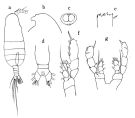 issued from : O. Tanaka in Publs Seto Mar. Biol. Lab., 1964, XII (1). [p.47, Fig.195]. Female: b, forehead (left lateral side); c, rostrum (frontal view); d, urosome; e, masticatory edge of Md; f, P5. Male: a, habitus (dorsal); g, P5.
|
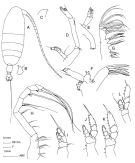 issued from : J.M. Bradford-Grieve in The Marine Fauna of New Zealand: Pelagic Calanoid Copepoda. National Institute of Water and Atmospheric Research (NIWA). NIWA Biodiversity Memoir, 111, 1999. [p.43, Fig.16]. Female: A, habitus (dorsal); B, renital somite (right lateral side); C, forehead (right lateral side); D, A2; E, Md; F, Mx1; G, Mx2; H, Mxp; I, P1; J, P2; K, P3; L, P5.
|
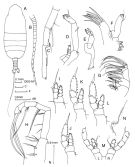 issued from : J.M. Bradford-Grieve in The Marine Fauna of New Zealand: Pelagic Calanoid Copepoda. National Institute of Water and Atmospheric Research (NIWA). NIWA Biodiversity Memoir, 111, 1999. [p.44, Fig.17]. Male: A, habitus (dorsal); B, left A1; C, three segments around the joint on left A1; D, A2; E, Md; F, Mx1; G, Mx2; H, Mxp; I, P1; J, P2; K, P3; L, P4; M, P5 (L = left leg; R = right leg); N, detail of inner border of exopod segment 2 of right P5.
|
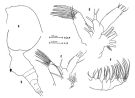 issued from : O. Tanaka & M. Omori in Publs Seto Mar. Biol. Lab., 1974, XXI (3/4). [p.242, Fig.222]. Female: a, forehead (lateral); b, last thoracic segment and urosome (lateral left side); c, Mx1; d, idem ( (large form); e, Mx2 (other specimen).
|
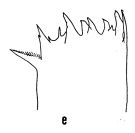 issued from : O. Tanaka & M. Omori in Publs Seto Mar. Biol. Lab., 1974, XXI (3/4). [p.198, Fig.1,e]. Female: e, mandibular teeth.
|
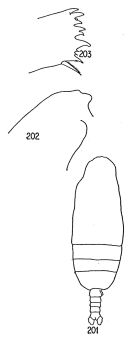 issued from : G.D. Grice & K. Huisemann in Proc. U.S. natn. Mus., 1967, 122 (3583). [p.59, Figs.201-203]. Male from Indian Ocean): 201, habitus (dorsal); 202, forehead (lateral); 203, Md (biting edge of the mandible blade).
|
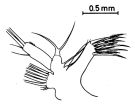 issued from : O. Tanaka & M. Omori in Information Bull on Planktology in Japan. Commemoration Number of Dr. Y. Matsue's Sixtieth Birthday, December 1967. [p.257, Fig.8]. Female: Mx1. Nota: The present specimens (females: 8.7-9.5; males: 8.2-8.4) are much larger in size than those hitherto been described by various authors. However, there is no structural difference between ordinary and larger forms.
|
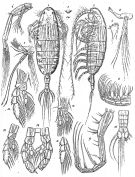 Issued from : G.O. Sars in Résult. Camp. Scient. Prince Albert I, 69, pls.1-127 (1924). [Pl.LXXXII, figs.1-15]. Female: 1, habitus (dorsal); 2, idem (lateral left side); 3, rostral prominence; 4, A2; 5, Md; 6, idem (masticatory edge, enlarged); 7, Mx1; 8, Mx2; 9, Mxp; 10, P1; 11, exopodal segments of P2; 12, P3; 13, P5. Male: 14, P5; 15, urosome (dorsal).
|
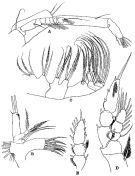 issued from : R.B.S. Sewell in The John Murray Expedition, 1933-34, Scientific Reports, VIII (1), 1947. [p.206, Fig.53]. Female (from Arabian Sea): A, A2; B, Mx1; C, mx2; D, P2; E, exopod of P3 (abnormal).
|
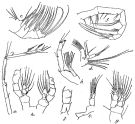 Issued from : R.B.S. Sewell in Mem. Indian Mus., 1932, X (continued). [p.317, Fig.104]. Male (from Laccadive Sea): a, distal segments and knee-joint of left A1; b, A2; c, Md; e, Mx2; f, Mxp; g, P1; h, P5; j, distal segments of exopod of right P5.
|
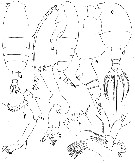 issued from : T. Park in Biology of the Antarctic Seas, XXII. Antarct. Res. Ser., Washington, 58. [p.15, Fig.9]. Female: a-b, habitus (dorsal and lateral, respectively); c, forehead (lateral); d-e, urosome (dorsal and lateral, respectively); f, A2; g, Md; h, Md (edge of mandibular blade). Nota: Forehead in lateral view produced ventrally forming a round tubercular rostrum, devoid of filaments; ridge bearing suprafrontal sensilla quite conspicuous. Urosome about 26 % length of prosome. Genital segment about 41 % length of urosome. Endopod of Md nearly as long as exopod.
|
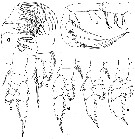 issued from : T. Park in Biology of the Antarctic Seas, XXII. Antarct. Res. Ser., Washington, 58. [p.16, Fig.10]. Female: a, Mx2; b, Mxp; c-g, P1 to P5 (anterior views).
|
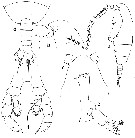 issued from : T. Park in Biology of the Antarctic Seas, XXII. Antarct. Res. Ser., Washington, 58. [p.17, Fig.11]. Male: a, habitus (lateral); b-c, forehead (lateral and dorsal, respectively); d, urosome (dorsal); e, Md; f, P5. Nota: Rostrum larger than in female, extending far beyond ventral surface of forehead. Urosome about 28 % length of prosome.
|
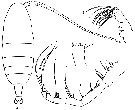 issued from : R.N. Wolfenden in Die Marinen Copepoden der Deutschen Südpolar-Expedition 1901-1903, 1911. [p.345, Fig.76]. As Augaptilus simplex. Female (from N off Tristan da Cunha Islands) : a, habitus (dorsal); b, Mx2; c, Mxp; d, Md (masticatory edge). See in remark from Matthews (1972).
|
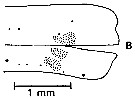 issued from : J. Mauchline in J. mar. biol. Ass, U.K., 1977, 57 (4). [p.980, Fig.4, B]. B, Integumental organs (right halves of 1st and 2nd thoracic segments).
|
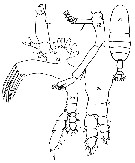 issued from : S. Ali-Khan & J. Ali-Khan in Crustaceana, 1984, 47 (3). [p;307, Figs.21-25]. Female (from 24°09'N, 64°27'E): 21, habitus (dorsal); 22, A2; 23, Mx1; 24, P1; 25, P5. Nota: The exopod of Mx1 bears 2 additional setae. The lateral spines on the 3rd exopodal segment of P5 agree with figures by Sars (1925) thus differ from that of Tanaka (1964).
|
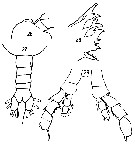 issued from : S. Ali-Khan & J. Ali-Khan in Crustaceana, 1984, 47 (3). [p;308, Figs.26-29]. Male: 26, forehead (lateral); 27, last thoracic segment and urosome (dorsal); 28, Md (biting edge); 29, P5.
|
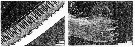 issued from : H. Matsuura, S. Nishida & J. Nishikawa in Deep-Sea Res. II,
2010, 57. [p.2106, Fig.10, k-l]. From Sulu Sea: k, SEM image of button setae on Mx2 and Mxp; l, SEM image of mandible blade. Nota: Mandible blade broad, with 11 cuspidate teeth of varying size (Type-III).
|
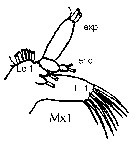 issued from : J.M. Bradford-Grieve, E.L. Markhaseva & C.E.F. Rocha & B. Abiahy in South Atlantic Zooplankton, Edit. D. Boltovskoy. 1999. Vol.2. Copepoda. [p.1039, Fig. 7.257]. Female: Mx1. Nota: Endo of Mx1 with 2 setae; exo with 3 setae; outer lobe 1 with 8 setae.
|
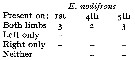 issued from : J.B.L. Matthews in Bull Gr. Mus. (Nat. Hist.) Zool., 1972, 24 (1). [p.25, Table I). Occurrence of a seta on the posterior surface near the outer margin of basipodite of P1, P4 and P5. Numbers refer to the number of individuals examined. It appears that the presence or absence of this seta on P1 may well be a sound taxonomic character In the material examined by Matthews (1972, p.24) only the small setae of the exopodite and exite of Mx1 showed any variation in number.
|
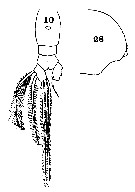 Issued from : C.O. Esterly in Univ. Calif. Publs Zool., 1913, 11 (10). [Pl. 10, Figs.10, 28]. As Augaptilus simplex. Female (from S California): 10, abdomen (ventral); 28, forehead (lateral). Body coloration transparent. Bristles of the caudal rami iridescent.
|
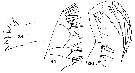 Issued from : C.O. Esterly in Univ. Calif. Publs Zool., 1913, 11 (10). [Pl. 11, Figs. 34, 36, 41]. As Augaptilus simplex. Female: 34, Md (mandibular blade); 36, Mxp; 41, Mx2. Nota: Plumose bristles of A2 and those of the mandibule palp are iridescent.
|
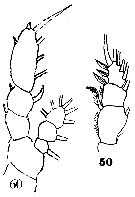 Issued from : C.O. Esterly in Univ. Calif. Publs Zool., 1913, 11 (10). [Pl. 12, Figs. 50, 60]. As Augaptilus simplex. Female: 50, exopod of P1; 60, P5. Nota; Exopod of P1 length (terminal spine excluded) = 743 mm. P5 length = 1.429 mm.
| | | | | Compl. Ref.: | | | Sewell, 1948 (p.349, 505, 522, 531, 532, 533, 539, 547, 558); Lysholm & al., 1945 (p.38); C.B. Wilson, 1950 (p.206); De Decker & Mombeck, 1964 (p.12); Grice & Hulsemann, 1965 (p.224); Park, 1970 (p.478); Roe, 1972 (p.277, tabl.1, tabl.2); Björnberg, 1973 (p.348); Vives & al., 1975 (p.50, tab.II, XII); Deevey & Brooks, 1977 (p.156, tab.2, Station "S"); Vives, 1982 (p.294); Guangshan & Honglin, 1984 (p.118, tab.); Lozano Soldevilla & al., 1988 (p.60); Heinrich, 1990 (p.18); Suarez, 1992 (App.1); Shih & Young,1995 (p.68); Padmavati & al., 1998 (p.349); Suarez-Morales & Gasca, 1998 a (p108); Lapernat, 2000 (tabl.3, 4); Razouls & al., 2000 (p.343, Appendix); Holmes, 2001 (p.12); Kazmi, 2004 (p.227); Dur & al., 2007 (p.197, Table IV); Schnack-Schiel & al., 2008 (p.1045: Tab.2); Galbraith, 2009 (pers. comm.); Park & Ferrari, 2009 (p.143, Table 4, Appendix 1, biogeography); Matsuura & al., 2010 (p.2098, Table 3, figs.7, 8, vertical distribution); in CalCOFI regional list (MDO, Nov. 2013; M. Ohman, comm. pers.) | | | | NZ: | 18 | | |
|
Distribution map of Euaugaptilus nodifrons by geographical zones
|
| | | | | | | | | | | | 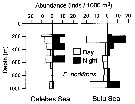 issued from : H. Matsuura, S. Nishida & J. Nishikawa in Deep-Sea Res. II,
2010, 57. [p.2104, Fig.7]. issued from : H. Matsuura, S. Nishida & J. Nishikawa in Deep-Sea Res. II,
2010, 57. [p.2104, Fig.7].
Vertical distribution of Euaugaptilus nodifrons in the Sulu Sea, compared with those in the Celebes Sea. |
| | | | Loc: | | | Antarct. ( S & SW Atlant., W Weddell Sea, Indian, SW & SE Pacif.), sub-Antarct. (Indian, SW & SE Pacif.), South Africa (E), Namibia, off N Tristan da Cunha, G. of Guinea, off NW Cape Verde Is., off Morocco-Mauritania, Canary-Azores, off Portugal, Ibero-moroccan Bay, Caribbean Sea, G. of Mexico, Florida, off Bermuda (Station "S"), Sargasso Sea, S Iceland, off W Ireland, SW Indian, G. of Oman, Arabian Sea, Laccadive Is., Celebes and Sulu Seas, Philippines, China Seas (East China Sea, South China Sea), Taiwan (SW), Japan (Izu), Vancouver Is., California, Pacif. (tropical), SW Galapagos, off Peru, Pacif. (SE tropical), S Chile (sub-Antarct.), Pacif. (W equatorial), New Zealand (NE & SW South Island) | | | | N: | 37 | | | | Lg.: | | | (1) F: 5,4; (10) F: 5,2; (16) F: 5,7-4,85; M: 6,3; (24) F: 7,1; 5,7-5,4; (44) M: 5,75-4,8; (48) F: 8,75-7,5; M: 8,08-7,58; (68) F: 9,5-5,39; M: 6,9-4,89; (69) F: 5,47; (70) F: 9,5-8,7; M: 8,4-8,2; (144) F: 6,1; (199) F: 7,8-5,1; M: 6,88-5,02; ! (315) F: 3,3; M: 4,5; (909) 5,3; 5,45; {F: 5,10-9,50; M: 4,80-8,40} | | | | Rem.: | meso-bathypelagic. Known to occur at depths between 600 and more than 1000 m, occasionally near the surface (Matthews, 1972). Sargasso Sea: 500-2000 m (Deevey & Brooks, 1977, Station "S");
This species belongs to the "squamatus" Group.
The specimens of the Izu region show a great variation (female: 5.39-9.50 mm and male: 4.89-6.90). After Matthews (1972, p.37) Wolfenden's description differs slightly from that of E. nodifrons, in body proportions, the number of segments recorded in the exopodite of A2, and the setation of the exopodite and exite of Mx1. All these differences may well be due to individual variation or to error in observation.
According to Tanaka & Omori (1974, p.243) more detail morphological analysis with sufficient number of species may define the taxonomy of this species (as studied by Frost and Fleminger (1968) in the genus Clausocalanus).
For Park (1993, p.19) the species can be recognized by the absence of rostral filaments, the large number of teeth on the mandibular gnathobase, the exceptionally long Mxp, and the presence of double sensory pores on the 3rd exopodal segment of P3 to P5.
In spite of the great differences of body legths observed by different authors, the absence of any recognizable morphological differences, they regarded all of these specimens as belonging to a single species.
In ''squamatus" Group after Matthews (1972, p.64) {See remarks in Euaugaptilus genus}. | | | Last update : 11/07/2022 | |
|
|
 Any use of this site for a publication will be mentioned with the following reference : Any use of this site for a publication will be mentioned with the following reference :
Razouls C., Desreumaux N., Kouwenberg J. and de Bovée F., 2005-2025. - Biodiversity of Marine Planktonic Copepods (morphology, geographical distribution and biological data). Sorbonne University, CNRS. Available at http://copepodes.obs-banyuls.fr/en [Accessed August 23, 2025] © copyright 2005-2025 Sorbonne University, CNRS
|
|
|
|




;)
;)
;)
;)
;)
;)
;)
;)
;)
;)
;)
;)
;)
;)
;)
;)
;)
;)
;)
;)
;)
;)
;)

;)