|
|
 |
|
Calanoida ( Order ) |
|
|
|
Diaptomoidea ( Superfamily ) |
|
|
|
Acartiidae ( Family ) |
|
|
|
Acartia ( Genus ) |
|
|
|
Odontacartia ( Sub-Genus ) |
|
|
| |
Acartia (Odontacartia) bispinosa Carl, 1907 (F,M) | |
| | | | | | | Syn.: | Acartia amboinensis (F): Sewell, 1914 a (p.242, figs.F, no M);
A. tokiokai Mori, 1942; Ohtsuka & al., 2015 (p.123, Rem.: p.125);
A. hamata Mori, 1937 (1964) (p.104, figs.F, Rem.); C.B. Wilson, 1950 (p.152, figs.F); ? Chiba & al., 1957 (p.310); ? 1957 a (p.12); Walter & Pasamonte, 1981 (1982) (p.447): Ohtsuka & al., 2015 (p.123, Rem.: p.125); Srinui & al., 2019 (p.89, 91, Rem: F, M). | | | | Ref.: | | | Carl, 1907 (p.13, 17, Descr.M, figs.M); Pesta, 1912 a (p.54, fig.M); Sewell, 1914 a (p.242, Rem.); Steuer, 1923 (p.33, figs.F,M); Sewell, 1932 (p.396, Rem.); Grice, 1964 (p.261, figs.F,Rem.); Nishida, 1985 (p.133, figs.F,M, Rem.); Ueda, 1986 a (p.18, Rem.); Chihara & Murano, 1997 (p.672, Pl.21,22: F,M); Conway & al., 2003 (p.99, figs.F,M, Rem.); Mulyadi, 2004 (p.140, figs.F,M, Rem.); Ohtsuka & al., 2015 (p.123, Table 2); Lee S. & al., 2019 (p.84, Table 3). | 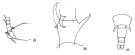 issued from : G.D. Grice in Crustaceana, 1964, 6 (4). [p.260, Figs.35-37]. Female (from specimen n°. U.S.N.M. 70729, holotype of C.B. Wilson, 1950): 35, head and basal part of A1; 36, basal part of A1 (dorsal view); 37, urosome (dorsal).
|
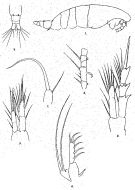 Issued from : R.B.S. Sewell in Spolia Zeylanica, 1914, 9. [Pl.XIX, Figs.1-7]. As Acartia amboinensis. Female (from Gulf of Mannar): 1, habitus (lateral right side); 2, urosome (dorsal); 3, A1 proximal segments; 4, Mxp; 5, P1; 6, P3; 7, P5.
|
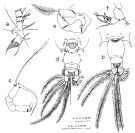 issued from : S. Nishida in Publ. Seto Mar. Biol. Lab., 1985, 30 (1/3). [p.134, Fig.5]. Female (from Kabira Bay, Ishigaki Is.): a, rostrum and A1 (lateral view); b, 5th thoracic segment and urosome (dorsal); c, P5. Male: d, 5th thoracic segment and urosome (dorsal); e, right P5; f, left P5.
|
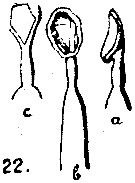 issued from : A. Steuer in Arb. zool. Inst. Innsbruck, 1923, 1 (5). [Taf.III, Figs.22 a-c)]. Male: br>Male: 22 a, attachment portion of the spematophore \"head\" (lateral view); 22b, idem (face view, cleaned up with Hypochlorite of sodium: NaClO); idem (face view; but cleaned up more longer).
|
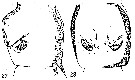 issued from : A. Steuer in Arb. zool. Inst. Innsbruck, 1923, 1 (5). [Taf. III, Figs.27, 28]. Female: 27, genital segment; 28, idem (lateral).
|
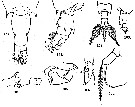 issued from : A. Steuer in Arb. zool. Inst. Innsbruck, 1923, 1 (5). [p.34, Figs.157-161, 163-165]. Female: 157, last thoracic segment and urosome (dorsal); 161, proximal segments of A1; 163, P5. Male: 158, last thoracic segment and urosome (dorsolateral); 159, idem (dorsal); 160, idem (lateral); 164, right P5; 165, exopodite segments 2-3 and portion of exopodite 1 of left P5.
|
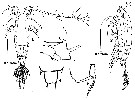 issued from : C.B. Wilson in Bull. U.S. natn. Mus., 1950, 100, 14 (4). [Pl. 2, Figs.1-5]. As Acartia hamata. Female (from Fiji Islands): 1-2, habitus (dorsal and lateral, respectively); 3, A1 (1st segment and proximal portion of segment 2); 4, posterior margin of fused 4th-5th thoracic segment and genital segment (dorsal); 5, P5.
|
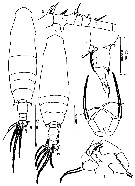 issued from : Mulyadi in Published by Res. Center Biol., Indonesia Inst. Sci. Bogor, 2004. [p.140, Fig.79]. Female (from 03°40'S, 128°10'E): a, habitus (dorsal); b, proximal segments of A1; c, last thoracic segment and urosome (lateral left side); d, P5. Male: e, habitus (dorsal); f, P5.
|
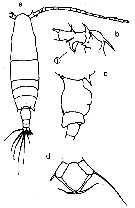 Issued from : M. Chihara & M. Murano in An Illustrated Guide to Marine Plankton in Japan, 1997. [p.679, Pl. 21, fig.12 a-d]. Female: a, habitus (dorsal); b, A1 (proximal segments); c, last thoracic segment and urosome (lateral); d, P5. Nota: numbers show characteristics of this species to compare with A. erythrea, A. pacifica, A. japonica.
|
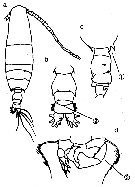 Issued from : M. Chihara & M. Murano in An Illustrated Guide to Marine Plankton in Japan, 1997. [p.680, Pl. 22, fig.12 a-d]. Male: a, habitus (dorsal); b, urosome (dorsal); c, last thoracic segment and urosome (lateral); d, P5. Nota: numbers show characteristics of this species to compare with A. erythrea, A. pacifica, A. japonica.
|
 Remark: Erratum concerning the name: read Srinui and not Siruani. Female: 1 - Genital double-somite having paired posterodorsal processes. 2 - 2nd segment of A1 with strong curved processes posteriorly. 3 - 1st A1 segment with 2 larges processes terminally. Male: 1 - Urosomite 3 without spine-like processes dorsally. 2 - Number of prominences on urosomite 4 more than 7. 3 - Terminal elements of left P5 as 2 spines.
|
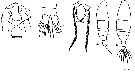 Issued from : T. Mori in The Pelagic Copepoda from the neighbouring waters of Japan. 2nd ed. 1964, The Soho CO, INC. (1st ed. 1937). [p.Pl. 51, figs. 1-5]. As Acartia hamata. Female (from 28°33'50'', 128°53'50''E)): 1, head (ventral); 2, caudal rami; 3, P5; 4-5, habitus (lateral and dorsal, respectively). Nota: - Rostral filaments present. - Lateral angles of the last thoracic segment rounded, furnished with fine spinules. - Genital segment as long as the combined length of the 2 following segments. - Caudal ramus slightly longer than its width. - Caudal setae equal in these thickness. - A1 have no spines on the proximal segments; - P5 symmetrical; the claw-like terminal segment without spinules, stout and curved gradually; the middle segment is nearly as long as its width; the marginal seta is about 2,5 times as long as the terminal claw.
|
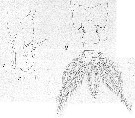 Issued from : J. Carl in Rev. Suisse Zool., 1907, 15. [Pl. I]. Acartia bispinosa . Male (from Baie d'Amboine = Ambon Bay, Indonesia): 4, last segment (Re 2 + 3 = exopodal segment 2 + 3 ) of P5; 2, posterior part of thoracic segment and urosome (dorsal view).
|
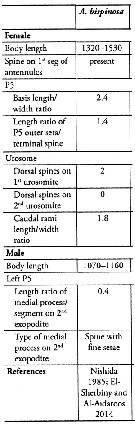 Issued from : S. Lee, H.Y. Soh & W. Lee in ZooKeys, 2019, 893. [p.84, Table 3]. Acartia (Odontacartia) bispinosa: Morphological characters. Compare with other Odontacartia species. Nota: 1 - Presence of spine on 1st and 2nd segments of female A1 .......2. 2 - Strong spines present on dorsal surface of female genittal double-somite ....... 3. 3 - Absence of processes (spines and spinules) on dorsal surface of 2nd urosomite ......4. 4 - Female caudal rami almost twice longer than wide; medial process on 2nd exopodite of male left P5 as spine with fine seta.
| | | | | Compl. Ref.: | | | Sewell, 1948 (p.419); Hammer & Carleton, 1979 (p.1, 8, swarm); Dessier, 1983 (p.89, Tableau 1, Rem., %); Binet, 1984 (tab.2, 3); 1985 (p.85, tab.3); Madhupratap & Haridas, 1986 (p.105, tab.2); Saitoh & al., 2011 (p.85, Table 4, 5); Abo-Taleb & Gharib, 2018 (p.139, Table 5, 146, occurrence %); . | | | | NZ: | 7 | | |
|
Distribution map of Acartia (Odontacartia) bispinosa by geographical zones
|
| | | | | | | | | 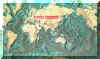 Chart of 1996 Chart of 1996 | |
| | | | Loc: | | | NW Red Sea (Hurghada), Arabian Gulf, Indian, Seychelles, Sri Lanka, Andaman Is., Indonesia-Malaysia (Ambon Bay), Viet-Nam (Cauda Bay), E China Sea, Japan, Palau Is., Hawaii (Kaneohe Bay), New Caledonia, Gilbert Is., Fidji, ? Australia. | | | | N: | 19 (Red Sea: 1; Indian: 5; Indonesia-Malaysia: 2; Pacif.: 12) | | | | Lg.: | | | (82) F: 1,2; (91) F: about 1,6; (164) F: 1,35-1,307; M: 1,183-1,17; (672) M: 1,3; (866) F: 1,3-1,6; M: 1,2-1,4; (991) F: 1,3; (1122) F: 1,3; M: 1,2; {F: 1,20-1,60; M: 1,17-1,40} | | | | Rem.: | neritic-oceanic.
Any confusion appears in the literature between A. hamata, A. fossae and A. bispinosa.
See Acartia australis Table 1 from Ueda (1986, p.18).
After C.R: Found for the first time in the Red Sea by Abo-Taleb & Gharib (2018).
See in DVP Conway & al., 2003 (version 1) | | | Last update : 30/03/2020 | |
|
|
 Any use of this site for a publication will be mentioned with the following reference : Any use of this site for a publication will be mentioned with the following reference :
Razouls C., Desreumaux N., Kouwenberg J. and de Bovée F., 2005-2025. - Biodiversity of Marine Planktonic Copepods (morphology, geographical distribution and biological data). Sorbonne University, CNRS. Available at http://copepodes.obs-banyuls.fr/en [Accessed December 02, 2025] © copyright 2005-2025 Sorbonne University, CNRS
|
|
|
|




 bispinosa - Plate 1 of morphological figures',750,500);)
 bispinosa - Plate 2 of morphological figures',750,500);)
 bispinosa - Plate 3 of morphological figures',750,500);)
 bispinosa - Plate 4 of morphological figures',750,500);)
 bispinosa - Plate 5 of morphological figures',750,500);)
 bispinosa - Plate 6 of morphological figures',750,500);)
 bispinosa - Plate 7 of morphological figures',750,500);)
 bispinosa - Plate 8 of morphological figures',750,500);)
 bispinosa - Plate 9 of morphological figures',750,500);)
 bispinosa - Plate 10 of morphological figures',750,500);)
 bispinosa - Plate 11 of morphological figures',750,500);)
 bispinosa - Plate 12 of morphological figures',750,500);)
 bispinosa - Plate 13 of morphological figures',750,500);)
 bispinosa - Plate 14 of morphological figures',750,500);)

 bispinosa - Distribution map 2',650,500);)








 bispinosa - Plate 1 of morphological figures)
 bispinosa - Plate 2 of morphological figures)
 bispinosa - Plate 3 of morphological figures)
 bispinosa - Plate 4 of morphological figures)
 bispinosa - Plate 5 of morphological figures)
 bispinosa - Plate 6 of morphological figures)
 bispinosa - Plate 7 of morphological figures)
 bispinosa - Plate 8 of morphological figures)
 bispinosa - Plate 9 of morphological figures)
 bispinosa - Plate 10 of morphological figures)
 bispinosa - Plate 11 of morphological figures)
 bispinosa - Plate 12 of morphological figures)
 bispinosa - Plate 13 of morphological figures)
 bispinosa - Plate 14 of morphological figures)
 bispinosa - Distribution map 2)