|
|
 |
|
Calanoida ( Order ) |
|
|
|
Diaptomoidea ( Superfamily ) |
|
|
|
Acartiidae ( Family ) |
|
|
|
Acartia ( Genus ) |
|
|
|
Odontacartia ( Sub-Genus ) |
|
|
| |
Acartia (Odontacartia) bowmani Abraham, 1976 (F,M) | |
| | | | | | | Syn.: | Acartia spinicauda : Wellershaus, 1969 (p.275, figs.M);
A. centrura : Tranter & Abraham, 1971 (p.223, fig.M). | | | | Ref.: | | | Abraham, 1976 (p.77, figs.F,M); Srinui & al., 2019 (p.89, 91, Rem: F,M); Lee S. & al. (p.83, Table 3) . | 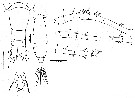 issued from : S. Abraham in Crustaceana, 1976, 30 (1). [p.75, Figs.1-3]. Female (from Cochin, S India): 1, habitus (dorsal); 1a, urosome (dorsal); 2, P5; 3, right A1.
|
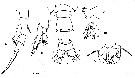 issued from : S. Abraham in Crustaceana, 1976, 30 (1). [p.76, Figs.7-12]. Male: 7, urosome (dorsal); 8, P5 (posterior view); 9, Md (masticatory edge); 10, Mxp; 11, P1; 12, P4.
|
 issued from : S. Abraham in Crustaceana, 1976, 30 (1). [p.79, Table I]. Comparative list of characters female of A. bowmani and A. centrura.
|
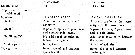 issued from : S. Abraham in Crustaceana, 1976, 30 (1). [p.79, Table II]. Comparative list of characters male of A. bowmani and A. centrura.
|
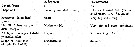 issued from : S. Abraham in Crustaceana, 1976, 30 (1). [p.79, Table III]. Comparative list of characters male of A. bowmani and A. spinicauda.
|
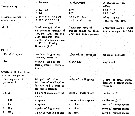 issued from : S. Abraham in Crustaceana, 1976, 30 (1). [p.80, Table IV]. Comparative list of characters female and male of A. bowmani, A. chilkaensis and A. chilkaensis var. sittangi.
|
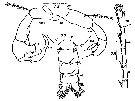 Issued from : S. Wellershaus in Veröf. Inst. Meeresf. Bremerhaven, 1969, XI. [p. 274, Fig. 76-78]. As Acartia (Odotacartia) spinicauda. Male (from Cochin Backwater and outlet, W Thevara): 76, P5; 77, urosome (dorsal); 78, distal part of right A1 (spines black). Nota: - Ratio prosome urosome 3.1-3.3. - A flattened hair on the inner side of the left exopod 2-3 of P5 which is different in other localities (see Steuer, 1923). - 2 strong setae or spines on the distal end of segments 22 and 23 on the right A1 (black in fig.78) ; segment 16 bears a spatula-shaped spine in addition to a pointed spine. - There are no additional spinules between the two spines of urosomal segment 4 (in contrast to Giesbrecht's figure (1892) for A. spinicauda.
|
 Remark: Erratum concerning the name: read Srinui and not Siruani. Female: 1 - Genital double-somite lacking posterodorsal processes. 2 - Ventroposterior corners of prosome round with pair of acutely pointed processes not reaching beyond half of genital double-somite. Male: 1- Urosomite 3 with large spine-like processes dorsally. 2 - Dorsal processes of urosomite 3 short, reaching posterior-most border of urosomite 4. 3 - Urosomites 3 and 4 each lacking prominences between pair of dorsal processes. 4 -, Inner seta of terminal endopodal segment of left P5 nearly equal to terminal segment.
|
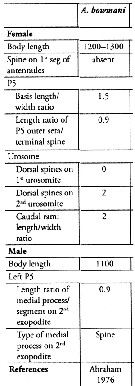 Issued from : S. Lee, H.Y. Soh & W. Lee in ZooKeys, 2019, 893. [p.84, Table 3]. Acartia (Odontacartia) bowmani: Morphological characters. Compare with other Odontacartia species. Nota: 1 - Absence of spine on 1st to 2 nd segments of female A1 .....2. 2 - Dorsal surface of female genital double-somite devoid of processes (spines and spinules) ....... 3. 3 - Female caudal rami twice longer than wide; medial process and 2nd exopodite segment of male left P5 almost similar in length.
| | | | | Compl. Ref.: | | | Madhupratap & Haridas, 1986 (p.105, tab.2); Ramaiah & al., 1996 (p.3); Achuthankutty & al., 1998 (p.1, Table 2, fig.5, seasonal abundance vs monsoon); Madhu & al., 2007 (p.54, Table 4, abundance vs monsoon). | | | | NZ: | 1 | | |
|
Distribution map of Acartia (Odontacartia) bowmani by geographical zones
|
| | | | | | 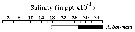 issued from : C.T. Achuthankutty, N. Ramaiah & G. Padmavati in Pelagic biogeography ICoPB II. Proc. 2nd Intern. Conf. Final report of SCOR/IOC working group 93, 9-14 July 1995. Workshop Report No. 142, Unesco, 1998. [p.8, Fig.6]. issued from : C.T. Achuthankutty, N. Ramaiah & G. Padmavati in Pelagic biogeography ICoPB II. Proc. 2nd Intern. Conf. Final report of SCOR/IOC working group 93, 9-14 July 1995. Workshop Report No. 142, Unesco, 1998. [p.8, Fig.6].
Salinity ranges for A. bowmani in coastal and estuarine waters of Goa (India).
Shaded area indicates the range of higher abundance. |
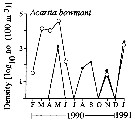 issued from : C.T. Achuthankutty, N. Ramaiah & G. Padmavati in Pelagic biogeography ICoPB II. Proc. 2nd Intern. Conf. Final report of SCOR/IOC working group 93, 9-14 July 1995. Workshop Report No. 142, Unesco, 1998. [p.6, Fig.5]. issued from : C.T. Achuthankutty, N. Ramaiah & G. Padmavati in Pelagic biogeography ICoPB II. Proc. 2nd Intern. Conf. Final report of SCOR/IOC working group 93, 9-14 July 1995. Workshop Report No. 142, Unesco, 1998. [p.6, Fig.5].
Monthly occurrence of Acartia bowmani in coastal (black circle) in front of Goa and and the Mandovi estuary (clear circle). |
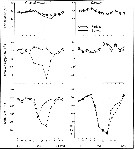 issued from : C.T. Achuthankutty, N. Ramaiah & G. Padmavati in Pelagic biogeography ICoPB II. Proc. 2nd Intern. Conf. Final report of SCOR/IOC working group 93, 9-14 July 1995. Workshop Report No. 142, Unesco, 1998. [p.3, Fig.2]. issued from : C.T. Achuthankutty, N. Ramaiah & G. Padmavati in Pelagic biogeography ICoPB II. Proc. 2nd Intern. Conf. Final report of SCOR/IOC working group 93, 9-14 July 1995. Workshop Report No. 142, Unesco, 1998. [p.3, Fig.2].
Hydrography of the coastal station in front of Goa and Mandovi estuarine station (W India).
Nota: The seasons are arbitrarily classified into the southwest monsoon (June-September), postmonsoon (October-January) and premonsoon (February-May). |
| | | | Loc: | | | India (Goa, Cochin, Kerala), Burhabalanga estuary), Bay of Bengal | | | | N: | 8 | | | | Lg.: | | | (170) F: 1,3-1,2; M: 1,1; {F: 1,20-1,30; M: 1,10} | | | | Rem.: | brackish, estuary.
After Wellershaus (1969, p.275), samples from water salinity between 10 and 31 p.1000. | | | Last update : 09/12/2021 | |
|
|
 Any use of this site for a publication will be mentioned with the following reference : Any use of this site for a publication will be mentioned with the following reference :
Razouls C., Desreumaux N., Kouwenberg J. and de Bovée F., 2005-2026. - Biodiversity of Marine Planktonic Copepods (morphology, geographical distribution and biological data). Sorbonne University, CNRS. Available at http://copepodes.obs-banyuls.fr/en [Accessed June 17, 2026] © copyright 2005-2026 Sorbonne University, CNRS
|
|
|
|




 bowmani - Plate 1 of morphological figures',750,500);)
 bowmani - Plate 2 of morphological figures',750,500);)
 bowmani - Plate 3 of morphological figures',750,500);)
 bowmani - Plate 4 of morphological figures',750,500);)
 bowmani - Plate 5 of morphological figures',750,500);)
 bowmani - Plate 6 of morphological figures',750,500);)
 bowmani - Plate 7 of morphological figures',750,500);)
 bowmani - Plate 8 of morphological figures',750,500);)
 bowmani - Plate 9 of morphological figures',750,500);)

 bowmani - Distribution map 2',750,500);)
 bowmani - Distribution map 3',750,500);)
 bowmani - Distribution map 4',750,500);)








 bowmani - Plate 1 of morphological figures)
 bowmani - Plate 2 of morphological figures)
 bowmani - Plate 3 of morphological figures)
 bowmani - Plate 4 of morphological figures)
 bowmani - Plate 5 of morphological figures)
 bowmani - Plate 6 of morphological figures)
 bowmani - Plate 7 of morphological figures)
 bowmani - Plate 8 of morphological figures)
 bowmani - Plate 9 of morphological figures)
 bowmani - Distribution map 2)
 bowmani - Distribution map 3)
 bowmani - Distribution map 4)