|
|
 |
|
Calanoida ( Order ) |
|
|
|
Arietelloidea ( Superfamily ) |
|
|
|
Augaptilidae ( Family ) |
|
|
|
Pseudaugaptilus ( Genus ) |
|
|
| |
Pseudaugaptilus longiremis Sars, 1907 (F,M) | |
| | | | | | | Syn.: | Isochaeta longisetosus I.C. Thompson, 1903 a (p.26, figs.F);
? Pseudaugaptilus orientalis Tanaka, 1964 b (p.85, figs.F) | | | | Ref.: | | | Sars, 1907 a (p.24); 1925 (p.310, figs.F,M); Rose, 1933 a (p.235, figs.F,M); Jespersen, 1940 (p.62); Lysholm & al., 1945 (p.40); Vervoort, 1951 (p.144, fig.M,Rem.); 1957 (p.140, fig.M, Rem.); Matthews, 1972 (p.55, Rem.); Roe, 1984 (p.359); Hülsemann, 1989 (p.98, Rem.: the priority rule did not apply in this case ); Vives & Shmeleva, 2007 (p.264, figs.F,M, Rem.) | 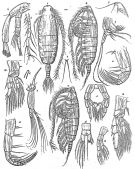 Issued from : G.O. Sars in Résult. Camp. Scient. Prince Albert I, 69, pls.1-127 (1924). [Pl.CIX, figs.1-17]. Female: 1, habitus (dorsal); 2, idem (lateral left side); 3, forehead (lateral); 4, rostrum; 5, distal portion of A1; 6, A2; 7, Md; 8, Md (masticatory edge, enlarged); 9, Mx1; 10, Mx2; 11, Mxp; 12, P1; 13, P3; 14, P5; 15, distal segments of urosome and caudal rami (dorsal). Male: 16, habitus (lateral left side); 17, P5.
|
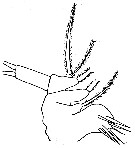 issued from : W. Vervoort in Verh. K. ned. Akad. Wet., Afd. Natuurk., 1951, (Sect. 2) 47 (2). [p.147, Fig.82]. Male (from ± 66°.5S, 11°W): left Mx1. Nota: The structure of Mx1 differs slightly from Sars' figure as the 2nd basal segment is figured there with 3 setae; an endopod is invisible. 1st inner lobe big and swollen, set with 6 slightly chitinized, nude, setoform spines; 2nd and 3rd inner lobes distinct, the 2nd with 1 small, the 3rd with 1 big seta. Endopod and 2nd basal segment distinctly separate; the basal segment with 1 big seta, the endopod with 1 big and 1 small seta. Exopod elongate, styliform, with 2 stronglyelongate, plumose setae.
| | | | | Compl. Ref.: | | | Grice & Hulsemann, 1965 (p.224); 1967 (p.19); Park, 1970 (p.478, 541, Rem.); Roe, 1972 (p.277, tabl.1, tabl.2); 1972 c (p.1035: Rem.); Vives, 1982 (p.294); Lozano Soldevilla & al., 1988 (p.60); Hopkins & Torres, 1988 (tab.1); Razouls & al., 2000 (p.343, tab. 5, Appendix); Schnack-Schiel & al., 2008 (p.1045: Tab. 2, as Psuedoaugaptilus); Park & Ferrari, 2009 (p.143, Table 4, Appendix 1, biogeography); Chaouadi & Hafferssas, 2018 (p.913, Table II: occurrence). | | | | NZ: | 6 + 1 doubtful | | |
|
Distribution map of Pseudaugaptilus longiremis by geographical zones
|
| | | | | | | | | | | | | Loc: | | | Antarct. (Weddell Sea, Indian), off Morocco-Mauritania, Canary Islands, Gibraltar-Madeira, off W Cabo Finisterre, Azores, G. of Mexico, SE Greenland, S Iceland, off W Ireland, W Medit. (Habibas Is.), W Indian, ? Japan. | | | | N: | 11 | | | | Lg.: | | | (1) F: 4,1; (31) M: 5,15; (199) F: 4,32-3,42; M: 3,72-3,5; {F: 3,42-4,32; M: 3,50-5,15} | | | | Rem.: | meso-bathypelagic. Known depth range from above 500 to below 1000 m (Matthews, 1972).
After Park (1970, p.541) P. orientalis Tanaka, 1964, is considerd as being synonymous with P. longiremis, originally distinguished from it by the presence of an external spine on the 2nd exopodal segment of P1.
For Matthews (1972, p.55) the main character distinguishing this species from P. orientalis is the presence or absence of a spine on the 2nd segment of the exopodite of P1, is one which in Euaugaptilus at least shows intraspecific variation.
This species is, perhaps, cited for the first time by Chaouadi & Hafferssas (2018 (p.913, Table II) in the Alboran Sea (Habibas Islands) | | | Last update : 28/02/2020 | |
|
|
 Any use of this site for a publication will be mentioned with the following reference : Any use of this site for a publication will be mentioned with the following reference :
Razouls C., Desreumaux N., Kouwenberg J. and de Bovée F., 2005-2025. - Biodiversity of Marine Planktonic Copepods (morphology, geographical distribution and biological data). Sorbonne University, CNRS. Available at http://copepodes.obs-banyuls.fr/en [Accessed August 23, 2025] © copyright 2005-2025 Sorbonne University, CNRS
|
|
|
|




;)
;)