|
|
 |
| incertae sedis (Cyclopoida) | | | | (1) Pachos Stebbing, 1910 (? incertae sedis (Cyclopoida) ) | |
| | Syn.: | Pachysoma Claus, 1863 (p.162); Giesbrecht, 1892 (p.82, 612); A. Scott, 1909 (p.261); Pesta, 1920 (p.653); Mori, 1937 (1964) (p.141); Zheng Zhong & al., 1984 (1989) (p.263, Rem.) | | Ref.: | Rose, 1933 a (p.305); Boxshall, 1977 a (p.148, clé spp.); Heron & Damkaer, 1978 (p.3, Rem.); Razouls, 1982 (p.681); Huys & Böttger-Schnack, 1996/97 (p.244, Rem.); Chihara & Murano, 1997 (p.978); Boxshall & Halsey, 2004 (p.16; 620: Def., spp. Key) | | Rem.: | Boxshall (1977 a, p.149) considère que ce genre est apparenté à Lubbockia. Cette position n'est pas admise par Heron & Damkaer (1978, p.3) suite à la remarque de Sars (1918, p.190) qui considère ce genre comme n'appartenant pas aux Oncaeidae.
Total: 4 spp.
| 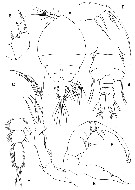 Issued from Boxshall & Halsey in The Ray Society, 2004, Part II. [p.621, Fig.202). A, Pachos punctatum (as Pachysoma punctatum) Female; B, Male urosome; C, A2; D, Mx1; E, Md; F, Male Mxp; G, Female Mxp; H, endopoid od female P4 Giesbrecht, 1893 [1892]: A, C-F and H; Boxshall, 1977: B and G. |
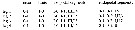 Issued from Boxshall & Halsey in The Ray Society, 2004, Part II. [p.620]. Armature formula of swimming legs P1 to P4. Nota: Inner basal seta absent from P1. P5 lacking free segment, incorporated into somite; represented by 3 setae (outer protopodal seta plus 2 exopodal setae) on produced angle of somite. P6 represented by 2 long setae on paired opercular plates closing off genital apertures in both sexes. |
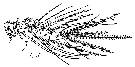 Issued from : M. Rose in Faune de France, P. Lechevalier, Paris, 1933, 26. [p.306, Fig.396]. Antennula from Pachos punctatum After Giesbrecht., 1892. Nota: A1 aesthetascs with brush-like tips are rare in the subclass Copepoda. One example in the calanoida ( Kirmesius groenlandicus, Phaennidae) and several examples of such aesthetascs are known in the poecilostomatoid males as Pachos tuberosum (Giesbrecht, 1892; Mori, 1937 [1964]). (see discussion to Kirmesius groenlandicus in Markhaseva & Semenova, 2005, p.46). | | | | |
|
|
 Toute utilisation de ce site pour une publication sera mentionnée avec la référence suivante : Toute utilisation de ce site pour une publication sera mentionnée avec la référence suivante :
Razouls C., Desreumaux N., Kouwenberg J. et de Bovée F., 2005-2026. - Biodiversité des Copépodes planctoniques marins (morphologie, répartition géographique et données biologiques). Sorbonne Université, CNRS. Disponible sur http://copepodes.obs-banyuls.fr [Accédé le 21 mars 2026] © copyright 2005-2026 Sorbonne Université, CNRS
|
|
|
|




;)
;)
;)