|
|
 |
Fiche d'espèce de Copépode |
|
|
Calanoida ( Ordre ) |
|
|
|
Clausocalanoidea ( Superfamille ) |
|
|
|
Aetideidae ( Famille ) |
|
|
|
Bradyidius ( Genre ) |
|
|
| |
Bradyidius curtus Markhaseva, 1993 (F) | |
| | | | | | | Ref.: | | | Markhaseva, 1993 a (p.50, Descr.F, figs.F); 1996 (p.74, figs.F) | 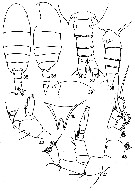 issued from : E.L. Markhaseva in Zoosyst. Rossica, 1993, 2 (1). [p.52, Figs.35-43]. Female (from 49°53'N, 155°38'E): 35-36, habitus (dorsal and lateral, respectively); 37-38, posterior of prosome and urosome (dorsal and lateral, respectively); 39, forehead (lateral); 40, rostrum; 41, A2; 42, Md (mandibular palp); 43, P1. Nota : Cephalothorax 3.0-3.8 times longer than urosome. Rostral rami not divergent. Points of thoracic segment 5 posterior corners short, scarcely covering proximal third of genital segment (dorsal view), directed slightly upwards to the back of specimen (lateral view). A1 reaching thoracic segment 4. Exopodite 1 of A2 without setae, exopodite 2 with 3 (2 medial and 1 distal) setae.Md palp base and endopodite 1 with 2 setae each, endopodite 2 with 9 setae. Posterior surface of Mx1 gnathobase with 4 thin setae and groups of small denticles near their bases, endopod with 15 setae. External spines on exopodite 1 of P1 and exopodite 2 extending to base of the following spine ; rarely the spine on exopodite 1 of P1 does not reach the base of the next spine ; spine on exopodite 3 nearly twice longer than its segment. Endopod P2-P4 with minute, scarcely visible spinules on the posterior surface ; terminal spines of exopodite 3 of P2-P4 with 24, 24 and 25 denticles, respectively.
|
 Bradyidius curtus Bradyidius curtus female: 1 - Rostrum with nondivergent rami. 2 - Points of posterior corners of last thoracic segment short, hardly reaching the end of first third of genital segment (dorsal view).
| | | | | Ref. compl.: | | | Markhaseva, 1998 (p.250, Fig.2) | | | | NZ: | 1 | | |
|
Carte de distribution de Bradyidius curtus par zones géographiques
|
| | | | Loc: | | | NW Pacif. (off Paramushir Island, Kuril).
Type locality: 49°53'N, 155°38'E. | | | | N: | 2 | | | | Lg.: | | | (37) F: 2,9-2,8; {F: 2,80-2,90} | | | | Rem.: | épipélagique.
Voir aussi les remarques en anglais | | | Dernière mise à jour : 30/12/2014 | |
|
|
 Toute utilisation de ce site pour une publication sera mentionnée avec la référence suivante : Toute utilisation de ce site pour une publication sera mentionnée avec la référence suivante :
Razouls C., Desreumaux N., Kouwenberg J. et de Bovée F., 2005-2026. - Biodiversité des Copépodes planctoniques marins (morphologie, répartition géographique et données biologiques). Sorbonne Université, CNRS. Disponible sur http://copepodes.obs-banyuls.fr [Accédé le 22 juin 2026] © copyright 2005-2026 Sorbonne Université, CNRS
|
|
|
|




;)
;)