|
|
 |
Fiche d'espèce de Copépode |
|
|
Calanoida ( Ordre ) |
|
|
|
Diaptomoidea ( Superfamille ) |
|
|
|
Tortanidae ( Famille ) |
|
|
|
Tortanus ( Genre ) |
|
|
|
Acutanus ( Sous-Genre ) |
|
|
| |
Tortanus (Acutanus) angularis Ohtsuka, 1992 (F,M) | |
| | | | | | | Ref.: | | | Ohtsuka, 1992 a (p.255, figs.F,M); Ohtsuka & Reid, 1998 (p.782: Rem, p.783); Boxshall & Halsey, 2004 (p.213: figs.F) | 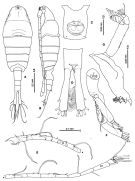 issued from : S. Ohtsuka in Proc. Biol. Soc. Washington, 1992, 105 (2). [p.257, Fig.1]. Female (from Twin Cays, off Belize): A, habitus (dorsal); B, idem (lateral left side); C, genital somite (ventral); D, Anal somite and caudal rami (dorsal); E, right A1; F, A2; G, Md.
|
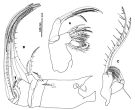 issued from : S. Ohtsuka in Proc. Biol. Soc. Washington, 1992, 105 (2). [p.258, Fig.2]. Female: A, Mx1; B, Mx2; C, Mxp. Nota: arrowhead on Mx2 meaning a relatively developed seta, compared with that of Tortanus erabuensis.
|
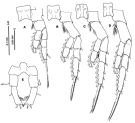 issued from : S. Ohtsuka in Proc. Biol. Soc. Washington, 1992, 105 (2). [p.259, Fig.3]. Female: A, P1 (anterior); B, P2 (anterior); C, P3 (anterior); D, P4 (anterior); E, P5 (anterior).
|
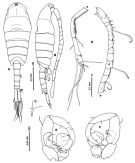 issued from : S. Ohtsuka in Proc. Biol. Soc. Washington, 1992, 105 (2). [p.261, Fig.4]. Male: A, habitus (dorsal); B, idem (lateral right side); C, posterolateral process of 2nd urosomal somite (ventral); D, right A1; E, P5 (anterior); F, P5 (posterior).
|
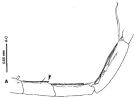 issued from : S. Ohtsuka in Proc. Biol. Soc. Washington, 1992, 105 (2). [p.263, Fig.6 A]. Male: A, grasping portions of right A1. Nota: An arrohead means an anterodistal process of segment 17 (compare with T. setacaudartus and T. compernis).
| | | | | Ref. compl.: | | | Suarez Morales, 1994 (tab.1); Suarez-Morales & Gasca, 1998 a (p.111) | | | | NZ: | 1 | | |
|
Carte de distribution de Tortanus (Acutanus) angularis par zones géographiques
|
| | | | Loc: | | | Belize (mangrove cay), Chetumal Bay (Mexico) | | | | N: | 3 | | | | Lg.: | | | (637) F: 1,09-0,98; M: 0,88-0,77; {F: 0,98-1,09; M: 0,77-0,88} | | | Dernière mise à jour : 01/02/2015 | |
|
|
 Toute utilisation de ce site pour une publication sera mentionnée avec la référence suivante : Toute utilisation de ce site pour une publication sera mentionnée avec la référence suivante :
Razouls C., Desreumaux N., Kouwenberg J. et de Bovée F., 2005-2025. - Biodiversité des Copépodes planctoniques marins (morphologie, répartition géographique et données biologiques). Sorbonne Université, CNRS. Disponible sur http://copepodes.obs-banyuls.fr [Accédé le 30 novembre 2025] © copyright 2005-2025 Sorbonne Université, CNRS
|
|
|
|




 angularis - Planche 1 de figures morphologiques',750,500);)
 angularis - Planche 2 de figures morphologiques',750,500);)
 angularis - Planche 3 de figures morphologiques',750,500);)
 angularis - Planche 4 de figures morphologiques',750,500);)
 angularis - Planche 5 de figures morphologiques',750,500);)








 angularis - Planche 1 de figures morphologiques)
 angularis - Planche 2 de figures morphologiques)
 angularis - Planche 3 de figures morphologiques)
 angularis - Planche 4 de figures morphologiques)
 angularis - Planche 5 de figures morphologiques)