issued from : M. Saraswathy
in Proc. Symp. Crustacea.- Symp. Ser. mar. biol. Ass.India, 1966, 2 (1). [p.96, Fig.8].
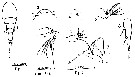
Copepodite (from Trivandrum coast, SW India): 1, habitus (dorsal); 2, forehead (ventral); 3, A2; 4, Md; 5, Mx1; 6, Mx2; 7, Mxp; 8, caudal ramus.
Nota: Rostrum trufid and bent downwards.
A1 5-segmented, 2nd segment longest;
A2 4-segmented, 4th segment minute and provided with long setae, 3rd segment with very characteristic flattened blade-like spines, inner surface of the segment with a close array of minute spines.
Md composed of a curved conical claw and 2 small denticulated spines.
Mx1 a small flat aoppendage with setae. Mx2 2-segmented, basal segment and the small distal segment with spines and setae
Mxp 2-segmented, basal segment with 2 plumose setae, the elongated distal segment with 2 plumose setae at its apex and 2 smaller plumose setae on its inner margin.
Two pairs of swimming legs, both rami 1-segmented, rudimentary P3.
3rd urosomal segment with 2 groups of spines on the ventral side





;)

 Toute utilisation de ce site pour une publication sera mentionnée avec la référence suivante :