|
|
 |
Fiche d'espèce de Copépode |
|
|
Cyclopoida ( Ordre ) |
|
|
|
Oncaeidae ( Famille ) |
|
|
|
Oncaea ( Genre ) |
|
|
| |
Oncaea paraclevei Böttger-Schnack, 2001 (F) | |
| | | | | | | Ref.: | | | Böttger-Schnack, 2001 (p.78, Descr.F, figs.F); Böttger-Schnack & Schnack, 2013 (p.4: Table 1, Rem.: s.str-Group) | 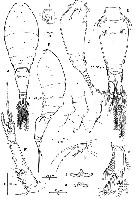 issued from : R. Böttger-Schnack in Bull. nat. Hist. Mus. Lond. (Zool.), 2001, 67 (1). [p.79, Fig.29]. Female (from Red Sea): A, habitus (dorsal); B, idem (lateral) [a, b, c, different degrees of telescoping of somites, causing variation in conspicuousness of dorso-posterior projection on P2-bearing somite]; C, urosome (dorsal, setae V and VI (right) not figured [d, e: variation in form of sclerotization between genital apertures]; D, urosome (lateral); E, A1; F, caudal ramus (dorsal); G, P5; H, P6. Remarks: Males were not encoutered during the present study, although ovigerous females and specimens carrying spermatophores were observed. Thos males co-occurring with females of O. clevei and O. paraclevei were all assigned to the first species at claser examination, based on the proportional length of endopodal spines on P4. However, as this is variable character in O. paraclevei, it might not be adequate to separate males of these two species. Further investigation using alternative methods, such a molecular analysis, may help to identify males of O. paraclevei, which cannot be distinguished morphologically.
|
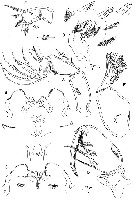 issued from : R. Böttger-Schnack in Bull. nat. Hist. Mus. Lond. (Zool.), 2001, 67 (1). [p.80, Fig.30]. Female : A, A1; B, labrum (anterior; C, idem (posterior); D, Md (showing individual elements) [d, blade, showing variation in number of dentiform processes]; E, Mx1; F, Mx2; G, Mxp.
|
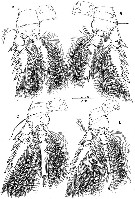 issued from : R. Böttger-Schnack in Bull. nat. Hist. Mus. Lond. (Zool.), 2001, 67 (1). [p.81, Fig.31]. Female: A, P1 (anterior); B, P2 (anterior); C, P3 (anterior); D, P4 (anterior).
| | | | | Ref. compl.: | | | Böttger-Schnack & al., 2001 (p.1029, tab.1); Rezai & al., 2004 (p.490, tab.2, Rem.); McKinnon & al., 2008 (p.844: Tab.1) | | | | NZ: | 3 | | |
|
Carte de distribution de Oncaea paraclevei par zones géographiques
|
| | | | | | | Loc: | | | Red Sea (? North, Central - S), N Arabian Sea, Straits of Malacca, W Australia (North West Cape) | | | | N: | 3 | | | | Lg.: | | | (819) F: 0,66; 0,65; {F: 0,65-0,66} | | | Dernière mise à jour : 05/12/2016 | |
|
|
 Toute utilisation de ce site pour une publication sera mentionnée avec la référence suivante : Toute utilisation de ce site pour une publication sera mentionnée avec la référence suivante :
Razouls C., Desreumaux N., Kouwenberg J. et de Bovée F., 2005-2026. - Biodiversité des Copépodes planctoniques marins (morphologie, répartition géographique et données biologiques). Sorbonne Université, CNRS. Disponible sur http://copepodes.obs-banyuls.fr [Accédé le 17 juin 2026] © copyright 2005-2026 Sorbonne Université, CNRS
|
|
|
|




;)
;)
;)