issued from : E. Suarez-Morales
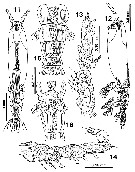
in Ann. Inst. Biol. Univ. Nac. Aut. Mexico, ser. Zool., 2001, 72 (1). [p.17, Figs.11-16].
Female (from 18°34'07''N, 87°22'47''W): 11-12, habitus (dorsal and lateral, respectively); 13, left A1 (dorsal); 14, right A1 (dorsal); 15, urosome (dorsal; caudal rami not shown); 16, 5th pedogrous somite and genital double-somite (ventral).
Nota:
- Cephalothorax about 63.4% of total body length (caudal rami excluded).
- Oral papilla slightly protuberant, located at about 0.5 of distance posteriorly along ventral surface of cephalothorax.
- Dorsal ocelli present, strongly pigmented only at inner margins; pigment cups separated by distance of about 1.7 ocelli diameters., rounded in dorsal view.
- 3 pairs of strongly chitinized, nipple-like cuticular processes located ventrally anterior to oral papilla.
- A1 moderately long, with 4 apparent segments, intersegmental division between putative segments 3-4 marked only by a constriction. Antennular length representing 15.8% of total body length, and 25% as long as cephalothorax. length ratio of segments 23.6 : 14.2 : 140.5 : 52.7 (includes fused 3rd and 4th segments).
- P5 formed by single lobe, bearing 3 terminal setae, plus 4th seta on proximal 1/3 of inner margin.
- Urosome comprising 5th pedigerous somite, genital double-somite plus 2 free somites.
- Genital doubble-somite representing 46% of urosome, with incomplete dorsal suture.
- Caudal rami subrectangular, with 6 setae.





;)
;)
;)
 Toute utilisation de ce site pour une publication sera mentionnée avec la référence suivante :