|
|
 |
Fiche d'espèce de Copépode |
|
|
Calanoida ( Ordre ) |
|
|
|
Clausocalanoidea ( Superfamille ) |
|
|
|
Mesaiokeratidae ( Famille ) |
|
|
|
Mesaiokeras ( Genre ) |
|
|
| |
Mesaiokeras nanseni Matthews, 1961 (F,M) | |
| | | | | | | Ref.: | | | Matthews, 1961 (p.33, figs.F,M); Fosshagen, 1978 (p.179, figs.F,M, juv.); Huys & Boxshall, 1991 (p.81,fig.F); Boxshall & Halsey, 2004 (p.144) | 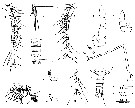 issued from : A. Fosshagen in Sarsia, 1978, 63. [p.181, Fig.2]. Female (from Norwegian fjords): A, caudal rami (dorsal); B, urosome (dorsal); C, A1; D, Mx1; E, left P5. Nota: A simgle small rostral filament. A1 23-segmented. P5 as a 1-segmented rudiment on the left side. Caudal rami with 3 transverse rows of dorsal spines, one in the middle, and one terminally; the terminal row is the more extensive and consists of coarser spines; in the middle of the inner margin of the right ramus there is a small ventrally directed seta; proximally on the inner margin of the left ramus there arises a very long seta directed to the right at a right angle to the urosome, this seta is without setules, it narrows distally into a very fine flexible tip; each ramus bears 4 terminal setae, the outermost one relatively weak. Male: F, urosome (dorsal); G, left A1; H, right A1 (distal segments); I, P5; J, left P5 (distal part). Nota: No rostral flament could be discerned. last prosomal segment slightly asymmetrical due to an extension of the right distal corner. 1st urosomal segment more prominently on the left side; on each side there is 1 transverse row of long spinules. The long proximal seta on the left caudal ramus in the female is replaced in the male by a small seta. Right A1 22-segmented and the left one 23-segmented; segments 9-12 separate on the right A1 but partly fused on the left, segments 19 and 20 fused on the right A1 but separate on the left A1. Right P5 is a rounded stump, carrying a terminal row of small spines, and near the inner margin a slender spine; the penultimate segment of left P5 bears a pointed distal process; the last segment ends in a strong spine and a blunt, flattened subterminal spine, on each side of which there is a small spine. Copepodids: K, P5 (stage V Male); L, P5 (stage IV Male); M, P5 (stage V Female).
|
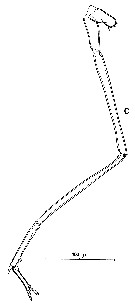 issued from : R. Huys & G.A. Boxshall in Copepod Evolution. The Ray Society, 1991, 159. [p.78, Fig.2.2.25, C]. Male (from 60°16'N, 05°08'E): C, P5.
| | | | | Ref. compl.: | | | Matthews, 1967 (p.159, Table 1, Rem.) | | | | NZ: | 1 | | |
|
Carte de distribution de Mesaiokeras nanseni par zones géographiques
|
| | | | Loc: | | | W Norway (Raunefjorden) | | | | N: | 3 | | | | Lg.: | | | (408) F: 0,51-0,48; M: 0,45-0,43; (409) F: 0,41; M: 0,37; {F: 0,41-0,51; M: 0,37-0,45} | | | | Rem.: | epibenthic (common below 55m to 600 m).
After Fosshagen (1978, p.180) the species finds optimal condition at salinities of more 34 p.1000 and at temperature between 5° and 8°C. | | | Dernière mise à jour : 17/01/2015 | |
|
|
 Toute utilisation de ce site pour une publication sera mentionnée avec la référence suivante : Toute utilisation de ce site pour une publication sera mentionnée avec la référence suivante :
Razouls C., Desreumaux N., Kouwenberg J. et de Bovée F., 2005-2025. - Biodiversité des Copépodes planctoniques marins (morphologie, répartition géographique et données biologiques). Sorbonne Université, CNRS. Disponible sur http://copepodes.obs-banyuls.fr [Accédé le 06 juin 2025] © copyright 2005-2025 Sorbonne Université, CNRS
|
|
|
|




;)
;)