|
|
 |
|
Calanoida ( Order ) |
|
|
|
Arietelloidea ( Superfamily ) |
|
|
| |
| | | |
| Augaptilidae Sars, 1905 ( Arietelloidea ) | | Ref.: | Sars, 1905 c (p.4); Gurney, 1931 a (p.84); Sewell, 1932 (p.312, Rev.); Rose, 1933 a (p.209); Brodsky, 1950 (1967) (p.82, 359); Matthews, 1972 (p.4); Björnberg, 1972 (p.49, N); Andronov, 1974 a (p.1005); Bowman & Abele, 1982 (p.9); Björnberg & al., 1981 (p.650); Razouls, 1982 (p.478); Brodsky & al., 1983 (p.141, 145); Zheng Zhong & al., 1984 (1989) (p.248, spp. Key); Mauchline, 1988 (p.705: cuticular pores); Huys & Boxshall, 1991 (p.460); Razouls, 1993 (p.306); Madhupratap & al., 1996 (p.863, Table 5: %/copepods); Chihara & Murano, 1997 (p.727); Bradford-Grieve & al., 1999 (p.882, 901, 903, 937, Genera Key); Bradford-Grieve,1999 b (p.39, Def., Rem.); Matsuura & Nishida, 2000 (p.339, Rem.: button setae on Mx2 and Mxp); Ohtsuka & Huys, 2001 (p.461); Boxshall & Halsey, 2004 (p.13, 14; 49; 66: Def.; p.68: Genera Key); Mulyadi, 2004 (p.184); Vives & Shmeleva, 2007 (p.168, Genera Key); Blanco-Bercial & al., 2011 (p.103, Table 1, Fig.2, 3, 4, molecular biology, phylogeny); Laakmann & al., 2019 (p.330, fig. 2, 3, phylogenetic relationships); Hirai & al., 2020 (p.1, Fig.4: metabarcoding, Fig.8: OTUs distribution patterns)
Bradford-Grieve J.M., (2002 onwards). Key to calanoid copepod families. Version 1 : 2 oct 2002. http://www.crustacea.net/crustace/calanoida/index.htm  | | Rem.: | Type-genus: Augaptilus Giesbrecht, 1889.
Definition after Bradford-Grieve (1999, p.41) female:
- Body usually slender, prosome oval.
- Urosome a relatively small proportion of total length.
- Cephalosome and pediger 1 separated, pedigers 4 and 5 fused
- Posterolaterak corners of the last thoracic segment usually rounded but sometimes pointed.
- Rostral filaments slender or absent, sometimes represented by a knob.
- Urosome usually short, 3-4-segmented.
- Genital segment with a ventral swelling.
- Caudal rami symmetrical with 6 setae
- A1 symmetrical, 24-25-segmented.
- P1-P5 with exopods 3-segmented; endopods usually 3-segmented except for P5 in Pontoptilus and few Euaugaptilus where it is 2-segmented and in Pachyptilus and Heteroptilus where it is 1-segmenyed/
- Occasionally P1 endopod 2-segmented (some Euaugaptilus, Heteroptilus, Pachyptilus, Augaptilus).
Male:
- Body similar to female.
- Urosome 5-segmented.
- Left A1 geniculate, ?21-22-segmented; sometimes geniculate on right.
- Mouthparts similar to female althrough may be atrophied in Haloptilus.
This family has been revised by Brodsky (1950) who adds the new genus Neoaugaptilus. Matthews (1972) takes up the history of this family and includes the genus Disco of Grice et Hulsemann (1965) which will constitute later the type of a new family (Discoidae).
Following Sewell (1932, 1947) and Vervoort (1965), Matthews reconsiders the problem of possible and desired groups within the genus Euaugaptilus by a numerical analysis. The similarity coefficients obtained from 35 characters and their classification by an analysis in principal coordinates permits the author to define two species groups: 'E. affinis' and 'E. squamatus', and to specify the specific affinities that can lead to a synonymy as for E. marginatus and E. longiantennalis. Likewise, it is suggested that the genus Neoaugaptilus should not be maintained. Tanaka and Omori (1974) have used the same procedure for the species sampled in the Japanese waters and consider 21 characters.
Taxonomic notes in Boxshall & Halsey (2004, p.68): The Augaptilidae exhibits numerous plesiomorphic character states, particularly in the segmentation and setation of P1 to P5 and the lack of fusion in A1. The family was placed in the superfamily Arietelloidea (as Augaptiloidea) by Andronov (1974) and Park (1986), characterised by the male geniculate A1 on the left side, by the elongation of the maxillulary exopod and by the well developed endite on the 1st endopodal segment of Mx2. The separation of the proximal segments of the antennal exopod was listed as a distinguishing character of the superfamily (Park, 1986) but augaptilids typically possess a double-segment derived from ancestral exopodal segments II and III, and ancestral exopodal segment IV is free.
Type-genus: Augaptilus Giesbrecht, 1889. Total: 10 or 11 Genera: Alrhabdus (?), Augaptilina, Augaptilus, Centraugaptilus, Euaugaptilus, Frankferrarius, Haloptilus, Heteroptilus, Pontoptilus, Pseudaugaptilus, Pseudhaloptilus.
Neoaugaptilus is synonymous with Euaugaptilus (in Matthews,1972, p.63) and Disco constitutes the type of the family of the Discoidae (in Gordeeva,1975, p.189).
Bradford-Grieve & al., 1999 (p.942) and Bradford-Grieve,1999 b (p.42) consider the genus Pseudhaloptilus as a synonym of Pachyptilus.
Boxshall & Halsey, 2004 (p.68) referring to a work of Soh (1998, unpublished) consider that Pachyptilus is a junior synonym of Pseudhaloptilus. They incorporate the genus Alrhabdus (Heterorhabdidae) as incertae sedis among the Augaptilidae until the male is known.
Markhaseva (2013, p.1250) defines a new genus Frankferrarius provisionally placed in this family.
Key to Genera after Boxshall & Halsey (2004, p.68) :
1 - P1 with inner coxal seta; P4 with outer basal seta ................2
1 - P1 without inner coxal seta; P4 without outer basal seta ...........7
2 - Female urosome 4-segmented; male (where known) with inner process on coxa of P5 .........3
2 - Female urosome 3-segmented; male without inner process on coxa of P5 .............4
3 - Mandibular palp biramous; Mxp with 2 setae of basal origin on basis .......Haloptilus.
3 - Mandibular palp with endopod reduced to asetose lobe; Mxp with 3 setae of basal origin on basis .........Alrhabdus.
4 - Mandibular palp biramous ..........5.
4 - Mandibular palp uniramous, lacking endopod, or reduced to 2-segmented vestige ...........6.
5 - A1 in both sexes extending to or beyond caudal rami; coxal endite of Mx1 developed ............Euaugaptilus.
5 - A1 in both sexes not extending beyond posterior corner of prosome; coxal endite of Mx1 absent ............. Centraugaptilus.
- 6 Mx2 and Mxp armed with setal brushes on distal segments; Mx1 with normally developed praecoxal arthrite .........Augaptilina.
6 - Mx2 and Mxp armed with normal setae; Mx1 modified, lacking praecoxal arthrite ...........Augaptilus.
7 - Mx1 with 1 or 2-segmented endopod ............9.
8 - Mx1 without endopod ..........9.
8 - Rostrum of female with pair of small chitinized filaments; female labrum large .........Pseudhaloptilus.
8 - Rostrum without filaments in both sexes; labrum small in both sexes ..........Pontoptilus.
9 - Mx1 epipodite lacking setae; P1 with 3-segmented endopod; P5 with 3-segmented endopod in female ...........Pseudaugaptilus.
9 - Mx1 epipodite with up to 6 long setae; P1 with 2-segmented endopod; P5 with 1-segmented endopod in female .............Heteroptilus | 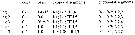 Issued from : G.A. Boxshall & S.H. Halsey in An Introduction to Copepod Diversity. The Ray Society, 2004, No 166, Part. I. [p.66]. Armature formula of swimming legs P1 to P5. * Inner seta on basis of P1 present in Alrhabdus, typically absent. Outer basal seta sometimes present on P3, as in Alrhabdus. Npta: Female P5 of similar construction to legs P1 to P4, with 3-segmented rami; endopod 2-segmented in Pontoptilus, 1-segmented in Heteroptilus and Pseudhaloptilus; setation of legs P1 to P5 often reduced. Exopodal setation of female P5 of Alrhabdus : 1-0; I-1; II,I,4. - Male P5 primitively symmetrical and biramous with 2 or 3-segmented rami, but retaining few setation elements, usually outer and terminal spines on exopod, and distal elzments on endopod. - Eggs release into water. |
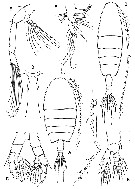 Issued from : G.A. Boxshall & S.H. Halsey in An Introduction to Copepod Diversity. The Ray Society, 2004, No 166, Part. I. [p.67, Fig.6]. Augaptilidae. A, Pseudhaloptilus lobatus (as Pachyptilus lobatus) habitus female; B, Euaugaptilus oblongus hanitus female; C, male P5; D, Euaugaptilus bullifer female rostrum; E, Haloptilus validus female A2; F, female Mx1; G, Haloptilus tenuis female P1; H, Augaptilus glacialis tip of male A1. [Sars, 1924]. |
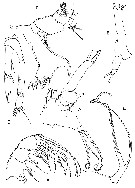 Issued from : G.A. Boxshall & S.H. Halsey in An Introduction to Copepod Diversity. The Ray Society, 2004, No 166, Part. I. [p.69, Fig.7]. Augaptilidae. A, Centraugaptilus cucullatus female Mx1; B, Augaptilus megalurus female Md; C, Augaotilus sp. female A2; D, Pseudhaloptilus pacificus female left Md; E, Augaptilus sp. female Mx1; F, Haloptilus fons female Mx2. [Soh, 1998]. |
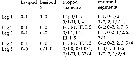 Issued from : J.M. Bradford-Grieve in NIWA Biodiversity Memoir, 111, 1999 [p.41]. Spine and seta formula of swimming legs P1 to P5. Female and male similar except P5. - P5 female: natatory, symmetrical, similar to other swimming legs but smaller than P2-P4; inner edge seta on exopod segment 2 often spine-like and articulated with its segment. - P5 male: with 3-segmented endopod and exopod on both left and right, slightly asymmetrical; right exopod segment 2 with inner expansion of variable shape but usually in the form of a thick spine. | | | | | (0) Alrhabdus Grice, 1973 (? Augaptilidae ) | |
| | Ref.: | Grice, 1973 (p.943, 946); Razouls, 1982 (p.476); 1993 (p.307); Mauchline, 1998 (p.70); Bradford-Grieve, 1999 b (p.71, Def.); Park, 2000 (p.1, 8, 141); Boxshall & Halsey, 2004 (p.68, Rem.); Renz & Markhaseva, 2015 (p.96, Table 4, fig.3, sex ratio, biogeography) | | Rem.: | Grice (1973, p.946) placed the genus among the Heterorhabdidae, until a male is found. Boxshall & Halsey (2004, p.68) placed the genus in Augaptilidae, as incertae sedis.
Type: Alrhabdus johrdeae Grice, 1973. Total: 1 sp.:
Diagnosis after Grice (1973, p.943):
1 - Prosome about twice the length of urosome.
2 - Head separate from 1st pedigerous somite, 4th and 5th pedigerous somites fused, posterior corner bifurcate.
3 - Urosome 4-segmented.
4 - Rostral plate provided with 2 strong spines.
5 - Labrum with cluster of ventrally projecting spines.
6 - Caudal rami asymmetrical, right ramus slightly longer than left and bears elongate seta.
7 - Seta on outer distolateral corner of basis of P3-P5.
8 - Modified seta on 1st and 2nd endopods of P5.
Gender feminine.
Diagnosis after Bradford-Grieve (1999 b, p.71) :
- Relatively large copepod. Male unknown
- Head and pedigerous segment 1 separate, pedigerous segments 4 and 5 separate, posterior corners bifurcate.
- Urosome 4-segmented.
- Rostral plate with 2 strong spines.
- Labrum with a cluster of ventrally projecting spines.
- Caudal rami asymmetrical, right ramus slightly longer than left and bearing an elongate seta.
- Md with a small palp, blade with 4 large , approximately evenly spaced teeth.
- Mx1 with a well-developed inner lobe 1, remainder of limb relatively small; outer lobe 1 with 5 setae, exopod with 6 setae, basipod 2 with 1 seta, and endopod with 3 setae.
- Mx2 with all lobes present, with setae and spines becoming thicker and stronger progressing from proximal to distal, including the terminal-most spine-like setae.
- Mxp basipodwith 8 spines and setae, basipod 2 with 3 marginal spines.
- P3-P5 basipod 2 with 1 seta on outer distolateral corner.
- P5 exopod segment 2 with a short spine, endopod segments 1 and 2 with inner edge setae modified into a lobate form witha sensory filament terminally. | | | | (1) Augaptilina Sars, 1920 | |
| | Ref.: | Sars, 1920 c (p.17); 1925 (p.308); Rose, 1933 a (p.234); Tanaka, 1964 b (p.84); Matthews, 1972 (p.4); Razouls, 1982 (p.516); Mauchline, 1988 (p.704); Razouls, 1993 (p.306); Mauchline, 1998 (p.66); Bradford-Grieve,1999 b (p.42, Def.); Boxshall & Halsey, 2004 (p.70); Vives & Shmeleva, 2007 (p.169) | | Rem.: | Type: Augaptillina scopifera Sars, 1920. Total: 1 sp.
Diagnosis after Bradford-Grieve (1999 b, p.42): As for the family definition with the following additional characters:
1 - Urosome of female 3-segmented.
2 - Mandibular palp and Mx1 very reduced.
3 - Distal setae on Mx2 and Mxp form dense, elongate bunches resembling a brush.
4 - P1 endopod 2-segmented. | | Remarks on dimensions and sex ratio: | | Body length from 1 female: 4.30 mm. | | | | (2) Augaptilus Giesbrecht, 1889 | |
| | Syn.: | Hemicalanus (part.) Claus, 1863 (p.176); Sars, 1900 (p.94) | | Ref.: | Giesbrecht, 1892 (part., p.65, 400); Giesbrecht & Schmeil, 1898 (p.120, clé spp.); Sars, 1900 (p.87); Esterly, 1905 (p.187); van Breemen, 1908 a (p.131, spp. Key); Farran, 1908 b (p.71); A. Scott, 1909 (p.135); Wolfenden, 1911 (p.332); Sars, 1920 c (p.12, Rem.); 1925 (p.254); Farran, 1926 (p.288); Sewell, 1932 (p.313, 325); Wilson, 1932 a (p.135); Rose, 1933 a (p.215, clé spp.); Brodsky, 1950 (1967) (p.366, spp. Key); Tanaka, 1964 b (p.74); Matthews, 1972 (p.3, 4, 45, tab.5); Razouls, 1982 (p.485); Mauchline, 1988 (p.702); Razouls, 1993 (p.306); Chihara & Murano, 1997 (p.727); Mauchline, 1998 (p.71: F; p.74: M); Bradford-Grieve & al., 1999 (p.939: spp. Key); Bradford-Grieve,1999 b (p.42, Def.); Boxshall & Halsey, 2004 (p.70); Vives & Shmeleva, 2007 (p.169, spp. key) | | Rem.: | type : Hemicalanus longicaudatus Claus,1863. Total: 7 spp. (of which 1 doubtful).
Diagnosis after Bradford-Grieve (1999b, p.42): As for the family definition with the following additional characteristics:
- Cephalosome and pediger 1 separated, pedigers 4 and 5 fused.
- Posterolateral corners of last thoracic segment usually rounded.
- Rostral filaments fine.
- Female urosome 3-segmented, genital segment nearly always a little asymmetrical.
- Female A1 25-segmented
- Urosome male 5-segmented.
- Left A1 prehensile.
- A2 exopod rarely extending beyond endopod and with a reduced number of segments.
- Mandibular palp uniramous.
- Mx1 very reduced, consisting of a 3-segmented rod.
- Mx2 with proximal lobes rudimentary and with distal setae bearing characteristic shield-shaped appendages.- Mxp often with shield-shaped appendages.
- External spines on swimming legs more or less atrophied.
- Female P5 biramous with endopod and exopod 3-segmented each. | | Remarks on dimensions and sex ratio: | | The mean female size is 4.374 mm (n = 12; SD = 1.3183), and for the males 1.141 mm ( n = 7; SD = 0.8617). The size ratio (Male: Female) is 0,947). The sex tatio (F;M) = 1.75 | | | Remark : The following species were originally included in the genus Augaptilus :
A. angustus Sars,1905 ( Cf. Euaugaptilus angustus ); A. antarcticus Wolfenden, 1911 (Cf. Euaugaptilus laticeps ); A. brevicaudatus Sars,1905 (Cf. Euaugaptilus squamatus ); A. bullifer Giesbrecht,1889 (Cf. Euaugaptilus bullifer ); A. californicus Esterly,1913 (Cf. Euaugaptilus squamatus ); A. clavatus Sars,1907 (Cf. Euaugaptilus clavatus ); A. cucullatus Sars,1905 (Cf. Centraugaptilus cucullatus ); A. depressus Esterly,1913 (Cf. Euaugaptilus filigerus ); A. elongatus Sars,1905 (Cf. Euaugaptilus elongatus ); A. facilis Farran,1908 (Cf. Euaugaptilus facilis ); Augaptilus fungiferus Steuer,1904 (F) [Ref.: Steuer,1904 (p.597,Descr.F); Wolfenden,1911 (p.336,figs.F); Matthews,1972 (p.35, Rem .)](Cf. Euaugaptilus magnus ); A. gibbus Wolfenden, 1904 (Cf. Euaugaptilus gibbus (Wolfenden, 1904); Augaptilus gibbus Sars,1905 [Ref.: Sars,1905 c (p.16,Rem.F);1907 a (p.3); Matthews,1972 (p.31)](Cf. Euaugaptilus gibbus (Wolfenden,1904)); A. gracilis Sars,1905 ( Cf. Euaugaptilus gracilis ); A. hecticus Giesbrecht,1889 (Cf. Euaugaptilus hecticus ); A. horridus Farran,1908 (F) (Cf. Centraugaptilus horridus ); A. laticeps Sars,1905 (Cf. Euaugaptilus laticeps ); A. latifrons Sars, 1907 (Cf. Euaugaptilus latifrons ); A. longicirrhus Sars,1905 (Cf. Euaugaptilus longicirrhus ); A. longimanus Sars,1905 (Cf. Euaugaptilus longimanus ); A. lucidus Esterly, 1911 (Cf. Centraugaptilus lucidus ); A. macrodus Esterly, 1911(Cf. Centraugaptilus rattrayi ); A. magnus Wolfenden,1904 (Cf. Euaugaptilus magnus ); A. mixtus Sars,1907 (Cf. Euaugaptilus mixtus ); A. nodifrons Sars,1905 (Cf. Euaugaptilus nodifrons ); A. oblongus Sars,1905 (Cf. Euaugaptilus oblongus ); A. palumbii Giesbrecht,1889 (Cf. Euaugaptilus palumboi ); A. placitus A. Scott,1909 (Cf. Euaugaptilus laticeps ); A. pyramidalis Esterly,1911 (Cf. Centraugaptilus horridus ); A. rattrayi T. Scott,1894 (Cf. Centraugaptilus rattrayi ); A. romanus Esterly, 1913 (Cf. Euaugaptilus filigerus ); A. rostratus Esterly,1906 (Cf. Euaugaptilus oblongus ); A. similis Farran,1908 (Cf. Euaugaptilus similis ); A. simplex Wolfenden,1911 (Cf. Euaugaptilus nodifrons ); Augaptilus simplex Esterly,1913 (Cf. Euaugaptilus nodifrons ); A. squamatus Giesbrecht,1889 (Cf. Euaugaptilus squamatus ); A. subfiligerus Wolfenden,1911 (Cf. Euaugaptilus oblongus ); A. tenuicaudis Sars,1905 (Cf. Euaugaptilus tenuicaudis ); A. tenuispinus Sars,1920 (Cf. Euaugaptilus tenuispinus ); A. truncatus Sars,1905 (Cf. Euaugaptilus truncatus ); A. validus A. Scott,1909 (Cf. Euaugaptilus validus ); A. zetesios Wolfenden,1902 (Cf. Augaptilus glacialis ) | | | | (3) Centraugaptilus Sars, 1920 | |
| | Ref.: | Sars, 1920 c (p.17);1925 (p.304); Sewell, 1932 (313, 326); Rose, 1933 a (p.232); Brodsky, 1950 (1967) (p.386, clé spp.); Tanaka, 1964 b (p.80, 81); Matthews, 1972 (p.4, 56); Razouls, 1982 (p.514); Gardner & Szabo, 1982 (p.383); Mauchline, 1988 (p.704); Razouls, 1993 (p.306); Chihara & Murano, 1997 (p.727); Mauchline, 1998 (p.71: F; p.74: M); Bradford-Grieve & al., 1999 (p.938, 939: clé spp.); Bradford-Grieve,1999 b (p.42, Def.); Boxshall & Halsey, 2004 (p.70); Vives & Shmeleva, 2007 (p.178, spp. key) | | Rem.: | type: Augaptilus rattrayi rattrayi T. Scott, 1894 . Total: 6 spp.
Diagnosis after Bradford-Grieve (1999 b, p.42):
- As for the family definition with additional chatacteristics.
- The genus is separated from Augaptilus by having a strong bifurcate rostrum projecting forward.
- Cephalosome and pediger 1 separated, pedigers 4 and 5 fused.
- A1 short, not extending beyond prosome.
- Md elongate with 2 fine teeth and a smaller tooth between them.
- Mx1 inner lobe 1 with 2 long, hooked spines bearing shield-like appendages and 1 short seta; inner lobes 2 and 3 absent; endopod with 3 setae; exopod with 3 setae; outer lobe with 5 setae.
- Mx2 and Mxp powerful with distal setae strong and rolled up, carrying shield-shaped appendages.
- P1 exopod segment 2 without an outer distal spine. | | Remarks on dimensions and sex ratio: | | The mean female size is 6.599 mm (n = 9; SD = 2.0756), and for the males 6.483 mm (n = 6; SD = 1.5074). The size ratio (Male: Female) is 0.982. The sex ratio (F: M) = 1.25. | | | | | (4) Euaugaptilus Sars, 1920 | |
| | Syn.: | Neogaptilus Brodsky, 1950 (1967) (p.360, 385); Tanaka, 1964 b (p.74); Matthews, 1972 (p.4, 63, Rem.); Razouls, 1982 (p.514); 1993 (p.306) | | Ref.: | Sars, 1920 c (p.13); 1925 (p.260, Rem.); Farran, 1926 (p.288); Sewell, 1932 (p.313, 316, Rem.); 1947 (p.196, 198, 206, 222, 231, Rev.); Rose, 1933 a (p.220, spp. Key); Brodsky, 1950 (1967) (p.373, spp. Key); Tanaka, 1964 b (p.45); Vervoort, 1965 (p.133, Rem.); Owre & Foyo, 1967 (p.83, spp. Key); Matthews, 1972 (p.3,4, Rev., tab.5); Tanaka Omori, 1974 (p.193, Rev., spp. Key); Roe, 1975 (p.346); Razouls, 1982 (p.495); Boxshall, 1986 (p.158); Mauchline, 1988 (p.702); Huys & Boxshall, 1991 (p.56, 316, 318); Razouls, 1993 (p.306); Park, 1993 (p.2, Rem., spp. Key); Chihara & Murano, 1997 (p.727); Mauchline, 1998 (p.71, 76: F; p.73, 74, 76: M); Bradford-Grieve & al., 1999 (p.938, 939: spp. Key); Bradford-Grieve,1999 b (p.46, Def.); Matsuura & Nishida, 2000 (p.339, Rem.: button setae on Mx2 and Mxp); Boxshall & Halsey, 2004 (p.70); Vives & Shmeleva, 2007 (p.182, spp. Key); Ohtsuka & Boxshall, 2004 (p.54: Rem.) | | Rem.: | Bradford-Grieve (1999 b) follows the position of Matthews (1972, p.63) concerning the synonymy of Neogaptilus. This genus is essentially bathypelagic.
Type: Augaptilus squamatus Giesbrecht, 1899. Total: 72 spp. + 1 unidentified.
Twenty-five characters used in the calculation of similarity coefficients have been tested by Matthews (1972) to discover which could be used in the diagnoses of the two groups. Since the sequence of species is associated with a tendency towards simplification of the structure and setation of the head appendages, a tendency which appears to have been followed along several different pathways, no single character was sufficient to define the groups. Several species, moreover, show affinities with both groups, so any definition must to some extent be arbitrary in its placing of the division between the groups. For this reason the groups have not been given generic or subgeneric rank.It is possible to classify the species based on the structure of Mx1 in 2 groups: ''affinis''' and ''qsquamatus Groups:
1 - "affinis'' Group:
Mx1 reduced with rarely an endopodite and 3rd endite (lobe) generally bears no setae ; in no case are an endopodite and a setose 3rd endite present together. The toyal number of setae and spines never exceeds 22, an dis usually considerably less.
The cup-shaped appendages on certain setae of Mx2 and Mxp almost always well developed.
2 - ''squamatus'' Group:
Mx1 endopodite often present. Generally the appendage with a total setae and spines 24 and 40.
The cup-shaped appendages on certain setae on Mx2 and Mxp often poorly developed or even absent.
E. angustus, E. grandicornis, E. rectus lack both endopodite in Mx1 and any setae on the 3rd endite, but in all three there are at least 26 setae and spines on the whole appendage.
E. marginatus, E. oblongus have only 21 and 23 setae and spines, respectively, on Mx1.
Diagnosis after Bradford-Grieve (1999 b, p.46): As for the family definition with the following additional characteristics:
- Cephalosome and pediger 1 separated
, pedigers 4 and 5 fused.
- Posterolateral corners of last thoracic segment rounded
- Rostral filaments may be present or absent.
- Distinguished from Augaptilus by the greater development of Md and speciallay the Mx1 inner lobe 1 well-developed and provided with a number of strong spines terminally.
- Mandibular palp may be uni or biramous.
- Mx1 inner lobes 2 and 3 and basipod 2 with or without setae, endopod present or absent.
- Mxp may be elongated or more squat.
- P1 exopod and endopods may be 3-segmented or may have some degree of fusion between segments; basipod 2 seta present or absent; external edge spines on exopod variable.
- Female P5 either with both rami 3-segtmented or with some degree of fusion between segments.
After Bode & al. (2018, p.75) some species of this genus are ambush predators, which prey on small copepods by using specialized ''button setae'' on their maxilla and maxilliped (Matsuura & Nishida, 2000; Matsuura & al., 2010).
| | Remarks on dimensions and sex ratio: | | The mean female size is 5.424 mm (n = 115; SD = 2.3099), and the mean male size is 5.5171 mm (n = 45; SD = 1.9846). The size ratio (Male: Female) is 1.017. The sex ratio F; M = 2.433 | | | | | (5) Frankferrarius Markhaseva, 2013 | |
| | Ref.: | Markhaseva, 2013 (p.1251, Def., Rem.); Renz & Markhaseva, 2015 (p.96, Table 4, fig.3, sex ratio, biogeography) | | Rem.: | Type: Frankferrarius admirabilis Markhaseva, 2013. 1 sp.
Provisionally placed in the Augaptilidae family by Markhaseva (2013, p.1263). For the author the species F. admirabilis shares with this family:
1- the general pattern of segmentation and setation of its swimming legs although P3 endopod segment 3 armament is 2, 2 and 3 setae (versus 2, 2 and 4 setae in augaptilids);
2 - a single genital operculum positioned medially on the ventral part of the genital double-somite;
3 - the female P5 has a 3-segmented exopod with armament of I-O, I-1, II, I, 3;
4- the male left P5 is of the augaptilid type. Nevertheless, the species type differs from other augaptilids in being without setae on Mxp basis and in details of morphology and setation of oral parts and basis of P1. This new genus probably should be placed in a new family but this must await a revision of the Augaptilidae. | | Remarks on dimensions and sex ratio: | | The body size for only 1 female is 7.0 mm, and for 1 male 11.2 mm. The male size is greater than the female that is not usual. | | | | (6) Haloptilus Giesbrecht, 1898 | |
| | Syn.: | Hemicalanus (part.) Claus, 1863 (p.176); Brady, 1883 (p.43); Giesbrecht, 1889, 1892 (p.65, 384); Sars, 1900 (p.94) | | Ref.: | Giesbrecht & Schmeil, 1898 (p.117, clé spp.); Sars, 1902 (1903) (p.120); van Breemen, 1908 a (p.127); A. Scott, 1909 (p.140); Sewell, 1932 (p.328); Rose, 1933 a (p.209, clé spp.); Mori, 1937 (1964) (p.74, clé spp.); Sewell, 1947 (p.189); Brodsky, 1950 (1967) (p.361, key spp.); Tanaka, 1964 b (p.39); Björnberg, 1972 (p.51, N); Matthews, 1972 (p.4, 47, tab.5); Björnberg & al., 1981 (p.653); Razouls, 1982 (p.478); Gardner & Szabo, 1982 (p.387); Mauchline, 1988 (p.702); Park, 1988 (p.2, Redef., key of Antactic spp. F, 3 groups); Zheng Zhong & al., 1984 (1989) (p.249, Rem.); Huys & Boxshall, 1991 (p.53); Razouls, 1993 (p.306); Chihara & Murano, 1997 (p.728); Mauchline, 1998 (p.71: F; p.74: M); Bradford-Grieve & al., 1999 (p.938, 941: spp. Key); Bradford-Grieve, 1999 b (p.58, Def.); Boxshall & Halsey, 2004 (p.68); Vives & Shmeleva, 2007 (p.234, spp. key) | | Rem.: | sp. type: Hemicalanus plumosus Claus, 1863. Total: 26 spp. (of which 2 doubtful) + 2 unidentified.
Park (1988, p.2) divides the genus into 3 groups based on the numbers of teeth on the mandibular cutting edge, the number of endopodal segments on Mx1 and the number of setae of Mx1 and Mx2. 1- Primitive group represented by H. fons, H. angusticeps, H. caribbeanensis, H. furcatus, H. major. 2- Specialized group: H. acutifrons, H. longicirrus, H. longicornis, H. mucronatus, H. H. ocellatus, H. ornatus, H. oxycephalus, H. paralongicirrus, H. plumosus, H. pseudooxycephalus, H. spiniceps, H. tenuis. 3- Neither obviously primitive nor fully specialized with regard to these characters: H. austini, H. chierchiae, H. validus.
Diagnosis after Bradford-Grieve (1999 b, p.58): As in the family with the following additional characteristics:
- Female urosome 4-segmented, symmetrical.
- Male urosome 5-segmented.
- Caudal rami and female mouthparts with long plumose setae.
- Male mouthparts atrophied.
- Female A1 25-segmented.
- Male A1 shorter than female and well supplied with aesthetascs, geniculate on left and 21-segmented, with a 4-segmented distal part.
- A2 endopod much longer than exopod.
- Mandible blade forked, endopod and exopod elongate.
- Mx1 well developed with inner lobes 2 and 3, endopod small, exopod elongate.
- Mx2 elongate with reduced lobes, distal setae not much longer than proximal setae.
- Mxp endopod thick.
- P5 exopod segment 2 with inner seta pointed.
- Female P5 with last inner seta of exopodal segment 3 of usual kength.
- Male P5 exopod and endopod 3-segmented and with both terminal exopod segments hooked, without a pincer, right and left alike. | | Remarks on dimensions and sex ratio: | | The mean female size is 4.346 mm (n = 43; SD = 1.5895) , and the mean male size is 2.736 mm (n = 23; SD = 0.764). The size ratio (Male: Female) is 0.630. The sex ratio F:M = 1.923. | | | | (7) Heteroptilus Sars, 1920 | |
| | Syn.: | Pontoptilus (part.) Sars, 1905 c (p.18) | | Ref.: | Sars, 1920 c (p.19);1925 (p.324); Rose, 1933 a (p.327); Brodsky, 1950 (1967) (p.39, 360, Rem.); Tanaka, 1964 b (p.91); Matthews, 1972 (p.4); Razouls, 1982 (p.519); Mauchline, 1988 (p.705); Razouls, 1993 (p.306); Mauchline, 1998 (p.71, 76, 76: F; p.74, 76: M); Bradford-Grieve, 1999 b (p.66, Def.); Boxshall & Halsey, 2004 (p.70); Vives & Shmeleva, 2007 (p.256, spp. key) | | Rem.: | sp. type: Pontoptilus attenuatus. 2 spp. + 1 unidentified.
Diagnosis after Bradford-Grieve (1999 b, p.66): As in the family with the following additional characters. The genus is distinguished by the structure of the mandibles which resemble those of Heterorhabdus with right mandibular blade much larger than the left and carrying an extremely large sctthe-like hook.
- Urosome of female 4-segmented. P1 with a 2-segmented endopod.
- Female P5 with a 1-segmented endopod.
- Male P5 with 3-segmented endopods. | | Remarks on dimensions and sex ratio: | | The mean female size is 4.723 mm (n = 3; SD = 0.8925) and for male 4.795 mm (n = 2; SD = 2.1819). The size ratio (Male: Female) is 0.719 from only 1 species. | | | | Neoaugaptilus Brodsky, 1950 | |
| | Ref.: | Brodsky, 1950 (1967) (p.360, 385); Tanaka, 1964 b (p.74); Matthews, 1972 (p.4, 63, Rem.); Razouls, 1982 (p.514); 1993 (p.306); Bradford-Grieve,1999 b (p.46, Rem.: 47) | | Rem.: | type: Neoaugaptilus distinctus. Cf. Euaugaptilus | | | | | Ref.: | Pachyptilus Sars, 1920 c (p.18); 1925 (p.318); Wilson, 1932 a (p.545); Rose, 1933 a (p.236); Brodsky, 1950 (1967) (p.361, 392); Tanaka, 1964 b (p.86); Bradford, 1972 (p.14); Matthews, 1972 (p.12); Razouls, 1982 (p.518); Gardner & Szabo, 1982 (p.391); Mauchline, 1988 (p.704); Razouls, 1993 (p.306); Chihara & Murano, 1997 (p.729); Mauchline, 1998 (p.71, 76: F); Bradford-Grieve & al., 1999 (p.938, 942: clé spp.); Bradford-Grieve,1999 b (p.67, déf.) | | Rem.: | Cf. Pseudhaloptilus (this genus is considered questionable by Bradford-Grieve et al., 1999, p. 942, but admitted by Boxshall & Halsey, 2004, p.68 who consider Pachyptilus to be a junior synonym). | | Remarks on dimensions and sex ratio: | | The mean female size is 5,395 mm (n= 4; S= 0,308; Cv= 0,057). The only known male has a length of 4,600 mm. The ratio of length (M/F) established for a single species is 0,817 or 81,7 %. | | | | (8) Pontoptilus Sars, 1905 | |
| | Ref.: | (part.) Sars, 1905 c (p.18); 1925 (p.312, Rev.); Sewell, 1932 (p.329); Rose, 1933 a (p.235); Tanaka, 1964 b (p.86); Matthews, 1972 (p.4); Razouls, 1982 (p.516); Mauchline, 1988 (p.704); Razouls, 1993 (p.306); Mauchline, 1998 (p.70: F; p.74: M); Bradford-Grieve,1999 b (p.668, Déf.); Boxshall & Halsey, 2004 (p.70); Vives & Shmeleva, 2007 (p.265, spp. key) | | Rem.: | Type species: Pontoptilus muticus Sars, 1905. Total: 6 spp.
Diagnosis after Bradford-Grieve (1999 b, p.66): As in the family with the following additional characters:
- Urosome female 4-segmented.
- A2 exopod longer than endopod.
- Mx1 with a large inner lobe 1 and all parts present with slender, curved setae.
- P5 female with endopod 2-segmented.
Nota: Body bulky. Cephalosome and pediger 1 separated, pedigers 4 and 5 fused. Posterolateral corners of last thoracic segment symmetrical, rounded or pointed . | | Remarks on dimensions and sex ratio: | | The mean female size is 5.870 mm (n = 8; SD = 1.4782). The only known male is 6.8 mm long. The size ratio (Male: Female) for a single species is 0.799. | | | | (9) Pseudaugaptilus Sars, 1907 | |
| | Ref.: | Sars, 1907 a (p.24); 1925 (p.310); Rose, 1933 a (p.235); Brodsky, 1950 (1967) (p.361, 390); Tanaka, 1964 b (p.84); Matthews, 1972 (p.3, 4, 55, tab.5); Razouls, 1982 (p.520); 1993 (p.306); Chihara & Murano, 1997 (p.729); Mauchline, 1998 (p.71: F; p.74: M); Bradford-Grieve,1999 b (p.68, Def.); Boxshall & Halsey, 2004 (p.70); Vives & Shmeleva, 2007 (p.264) | | Rem.: | Type: Isochaeta longisetosus. Total: 3 spp. (of which 1 doubtful).
For Bradford-Grieve (1999 b, p.68) this genus differs from the genus Euaugaptilus by a 4-segmented urosome in female.
- Rostral filaments long and thin.
- Mandibular blade long and thin and denticulate distally.
- P5 in both sexes with exopod without outer edge spines; and differing little between the sexes. | | Remarks on dimensions and sex ratio: | | The mean female size is 4.856 mm (n = 5; SD = 1.053), and for the male of one species 4.320 mm. The size ratio (Male: female) is 1.026 from only 1 species. | | | | (10) Pseudhaloptilus Wolfenden, 1911 | |
| | Syn.: | Pachyptilus Sars, 1920 c (p.18); 1925 (p.318); Wilson, 1932 a (p.545); Rose, 1933 a (p.236); Brodsky, 1950 (1967) (p.361, 392); Tanaka, 1964 b (p.86); Bradford, 1972 (p.14); Matthews, 1972 (p.12); Razouls, 1982 (p.518); Gardner & Szabo, 1982 (p.391); Mauchline, 1988 (p.704); Razouls, 1993 (p.306); Chihara & Murano, 1997 (p.729); Mauchline, 1998 (p.73, 76: F); Bradford-Grieve & al., 1999 (p.938, 942: spp. Key, Rem.: genus questionable); Bradford-Grieve,1999 b (p.67, Def.); Vives & Shmeleva, 2007 (p.259, spp. key) | | Ref.: | Wolfenden, 1911 (p.325); Wilson, 1932 a (p.545); Matthews, 1972 (p.4); Razouls, 1982 (p.485); 1993 (p.306); Boxshall & Halsey (2004, p.68: Rem; p.70) | | Rem.: | Type: Pontoptilus abbreviatus Sars, 1905.Total: 5 spp.
Diagnosis after Bradford-Grieve (1999 b, p.66): As in the family with the following additional characters:
- Genus distinguished from Pontoptilus by the markedly compact body.
- Presence of a well-developed, bifurcate rostrum.
- Extraordinary development of the anterior lip.
- Md blade elarged and axe-shaped.
- P5 female with 1-segmented endopods. | | Remarks on dimensions and sex ratio: | | The mean female size is 5.542 mm (n = 9; SD =0.9374). The size ratio (Male: Female) is 0.817 from only 1 species. The sex ratio (F: M) is 5. | | | | |
|
|
 Any use of this site for a publication will be mentioned with the following reference : Any use of this site for a publication will be mentioned with the following reference :
Razouls C., Desreumaux N., Kouwenberg J. and de Bovée F., 2005-2026. - Biodiversity of Marine Planktonic Copepods (morphology, geographical distribution and biological data). Sorbonne University, CNRS. Available at http://copepodes.obs-banyuls.fr/en [Accessed March 27, 2026] © copyright 2005-2026 Sorbonne University, CNRS
|
|
|
|



;)
;)
;)
;)
;)