|
|
 |
Fiche d'espèce de Copépode |
|
|
Calanoida ( Ordre ) |
|
|
|
Spinocalanoidea ( Superfamille ) |
|
|
|
Spinocalanidae ( Famille ) |
|
|
|
Spinocalanus ( Genre ) |
|
|
| |
Spinocalanus abyssalis Giesbrecht, 1888 (F,M) | |
| | | | | | | Syn.: | no Spinocalanus abyssalis : Sars, 1903 (p.157, figs.M); With, 1915 (p.69); Jespersen, 1934 (p.51); 1940 (p.16);
S. brevicaudatus (part) Brodsky, 1950 (1967) (p.136);
no S. abyssalis pygmaeus Farran, 1926 (p.246); 1936 a (p.85); ? Hardy & Gunther, 1935 (1936) (p.156, Rem.); Grice, 1963 a (p.495);
S. abyssalis pygmaeus : Farran & Vervoort, 1951 g (part., n° 39, p.3, figs.F); Hopkins, 1985 (p.197, Table 1, gut contents: herbivorous);
S. parabyssalis Park, 1970 (part., p.483, figs.M, no F);
? S. major Esterly,1906 (p.55);
Spinocalanus abyssalis Tanaka, 1937 (part., p.253, figs.M, non F); Brodsky, 1950 (1967) (part., p.132, fig.M, no F) | | | | Ref.: | | | Giesbrecht, 1892 (p.209, Descr.F, figs.F); Giesbrecht & Schmeil, 1898 (p.31); Farran, 1908 b (p.27, Rem.); Lysholm & Nordgaard, 1921 (p.10); ? Sars, 1925 (p.28); Farran, 1926 (part., p.242, Rem.); 1929 (part., p.227: small forms: F: 1,2-1,18); Lysholm & al., 1945 (p.11); Vervoort, 1946 (p.147, Rem.); Brodsky, 1950 (1967) (p.130, figs.F); Vervoort, 1951 (p.70, Rem.); ? 1957 (p.40, Rem.); ? Tanaka, 1956 c (p.389); ? 1960 (p.36); Vives, 1967 (p.551, fig.M); Grice & Hulsemann, 1965 (p.229, fig.F); Vaupel-Klein, 1970 (p.4, 10); Park, 1970 (p.475, 481, figs.F; Rem.: p.482); ? Minoda, 1971 (p.22); ? Bradford, 1971 b (p.17, figs.F,M); Grice, 1971 (p.275, 280, figs.F: I-J); Minoda, 1971 (part., p.22); Roe, 1975 (p.298, figs.M, Rem. M); Damkaer, 1975 (part., p.17, figs.F, Rem.F, no M); Brodsky & al., 1983 (p.250, figs.F,M, Rem.); Bradford-Grieve & al., 1999 (p.878, 914, figs.F,M); Vives & Shmeleva, 2007 (p.833, figs.F,M, Rem.); Blanco-Bercial & al., 2011 (p.103, Table 1, Biol. mol, phylogeny) | 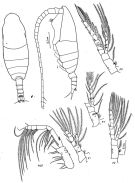 issued from : Brodsky K.A., Vyshkvartseva N.V., Kos M.S. & Markhaseva E.L. in Opred. Faune SSSR, 1983, 135. [p.251, Fig.114]. Female.
|
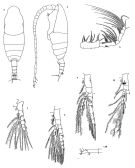 issued from : D.M. Damkaer in NOAA Technical Report NMFS CIRC-391, Seattle, 1975. [p.18, Fig.4-10; p.63, Fig.148]. Female: 4, habitus (dorsal); 5, idem (left lateral side); 6, Mxp; 7, P1; 8, P2; 9, P3; 10, P4; 148, terminal segments of A1.
|
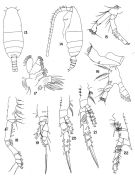 Issued from : T. S. Park in Bull. Mar. Sc., 1970, 20 (2). [p.]480, Figs.13-22]. Female: 13, habitus (dorsal); 14, idem (lateral left side); 15, A2; 16, Md; 17, Mx1; 18, Mxp; 19, P1 (anterior); 20, P2 (posterior); 21, P3 (posterior); 22, P4 (2nd and 3rd exopod segments broken off), posterior. Nota: A2 7-segmented (1st segment with or without a seta, 2nd segment with 3 setae, and 3rd to 6th segments each with a seta. Md: basis with 4 setae and some patches of stiff hairs. Mxp with a comb of spines on basis.
|
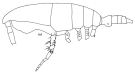 issued from : G.D. Grice & K. Hulsemann in J. Zool., 1965, 146. [p.230, Fig.7, a]. Female (from NE Atlant.): a, habitus (lateral left side).
|
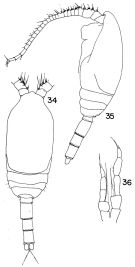 Issued from : T. S. Park in Bull. Mar. Sc., 1970, 20 (2). [p.486, Figs.34-42]. As Spinocalanus parabyssalis. Male (from Caribbean Sea): 34, habitus (dorsal); 35, idem (lateral left side); 36, P5 (posterior). Nota: Prosome about twice as long as urosome. 2nd urosomal segment about 1.5 times as long as the 3rd. Exopod of right P5 reaching middle of 2nd segment of exopod of left P5; right endopod longer than left endopod.
|
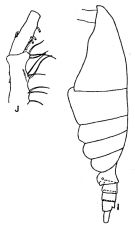 issued from : G.D. Grice in Cah. Biol. Mar., 1971, XII. [p.278, Fig.3 I-J]. Female (from Medit.): I, habitus (lateral left side); J, Mxp (coxa and basis).
|
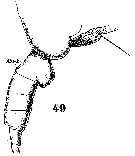 Issued from : W. Giesbrecht in Systematik und Faunistik der Pelagischen Copepoden des Golfes von Neapel und der angrenzenden Meeres-Abschnitte. – Fauna Flora Golf. Neapel, 1892. Atlas von 54 Tafeln. [Taf. 36, Fig.49]; Female: abdomen (lateral, right side).
|
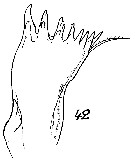 Issued from : W. Giesbrecht in Systematik und Faunistik der Pelagischen Copepoden des Golfes von Neapel und der angrenzenden Meeres-Abschnitte. – Fauna Flora Golf. Neapel, 1892. Atlas von 54 Tafeln. [Taf. 13, Fig.42]; Female: 42, Md (mandibular blade).
|
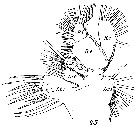 Issued from : W. Giesbrecht in Systematik und Faunistik der Pelagischen Copepoden des Golfes von Neapel und der angrenzenden Meeres-Abschnitte. – Fauna Flora Golf. Neapel, 1892. Atlas von 54 Tafeln. [Taf.13, Fig. 43]. Female: 43, Mx1 (anterior view). B = basipod; Re = exopod; Ri : endopod; Li = inner lobe; Le = outer lobe.
|
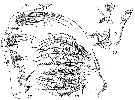 Issued from : W. Giesbrecht in Systematik und Faunistik der Pelagischen Copepoden des Golfes von Neapel und der angrenzenden Meeres-Abschnitte. – Fauna Flora Golf. Neapel, 1892. Atlas von 54 Tafeln. [Taf. 13, Figs.45, 47, 48 ]. Female: 45, Md (mandibular palp); 47, Mxp (anterior view); 48, Mx2 (posterior view). B = basipod; Ri = endopod; L = lobe; S = seta.
|
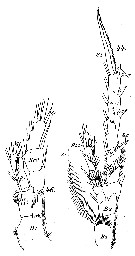 Issued from : W. Giesbrecht in Systematik und Faunistik der Pelagischen Copepoden des Golfes von Neapel und der angrenzenden Meeres-Abschnitte. – Fauna Flora Golf. Neapel, 1892. Atlas von 54 Tafeln. [Taf. 13, Figs.44, 46 ]. Female: 44, P4 (posterior view); 46, P1 (anterior view). Si = inner seta; se = outer seta; St = terminal seta.; B = basipod; Ri3 = 3rd segment of endopod.
|
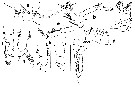 issued from : H.S.J. Roe in Bull. Br. Mus. (Nat. Hist.) Zool., London, 1975, 28 (7). [p.299, Fig.1, a-j]; Male (Cape verde Islands): a, base of A1; b, A2; c, Md; d, Mx2; e, Mxp; f, P1; g, P2; h, P3; i, P4; ; j, P5. Bar scale 0.1 mm unless indicated. Nota : No rostrum. A1 19-segmented (basal eught segments with large flattened sensory filaments, 1st segment with a small group of spines, reaches to about halfway along the 2nd abdominal segment. Cephalothorax arched dorsally, 1.7 times as long as the 5-segmented abdomen. head and 1st thoracic segment fused, 4th and 5th partially fused. 2rd thoracic segment has protruding corners in dorsal view. Anal segment very short, telescoped into the 4th abdominal segment. P5 reaches back to the hind edge of the 2nd abdominal segment.
|
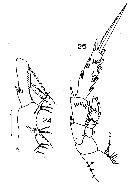 Issued from : J.M. Bradford in N.Z. Oceanogr. Inst., 1971, 206, Part 8, No 59. [p.17, Figs.24, 25]. Female (from Ross Sea): 24, basipod 1 and 2 of Mxp; 25, P2. Scale bar: 100 µm.
|
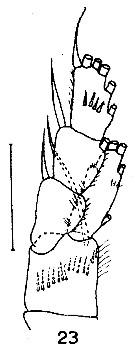 Issued from : J.M. Bradford in N.Z. Oceanogr. Inst., 1971, 206, Part 8, No 59. [p.17, Fig.23]. Female (from Ross Sea): 23, P1. Scale bar: 100 µm.
|
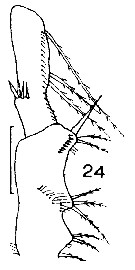 Issued from : J.M. Bradford in N.Z. Oceanogr. Inst., 1971, 206, Part 8, No 59. [p.17, Fig.24]. Female (from Ross Sea): Mxp (basipods 1 and 2). Scale bar: 100 µm.
|
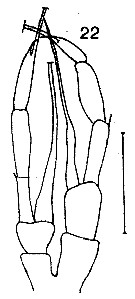 Issued from : J.M. Bradford in N.Z. Oceanogr. Inst., 1971, 206, Part 8, No 59. [p.17, Fig.22]. Male (from 71°15'S, 176°30'E): 22, P5. Scale bar: 100 µm.
|
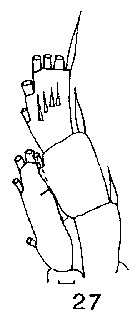 Issued from : J.M. Bradford in N.Z. Oceanogr. Inst., 1971, 206, Part 8, No 59. [p.17, Fig.27]. Male (from Ross Sea): 27, P1. Scale bar: 10 µm.
|
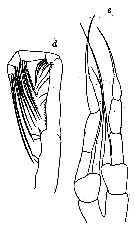 Issued from : O. Tanaka in Japanese J. Zool., 1937, VII, 13. [p.254, Fig.4, e-d]. Male (from coast of Heda, Japan): d, Mxp; e, P5. Nota: Cephalothorax: 1.14 mm; abdomen: 0.48 mm. Frontal margin of the head contracted in the middle. Head and 1st thoracic segment fused, 4th and 5th separated. Abdomen 5-segmented. A1 24-segmented. P5 as With's figure.
|
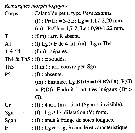 Issued from : C. Razouls in Ann. Inst. océanogr., Paris, 1994, 70 (1). [p.58]. Caractéristiques morphologiques de Spinocalanus abyssalis femelle et mâle adultes. Terminologie et abbréviations: voir à Calanus propinquus.
| | | | | Ref. compl.: | | | Pearson, 1906 (p.10); Jespersen, 1939 (p.46, Rem., Table 25); Wilson, 1942 a (p.209); Sewell, 1948 (p.347, 495, 499, 545, 549, 559, 566, 568); ? C.B. Wilson, 1950 (p.341); Gundersen, 1953 (p.1, 26, seasonal abundance, Fjords distribution); Østvedt, 1955 (p.14: Table 3), p.59; Minoda, 1958 (p.253, 255: occurrence); ? Fagetti, 1962 (p.16); V.N. Greze, 1963 a (tabl.2); M.W. Johnson, 1963 (p.89, Table 1, 2); Unterüberbacher, 1964 (p.20); Shmeleva, 1964 a (p.1068); Grice & Hulsemann, 1965 (p.223); Pavlova, 1966 (p.43); Furuhashi, 1966 a (p.295, vertical distribution vs mixing Oyashio/Kuroshio region, Table 10); Grice & Hulsemann, 1967 (p.14); Matthews, 1967 (p.159, Table 1, Rem.); Fleminger, 1967 a (tabl.1); Vinogradov, 1968 (1970) (p.258, 266); Deevey, 1971 (p.225); Roe, 1972 (p.277, tabl.1, tabl.2); 1972 a (p.331, Rem.); Björnberg, 1973 (p.322, 389); Harding, 1974 (p.141, tab. 3, gut contents); Vives & al., 1975 (p.35, tab.II, III); Deevey & Brooks, 1977 (p.256, tab.2, Station "S"); Pipe & Coombs, 1980 (p.223, figs.1, 2, 4, table 1, vertical distribution); Vives, 1982 (p.290); Rudyakov, 1982 (p.208, Table 2); Kovalev & Schmeleva, 1982 (p.83); Roe, 1984 (p.356); Hopkins, 1985 (p.197, Table 1, gut contents); Lozano Soldevilla & al., 1988 (p.58); Ward & al., 1995 (p.195, Table 2); Errhif & al., 1997 (p.423); Kosobokova & al., 1998 (tab.2); Suarez-Morales & Gasca, 1998 a (p.111); Razouls & al., 2000 (p.343, tab. 5, Appendix); Fernandez-Alamo & al., 2000 (p.1139, Appendix); Kosobokova & Hirche, 2000 (p.2029, tab.2); Holmes, 2001 (p.41); Sameoto & al., 2002 (p.13); Gaard & al., 2008 (p.59, Table1, N Atlantic Mid-Ridge); Galbraith, 2009 (pers. comm.); Park & Ferrari, 2009 (p.143, Table 4, Appendix 1); Schnack-Schiel & al., 2010 (p.2064, Table 2: E Atlantic subtropical/tropical); Mazzocchi & Di Capua, 2010 (p.427); Medellin-Mora & Navas S., 2010 (p.265, Tab. 2); Dvoretsky & Dvoretsky, 2010 (p.991, Table 2); Andersen N.G. & al., 2011 (p.71, Fig.3: abundance); Michels & al., 2012 (p.369, Table 1, occurrence frequency); in CalCOFI regional list (MDO, Nov. 2013; M. Ohman, comm. pers.); Sano & al., 2013 (p.11, Table 6, Rem.: p.21, food habits); Benedetti & al., 2016 (p.159, Table I, fig.1, functional characters); Belmonte, 2018 (p.273, Table I: Italian zones) | | | | NZ: | 20 | | |
|
Carte de distribution de Spinocalanus abyssalis par zones géographiques
|
| | | | | | | | | | | | | | | 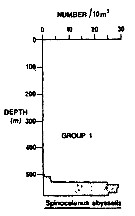 Issued from : R.K. Pipe & S.H. Coombs in J. Plankton Res., 1980, 2 (3). [p.230, Fig.4]. Issued from : R.K. Pipe & S.H. Coombs in J. Plankton Res., 1980, 2 (3). [p.230, Fig.4].
Spinocalanus abyssalis from Wyville Thomson Ridge (60°03.4' N, 07°03.9' W to 60°08' N, 07°02.9' W) on 24 April 1978 : Vertical distribution.
Members of this group (Group 1) were restricted, for the most part, to Norwegian Sea Deep water at depths below 530 m in temperatures of 0-4.8°C.
This group contained 7 calanoids and 1 cyclopoid, plus 2 chaetognaths and 1 euphausid. The 2 most abundant species were S. abyssalis and Oncaea (= Triconia) conifera which together contributed over 75% of the specimen taken in the group. Their distributions showing peak abundance between 530 m and the bottom of the haul (580 m).
Euphausia norvegica euphhausid was attached to this group at a lower level of similarity (19%).
A computed coefficient of dissimilarity was used in association with a 'group-average' clustering strategy (see Clifford & Stephenson, 1975) to classify the plankton taxa on the basis of their vertical distribution after the indices of similarity and the results arranged diagramatically in the form of a dendogram (Fig.2). Classification was carried out using the Bray-Curtis measure which gives a coefficient of dissimilarity. |
| | | | Loc: | | | Cosmopolite: Antarct. (Croker Passage, Peninsula, Weddell Sea, SW Atlant., Indian, SW Pacif., Ross Sea), sub-Antarct. (South Georgia, Indian, SE Pacif.), Caribbean Colombia, Sargasso Sea, off Bermuda: Station "S" (32°10'N, 64°30'W), off E Cape Cod, Atlant., Porcupine Bank, Barents Sea, Norwegian Sea, Akrefjord, Raunefjorden (rare), North Sea, Medit. (W Basin, Ligurian Sea, Tyrrhenian Sea, Adriatic Sea, Aegean Sea), Indian, Pacif., Kuroshio zone, Arct. (Polar Basin), Wyville Thomson Ridgde, Laptev Sea, Kejser Franz Joseph fjord (rare) | | | | N: | 98 | | | | Lg.: | | | (8) M: 1,22-1,06; (13) F: 1,32-0,85; ? (25) F: 2,2-1,7; M: 2,2-1,7; (31) F: 1,89-1,65; (38) F: 1,6-1,45; (47) F: 1,25-1,1; (88) M: 0,9; ? (102) F: 2-1; M: 1,9; (128) M: 1,62; (199) F: 1,6-0,83; (432) F: 1,5-1,2; (545) F: 1,3-1; {F: 0,83-1,98; M: 0,90-1,62} | | | | Rem.: | méso à bathypélagique.
Sampling depth (Antarct., sub-Antarct.) : 300-1000-2000 m. 500-580 m (Pipe & Coombs, 1980, Arctic: 60°N).
Cette espèce semble présenter une migration nycthémérale inverse.
Certaines confusions existent entre cette espèce et S. brevicaudatus, S. terranovae; d’où une distribution géographique peu sûre.
Une différence peut être notée entre les figures de la P5 in Roe (1975) et Park (1970).
Voir aussi les remarques en anglais | | | Dernière mise à jour : 18/01/2021 | |
|
|
 Toute utilisation de ce site pour une publication sera mentionnée avec la référence suivante : Toute utilisation de ce site pour une publication sera mentionnée avec la référence suivante :
Razouls C., Desreumaux N., Kouwenberg J. et de Bovée F., 2005-2025. - Biodiversité des Copépodes planctoniques marins (morphologie, répartition géographique et données biologiques). Sorbonne Université, CNRS. Disponible sur http://copepodes.obs-banyuls.fr [Accédé le 30 août 2025] © copyright 2005-2025 Sorbonne Université, CNRS
|
|
|
|




;)
;)
;)
;)
;)
;)
;)
;)
;)
;)
;)
;)
;)
;)
;)
;)
;)
;)
;)

;)