|
|
 |
| Speleophriidae Boxshall & Jaume, 2000 ( Misophrioida ) | | Ref.: | Boxshall & Halsey, 2004 (p.40; 221: Def.; p.222: Genera key); Vives & Shmeleva, 2010 (p.140, Rem., Genera key); Bradford-Grieve & al., 2014 (p.531: Rem.) | | Rem.: | Boxshall & Jaume (2000 a, p.1) create a family for genera initially placed among the Misophriidae. 7 G: Archimisophria, Boxshallia, Expansophria, Huysia, Protospeleophria, Speleophria, Speleophriopsis, (? plus 1 of uncertain status: Dimisophria).
For Boxshall & Halsey (2004, p.222), speleophriids occur primarily in anchialine habitats, the only exception being the two species of Archimisophria both of which occur in the deep hyperbenthic community in the tropical Atlantic. Large members of Speleophriopsis specimens can be taken in baited traps in caves (Jaume pers. com.) suggesting that they are scavengers.
Boxshall & Jaume (2000 a) analysed the biogeography and the history of colonisetion of anchialine habitats by the speleophriids, concluding that the extreme disjunct distribution pattern by members of the family results from a dispersal and colonisation episode prior to the closure of the Tethys Sea, and that deep-water forms may represent a secondary colonisation rather than an indication of deep-water ancestry for the entire order.
Key to genera after Boxshall & Halsey (2004, p.222):
1 - P1 with 3-segmented endopod ........... 2.
1' - P1 with 2-segmented endopod ............ 4.
2 - 1st pedigerous somite free but completely concealed beneath carapace-like posterior extension of dorsal cephalic shield ................ Archimisophria.
2' - 1st pedigerous somite free and fully or largely exposed, not concealed ........ 3.
3 - P5 with inner spine on basis representing endopod; female A1 27-segmented with conspicuous swelling on proximal segment ........... Boxshallia.
3' - P5, if present, lacking any vestige of endopod; female A1 26-segmented .......... Expansophria.
4 - P5 with 1-segmented endopod bearing apical seta .......... Huysia.
4' - P5 lacking any vestige of endopod ........... 5.
5 - P4 with 3 or 4 inner setae on 3rd exopodal segment; terminal segment of female P5 with 3 or 4 setal elements, innermost fused to segment .......... 6.
5' - P4 with 5 inner setae on 3rd exopodal segment; terminal segment of female P5 with 6 setal elements ........... Speleophriopsis.
6 - P4 with 3 inner on 3rd exopodal segment; Mxp with inner praecoxal seta ......... Protospeleophria.
6' - P4 with 4 inner setae on 3rd exopodal segment; Mxp lacking praecoxal seta ............ Speleophria. | 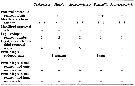 issued from : D. Jaume, G.A. Boxshall & T.M. Iliffe in J. Nat. Hist., 1998, 32. [p.672, Table 1] Main distinguishing features between genera in the Spelepphria group. |
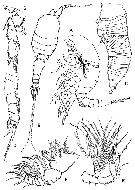 Issued from : G.A. Boxshall & S.H. Halsey in An Introduction to Copepod Diversity, Part II, The Ray Society, 2004, Part II, No 166. [p.223, Fig.58]. A, Expansophria galapagensis male; B, Speleophria bunderae female; C, Archimisophria discoveryi female urosome; D, Archimisophria squamosa P5 female; E, Boxshallia bulbantennulata A2; F, Mxp; G, female P5 and intercoxal sclerite.
From Boxshall & Iliffe, 1990: A; Jaume, Boxshall & Humphreys, 2001: B; Huys & Boxshall, 1991: C-G. |
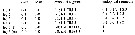 Issued from : G.A. Boxshall & S.H. Halsey in An Introduction to Copepod Diversity, Part II, The Ray Society, 2004, Part II, No 166. [p.221]. Armature formula of swimming legs P1 to P4 and legs P5 male (m) and female (f). Nota: Swimming legs P1 to P4 biramous, typically with 3-segmented rami except endopod of P1 often 2-segmented due to failure of 2nd and 3rd segmets to separate; members of each leg pair joined by intercoxal sclerite; inner coxal seta and outer seta on basis present, inner seta on basis on P1 only. - Setation often reduced or modified by transformation of setae into spines. - P5 primitively biramous; members of leg pair joined by intercoxal sclerite; praecoxa usually absent; coxa and basis separate or fused; basis with outer seta; inner coxal seta absent; exopod typically 2-segmented and bearing up to 7 setal elements in female; 2 or 3-segmented and with up to 8 setae in male; endopod 1-segmented and bearing 1 seta in both sexes, or reduced to single seta as in Boxshallia. P5 usually uniramous due to loss of endopod; entire P5 absent in Expansophria apoda Boxshall & Iliffe, 1987. - P6 confluent in female, separate in male, represented by opercular plate closing off genital openings. | | | | | (1) Archimisophria Boxshall, 1983 | |
| | Ref.: | Boxshall, 1989 (p.522); Huys & Boxshall, 1991 (p.88, 407, 460); Boxshall & Halsey, 2004 (p.222) | | Rem.: | Type: Archimisophria Boxshall, 1983. Total: 2 species.
Hyperbenthic | | Remarks on dimensions and sex ratio: | | The mean female size is 1.367 mm (n = 3; SD = 0.2517) and the mean male size is 1.20 mm (n = 2). The size ratio (male/female) is 0.94, or approximately 88-96 %. The sex ratio (female/male) is up to date 2/1 in 2014. | | | | (2) Boxshallia Huys, 1988 | |
| | Ref.: | Huys, 1988 a (p.139, Rem.); Boxshall, 1989 (p.522, 524); Huys & Boxshall, 1991 (p.88, 461); Jaume & al., 1998 (p.672); Boxshall & Halsey, 2004 (p.222); Vives & Shmeleva, 2010 (p.152, Rem.) | | Rem.: | Type: Boxshallia bulbantennulata Huys, 1988. Total: 1 sp.
Diagnosis after R. Huy (1988, p.139) :
- Prosome 5-segmented with posterior margin of Mxp-bearing somite not produced into carapace-like expansion.
- 1st pedigerous somite exposed.
- Urosome 5-segmented in female ; genital double-somite without any trace of subdivisions.
- A1 with conspicuous swelling at the outer side of segment 1 ; 27-segmented in female with aesthetascs on segments XI, XVI and XXVII ; 23-segmented in male, unigeniculate between segments XIX and XX, with aestherascs on segments XI, XVI and XXIII.
- Exopod of A2 7-segmented ; endopod indistinctly 3-segmented
- Md palp biramous ; basis with 3 setae ; endopod 2-segmented ; exopod 3-segmented.
- Mx1 with 1-segmented rami ; epipodite with 7 setae.
Praecoxa and coxa of Mx2 with 2 endites each ; endopod 3-segmented.
- Mxp with 4 endites on syncoxa and with 6-segmented endopod.
- Coxa of P1 wkthout inner spine ; endopod 3-segmented.
- Distal exopod segment P1-P4 with 3 outer spines.
- Distolateral angle of 2nd endopod segment bifid in P2-P4.
- P5 biramous, endopod represented as a bipinnate spine ; exopod 2-segmented ; with distinct intercoxal sclerite and coxa in female ; positioned midventrally in male.
- Caudal ramus with 6 setae.
The new genus can be distinguished from all other misophrioids by the presence of the bulb-shaped process on the 1st antennular segment of both sexes. This structure is already discernible in the copepodite I stage. In spite of the profound condensation of the proximal segments, the primitive 27-segmented condition is still recognisable.
The new genus is unique in the presence of 3 setae on the basis of Md. Another unusual feature is the presence of 4 setae midway along the inner margin of the proximal endopod segment. A high number of armature elements occurrs also on different parts of Mx1. The new genus is unique amongst misophrioids in lacking an inner spine on the coxa of P1 in both sexes. The new genus shows a bifidprocess on the distolateral angle of the 2nd endopod segment of P2-P4; this detailed structure is also present in most deep-sea genera, however, not always on the same legs. | | | | (0) Dimisophria Boxshall & Iliffe, 1987 | |
| | Ref.: | Boxshall & Iliffe, 1987 (p.245); Boxshall, 1989 (p.522); Huys & Boxshall, 1991 (p.88); Boxshall & Halsey, 2004 (p.222, Rem.); Vives & Shmeleva, 2010 (p.154, Rem.) | | Rem.: | Type: Dimisophria cavernicola Boxshall & Iliffe, 1987. Total: 1 sp. | | | | (3) Expansophria Boxshall & Iliffe, 1987 | |
| | Ref.: | Boxshall & Iliffe, 1987 (p.230); Boxshall, 1989 (p.522); Huys & Boxshall, 1991 (p.88); Jaume & Boxshall, 1996 a (p.1591, Rem: biogeography); Vives & Shmeleva, 2010 (p.141, Rem., spp. key) | | Rem.: | type: Expansophria dimorpha. Total 4 spp. | | Remarks on dimensions and sex ratio: | | The mean female size is 0.583 mm (n = 6; SD = 0.0698) and the mean male size is 0.48 mm (n = 2). The size ratio (male/female) is 0.84, or approximately 82-84 %. The sex ratio (female/male) is up to date 3/1 in 2014. | | | | | (4) Huysia Jaume, Boxshall & Iliffe, 1998 | |
| | Ref.: | Jaume & al., 1998 (p.663); Boxshall & Halsey, 2004 (p.222) | | Rem.: | Type: Huysia bahamensis Jaume, Boxshall & Iliffe, 1998 . Total: 1 sp. | | | | (5) Protospeleophria Jaume, Boxshall & Iliffe, 1998 | |
| | Ref.: | Jaume & al., 1998 (p.672); Boxshall & Halsey, 2004 (p.222) | | Rem.: | Type: Protospeleophria lucayae Jaume, Boxshall & Iliffe, 1998. Total: 1 sp. | | | | (6) Speleophria Boxshall & Iliffe,1986; emend. Jaume & Boxshall, 1996 | |
| | Ref.: | Boxshall & Iliffe, 1986 (p.55); Boxshall, 1989 (p.522); Huys & Boxshall, 1991 (p.88, 467); Jaume & Boxshall, 1996 (p.998, 1004, Rem.); Jaume & al., 2001 (p.20, Rem.); Boxshall & Halsey, 2004 (p.222); Karanovic & Eberharde, 2009 (p.61, spp. Key Females); Vives & Shmeleva, 2010 (p.144, Rem., spp. Key) | | Rem.: | Type: Speleohria bivexilla. Total: 5 spp. | | Remarks on dimensions and sex ratio: | | The mean female size is 0.556 mm (n = 9; SD = 0.1106) and the mean male size is 0.53 mm (n = 4, SD = 0.0658). The size ratio (male/female) is variable according to the species: 0.97- 0.74, or approximately 89 %. The sex ratio (female/male) is up to date 4/2 in 2014. | | | | | (7) Speleophriopsis Jaume & Boxshall, 1996 | |
| | Syn.: | Speleophria Boxshall & Iliffe, 1986 (part.) | | Ref.: | Jaume & Boxshall, 1996 (p.990, 1004, Rem.); 1996 a (p.1591, : biogeography); Boxshall & Halsey, 2004 (p.222); Vives & Shmeleva, 2010 (p.43, Rem., spp. Key) | | Rem.: | type: Speleophriopsis balearicus. Total: 4 spp.
| | Remarks on dimensions and sex ratio: | | The mean female size is 0.720 mm (n = 4; SD = 0.2544) and the mean male size is 0.85 mm (n = 2). The size ratio (male/female) is variable according to the species 0.89-1.07, or approximately 98 %. The sex ratio (female/male) is up to date 4/2 in 2014. | | | | |
|
|
 Any use of this site for a publication will be mentioned with the following reference : Any use of this site for a publication will be mentioned with the following reference :
Razouls C., Desreumaux N., Kouwenberg J. and de Bovée F., 2005-2026. - Biodiversity of Marine Planktonic Copepods (morphology, geographical distribution and biological data). Sorbonne University, CNRS. Available at http://copepodes.obs-banyuls.fr/en [Accessed March 14, 2026] © copyright 2005-2026 Sorbonne University, CNRS
|
|
|
|




;)
;)
;)