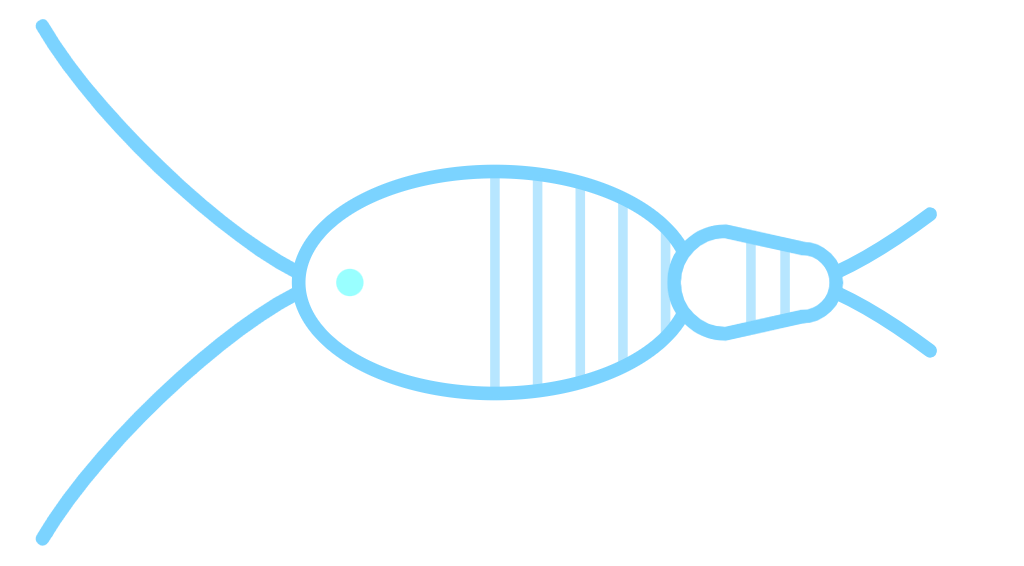



General features of the external morphology of marine planktonic Copepods
Body forms
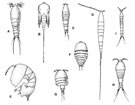
These are evidently related to a particular type of habitat (whether marine or freshwater) and behaviour :
- Planktonic suspension forms, analogous to Calanus finmarchicus, have large antennules, an ovoid anterior body and a narrow cylindrical posterior body, generally shorter and extended by the furca bearing long plumose setae whose suspensory function is evident.
- Benthic forms, living in contact with the substrate or within sediments, have a cylindrical appearance, most often without a clear delimitation between the two body parts, short antennules, a short furca with only one or two long and non-plumose setae.
- Intermediate forms possess both swimming and temporary attachment behaviours. The anterior body, tapering posteriorly, is distinct from the posterior body, but the demarcation between the two parts is less pronounced than in the first group, less cylindrical than the second, with short antennules.
 With the occasional exception of the frontal region, the postero-lateral angles of the "last visible thoracic segment", and the female genital segment, the body is not adorned with large spines or expansions, except in a few cases such as the Harpacticoids Laophonte horrida, in the abyssal genus Pontostratiotes (fig. G5 , B) and the curious Ceratonotus coineaui. Very frequently among numerous copepods one observes the presence of minute, more or less numerous spines towards the posterior segments of the body, dorsally and laterally. More discreetly, epicuticular microstructures such as micro-setae and pores can be seen on the body.
The shape of the female genital segment often loses its cylindrical appearance in relation to its function. Its internal and external structure is sometimes very complex.
This segment shows a simple ventral concavity in Calanus finmarchicus, a prominently "button-shaped" genital area in the genera Euchaeta, Paraeuchaeta, and can be completely deformed and asymmetrical in most Pontellidae.
Finally, the form of the various body parts cannot be entirely independent of the degree of development of the appendages they bear and their functional, or indeed multifunctional, role.