


General Features of the External Morphology of Marine Planktonic Copepods
Mating
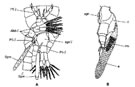
Mating appears to be the most frequent case in copepods (cf. in Tierwelt Deutschlands, 9, 1928) (fig. G16, A), but the mode of copulation varies with species. In all cases, after capture of the female and her immobilisation by the male using the geniculate antennule, it results in the deposition of the spermatophore, most frequently near the genital area. In calanoids this is achieved via the pincer-shaped part of the fifth pair of legs.
The first description of the spermatophore in copepods refers to the freshwater cyclopoid Cyclops castor (Siebold, 1839), a structure necessary given the absence of a copulatory organ and the non-flagellate spermatozoa. This structure is well described in certain species (see in Subramoniam, 1993), for example in the calanoids Acartia tonsa and Euchaeta norvegica presenting a spermatophore whose attachment system is simple compared to that of species of Centropagidae and Pontellidae, more complex with a species-specific mating device pre-adapted to the female genital segment and the genital region (Heberer, 1932; Fleminger, 1967; Lee, 1972) (fig. G16, B).
In the case of simple attachment, the spermatophore is glued using an adhesive substance that hardens very rapidly in water (Hammer, 1978).
The bringing together of the sexes, induced and oriented, as well as mating, involve chemical and mechanical mechanisms whose substrates are seen in the glandular system and the tegumental tactile setae.
Blades and Youngbluth (1979) describe the highly sophisticated reproductive behaviour of the marine calanoid Labidocera aestiva, which shows a series of pre-copulatory caresses.
The duration of mating appears to be very variable; it would be shorter in calanoids than in harpacticoids (Canthocamptus, a freshwater form, remains mated for about eight days before the final act) and cyclopoids (male and female Oncaea are often captured firmly attached to one another).
McLaren and Corkett (1978) indicate that in Pseudocalanus sp. (marine calanoid), mating occurs preferentially between individuals of similar size.
Real observations of spermatophore transfer are lacking; thus the involvement of P5 and the action of a pheromone remain speculative (Subramoniam, 1993).
The presence of a single spermatophore is observed preferentially on the genital segment of the adult female and not on any earlier stage, as shown by Hopkins and Machin (1977) on Euchaeta norvegica.
In cyclopoids, Dussart (1967) reports the attachment of two spermatophores glued symmetrically near the female genital pore.