Introduction | Morphologie générale | Morphologie des diverses parties du corps et des appendices | Dimensions | Formes | Principales modifications structurelles | Les antennules | Les antennes | Le cadre buccal : Labrum et labium | Les Mandibules | Les Maxillules ou premières maxilles | Les Maxilles (Maxilla) ou secondes maxilles | Les Maxillipèdes | Les pattes natatoires | Variation du nombre des segments corporels | Nomenclature des parties du corps et Métamérie | Structures et organes tégumentaires | Organes visuels | Variations de la morphologie | Sex-ratio | Gynandromorphisme et intersexualité | Accouplement | Parthénogénèse | Caractéristique de la ponte | Les formes larvaires | La durée du développement | La croissance | Régénération | Anomalies | Classification et Phylogénie | Références | Photothèque
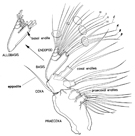
Elles ont été considérées à tort par divers auteurs comme des maxillipèdes antérieurs (Mxp1) en raison de leur proximité topographique, et souvent de leurs ressemblances avec les appendices suivants (fig.
|


|
Razouls C., Desreumaux N., Kouwenberg J. and de Bovée F., 2005-2026. - Biodiversity of Marine Planktonic Copepods (morphology, geographical distribution and biological data). Sorbonne University, CNRS. Available at http://copepodes.obs-banyuls.fr/en [Accessed June 21, 2026] © copyright 2005-2026 Sorbonne University, CNRS |
 Any use of this site for a publication will be mentioned with the following reference :