


General Morphology of Marine Planktonic Copepods
The antennae
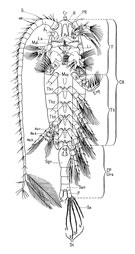
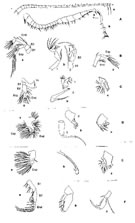
During the nauplius stages, copepods bear a second biramous antenna that serves as a locomotory appendage (together with the antennules and mandibles). The exopodite comprises more segments than the slightly shorter endopodite. This primitive character is retained in the adult stage in free-living copepods such as Calanus finmarchicus, where it appears to have preserved its locomotory function, at least partially (fig. G3 , B, a).
1 In the Calanoida, the antennae are always biramous, with the endopodite and exopodite of more or less equal length and multisegmented. The endopodite is generally three-segmented with a more or less distinct fusion of the distal segment, but generally less by fusion than by the insertion of groups of setae that allow individualisation. The exopodite is multisegmented with 7 or 8, or even 9 segments (Euchirella messinensis).
In the Calanoida, there are species in which the size of the exopodite is reduced (Acartia).
2 In the Harpacticoida, this tendency is even more pronounced and may lead to an insignificant size. When present, the number of segments may range from 1 to 8 (generally 4 or fewer). The endopodite has 3 segments, the first of which may be fused with the basis to form an allobasis (Lang, 1948, p.46). The antenna is relatively more robust and shortened, less setose than in the Calanoida, and bears spines and denticulations, in relation to the free but benthic mode of life of the group. In forms that are somewhat natatory, the exopodite is still well developed.
3 In free-living Cyclopoida (fig. G3 , B, b) a complete disappearance of the exopodite or its regression to a vestigial segment is observed. This condition results, during development, from the alignment of the sympodite and the endopodite (2 or 3 segments) along the same axis. The antennae have become smaller than the antennules (A1), suggesting a decrease in their functional importance.
Kabata (1979) considers that by gradually losing their locomotory function the antennae evolved into prehensile organs, allowing diversification towards commensal, semi-parasitic and then parasitic forms (Poecilostomatoida and Siphonostomatoida).
4 In free-living Poecilostomatoida, the coxa and basis are fused into a coxobasis bearing a distal seta, followed by 2 or 3 segments, the distal one armed with one or several hook-like setae. The exopodite is absent.
This appendage is adapted for prehension. Still barely marked in the Oncaeidae, it becomes more pronounced in the Sapphirinidae, Lubbockiidae, and even more so in the Corycaeidae with a true unciform claw.
In the Sapphirinidae (often observed on salps), for example, although relatively small, the antennae are definitively prehensile. The basal segment is short and an articulation is intercalated between it and a much longer second segment; the two following distal segments have become equivalent to the pincer and the claw that folds against the second segment.
In the genus Corycaeus (fig. G3 , B, b2) they reach a condition similar to that of a fish-gill parasite (Ergasilus). The structural differences between the sexes suggest that males use this appendage during mating (Kabata, 1979, p.20). Thus the antennae may take on the function fulfilled by the antennules in other free-living copepods. In both cases, the muscular development required for the flexion of the distal segments has resulted in a modification of the anterior segment or segments.
5 In free-living Siphonostomatoida, the coxa and basis, lacking setae, may be fused, as may the first segment of the endopodite, and may bear (Hyalopontius, Pontoeciella) or not (Ratania) an exopodite reduced to a small segment. The well-developed endopodite has 2 segments, the distal one bearing a strong hooked seta (Hyalopontius), plus several small setae with long terminal hooks (Ratania).
The function of this appendage corresponds to temporary attachment to the prey (Hyalopontius), or is non-prehensile (Pontoeciella).
6 In the order Monstrilloida, the antennae have completely disappeared, as have the other buccal appendages, in the adult.