


General Features of the External Morphology of Marine Planktonic Copepods
General morphology
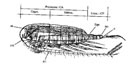
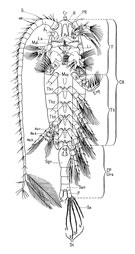
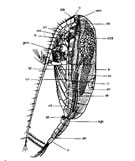
The body presents two distinct segmented regions (tagmata): the anterior one, larger and broader, constitutes the anterior body or Prosome; the posterior part, shorter and narrower, forms the posterior body or Urosome. These two parts are articulated in the sagitto-vertical plane.
The anterior body consists of six visible segments: the first corresponds to the head or Cephalosome, bearing five pairs of appendages: the antennules (A1), the antennae (A2), the mandibles (Md), the maxillules (Mx1), the maxillae (Mx2), plus the first thoracic somite, fused to the head, which bears a pair of maxillipeds (Mxp).
The five following segments are termed "thoracic" and constitute the metasome. Each bears ventrally a pair of biramous swimming legs, united by a chitinous plate (intercoxal sclerite) which renders them functionally coupled (P1 to P5). This characteristic gave its name to this class (or subclass), derived from the Greek kopion: small oar, and podos: foot, more commonly translated as oar-shaped leg.
The posterior body, called the "abdomen" or urosome, is composed of four segments in the female and five in the male, all lacking appendages. The first, articulated with the anterior body, is the "genital segment" (Sgn); the last presents the anus (An) medio-dorsally: this is the anal segment (San), on which the caudal rami (furca) are inserted, consisting of two independent, parallel and more or less flattened rods. Each bears distally six setae: four terminal setae (St), one on the inner apical margin (Si) and one on the outer margin (Se).
The thinness of the cuticle allows observation of various internal organs (fig. G1B).
‹ IntroductionMorphology of the various body parts and appendages ›