


General Features of the External Morphology of Marine Planktonic Copepods
Classification and Phylogeny
;) J.E. Bron, D. Frisch, E. Goetze, S.C. Johnson, C.E. Lee & G.A. Wyngaard in Frontiers in Zoology, 2011, 8:22. [p.11, Fig.2].
J.E. Bron, D. Frisch, E. Goetze, S.C. Johnson, C.E. Lee & G.A. Wyngaard in Frontiers in Zoology, 2011, 8:22. [p.11, Fig.2].
Simplified phylogram showing the position of the copepods with respect to the other major arthropod taxa.
This topology is based on the largest data set available, 41 kb of single-copy nuclear protein coding genes, and is modified after Regier & al. (2005).
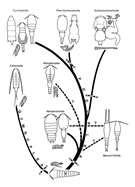
The current classification of copepods, taken as a whole, is based on external morphological characters considered from an evolutionary perspective, as remarkably expressed by Huys and Boxshall (1991) following Kabata (1979). A consensus seems to exist both on the hypothetical structure of the copepod ancestor (Cf. in Boxshall, Ferrari & Tiemann, 1984) and on the evolutionary scheme of the group (Cf. Huys & Boxshall, 1991; J.-s. Ho, 1990). In the near future, genetic analysis should clarify the phyletic relationships at the various taxonomic levels.
Currently the subclass Copepoda comprises nine orders: Platycopioida, Calanoida, Misophrioida, Gelyelloida, Harpacticoida, Mormonilloida, Cyclopoida, Siphonostomatoida, Monstrilloida.
Boxshall & Halsey (2004, p.1) question the existence of the Poecilostomatoida.
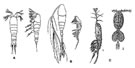 All these orders, with the exception of the Gelyelloida (found in groundwaters of karstic environments) (fig. G18, A)
(Ref.: Boxshall & Halsey, 2004 (p.419 & seq.)), have representatives that are entirely or partly free-living in the pelagic domain.
All these orders, with the exception of the Gelyelloida (found in groundwaters of karstic environments) (fig. G18, A)
(Ref.: Boxshall & Halsey, 2004 (p.419 & seq.)), have representatives that are entirely or partly free-living in the pelagic domain.
Order: Platycopioida ( Cf.  ) Fosshagen, 1985 (fig. G17, A)
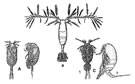
Ref.: Boxshall & Halsey, 2004 (p.45 & seq.)
Body of gymnoplean type, with articulation between thoracic segment "5" and the first urosomal segment.
Prosome comprising the cephalosome and 5 free pedigerous somites; urosome with 5 segments in both sexes.
Antennules short and stout with a large number of segments, little differentiated between the sexes. Generally without geniculation in the male except in Antrisocopia, in which both antennules are geniculate.
Antennae with exopodites more developed than the endopodites.
Labrum trifoliate.
An intermaxilliped process on a median sclerite bearing teeth.
Swimming legs 2 to 5 built on the same plan, the setae almost completely transformed into spines.
Male leg 5 similar to leg 4, except in Platycopia with modifications on both rami.
Urosome similar in both sexes.
Remarks: Free-living marine forms, hyperbenthic, in shallow water or in submarine caves. 1 family: Platycopiidae Sars,1911 with 4 genera: Antrisocopia, Nanocopia, Platycopia, Sarsicopia.
Super-Order: Gymnoplea Giesbrecht,1882
Order: Calanoida ( Cf. ) Sars,1902 (fig. G17, B)
Ref.: Boxshall & Halsey, 2004 (p.49 & seq.)
Body of gymnoplean type, with articulation between thoracic segment "5" and the genital segment.
Prosome comprising a cephalosome and 5 free pedigerous somites; urosome with 4 segments in the female and 5 in the male.
Antennules long with numerous segments (up to 27), but often with fusions. Often modified into a prehensile organ on one side (most commonly the right) in the male.
Mouth with poorly developed labrum and labium.
Antennae, mandibles and maxillules biramous. Maxillae and maxillipeds uniramous.
Swimming legs biramous, multisegmented, bearing plumose setae.
Female leg 5 symmetrical, present, reduced or absent, always more or less modified in the male.
Presence of a heart.
Remarks: Free-living marine, brackish or freshwater forms from stagnant waters. The dominant group in the pelagic domain, very abundant numerically but with low diversity (fewer than 1800 species), occupying the entire water column from the greatest depths (hadopelagic) to the subsurface layer (hyponeuston) and from the coastal and estuarine province, submarine cavities, to the oceanic province: 42 families with approximately 238 genera. Acartiidae, Aetideidae, Arietellidae, Augaptilidae, Bathypontiidae, Boholinidae, Calanidae, Candaciidae, Centropagidae, Clausocalanidae, Diaixidae, Discoidae, Epacteriscidae, Eucalanidae, Euchaetidae, Fosshageniidae, Heterorhabdidae, Hyperbionychidae, Lucicutiidae, Megacalanidae, Mesaiokeratidae, Metridinidae, Nullosetigeridae, Paracalanidae, Parapontellidae, Phaennidae, Pontellidae, Pseudocyclopidae, Pseudocyclopiidae, Pseudodiaptomidae, Rhincalanidae, Ridgewayiidae, Rostrocalanidae, Ryocalanidae, Scolecitrichidae, Spinocalanidae, Stephidae, Sulcanidae, Temoridae, Tharybidae, Tortanidae. The Diaptomidae are entirely freshwater.
Remark: These families are distributed among 10 superfamilies as defined in Boxshall & Halsey, 2004 (p.38).
Order: Misophrioida ( Cf. ) Gurney,1933 (fig. G17, C)
Ref.: Boxshall & Halsey, 2004 (p.215 & seq.)
Body of podoplean type, with articulation between thoracic segments "4" and "5".
Prosome comprising a cephalosome plus 4 free pedigerous somites; urosome with 6 segments in both male and female (with partial fusion of the genital somites and the first abdominal somite).
Antennules short with 11 to 27 segments, often with fusions, prehensile on both sides in the male.
Antennae with a well-developed exopodite.
Mandible with a masticatory blade.
The carapace of the cephalosome can expand posteriorly owing to dilation of the digestive tract.
Mouth as in the Calanoida.
Reduced heart present or absent.
Remarks: Free-living marine forms, living near the bottom (hyperbenthic) in coastal waters or at depth, in submarine cavities of volcanic islands.
3 families: Misophriidae, Palpophriidae, Speleophriidae.
Ref.: Boxshall & Halsey, 2004 (p.415 & seq.)
Body of podoplean type, with articulation between segments "4" and "5".
Prosome comprising a cephalosome and 4 free pedigerous somites; urosome with 4 segments in the female and 5 in the male.
Antennules long but with only 3 or 4 segments, geniculate on both sides in the male.
Mouth with labrum and labium not very prominent.
Buccal appendages as in the gnathostome Cyclopoids, atrophied in the male.
Swimming legs biramous, multisegmented. Leg 5 absent.
Remarks: free-living marine meso- to bathypelagic forms. 1 family: Mormonillidae Giesbrecht, 1892 with two genera Mormonilla Giesbrecht,1891 and two species, and Neomormonilla Ivanenko & Defaye, 2006, but widely represented in all seas.
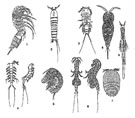
Ref.: Boxshall & Halsey, 2004 (p.224 & seq.)
Body of podoplean type, with poorly marked delimitation between prosome and urosome. Articulation between thoracic segments "4" and "5".
Prosome comprising the cephalosome and 4 free pedigerous somites; urosome with 6 segments in both male and female (with partial fusion of the genital segment and the first abdominal segment).
Antennules short, generally with fewer than 10 segments, prehensile on both sides in the male.
Antennae and mandibles biramous.
Antenna with exopodite shorter than the endopodite.
The first pair of thoracic legs of the same structure as the following pairs but more or less transformed into a prehensile organ; the next three pairs always natatory with three-segmented rami, the endopodites sometimes shorter than the exopodites. The last pair (P5) very different from the preceding ones, of lamellar structure. Often a rudimentary P6 in the male.
The heart always absent.
Remarks: the Harpacticoids are considered the order closest to the ancestral type. They are also the most diverse and the group that has colonised the widest variety of habitats, including the most extreme. Free-living marine or freshwater forms living mainly on the bottom and in sediments, rarely commensal. Some pelagic forms in the open sea or on coasts distributed among 7 families: Aegisthidae, Clytemnestridae, Ectinosomatidae, Miraciidae, Tachidiidae, Thalestridae and Tisbidae, with only 12 genera each represented by one or two species.
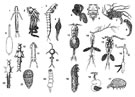
Ref.: Boxshall & Halsey, 2004 (p.422 & seq.)
Body of podoplean type, with articulation between pedigerous somites "4" and "5".
Prosome comprising a cephalosome and 4 free pedigerous somites; urosome with 6 segments in both sexes (often with fusion between the genital somite and the first abdominal somite).
Antennules short, with 6 to 26 segments (with numerous fusions), geniculate on both sides in the male.
Antennae biramous, sometimes uniramous with the exopodite absent, with a terminal claw in certain families.
Mouth with labrum and labium not very prominent.
Mandibles and maxillules biramous, the mandible with a masticatory blade (gnathobase) but with a palp of variable structure depending on the family, or even absent (Lernaeidae).
Swimming legs well developed except for the reduced P5.
Remarks: Free-living marine and continental freshwater forms, planktonic or benthic, commensal or parasitic on invertebrates or vertebrates (with a strongly deformed body). Some rare pelagic forms distributed among several families: Clausidiidae, Corycaeidae, Lubbockiidae, Oithonidae, Sapphirinidae, Speleoithonidae. The Thaumatopsyllidae lack buccal appendages, which gives them the appearance of a Monstrillid.
Remark: Thaumatopsylloida Ho, Dojiri, Hendler & Deets,2003. The family Thespesiopsyllidae (= Thaumatopsyllidae), included by Sars (1921) in the section of the cyclopimorphic Monstrilloida, was transferred to the Cyclopoida (Huys & Boxshall, 1991), but this transfer is contested by J-s. Ho, 1994. Ho & al. (2003, p.582 & seq.) establish this new order. The latter is not accepted by Boxshall & Halsey (2004, p.41). (figs. G18, C2)
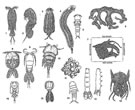
Body of podoplean type, with articulation between thoracic segments "4" and "5".
Prosome comprising a cephalosome and 4 free pedigerous somites; urosome with 6 segments in both sexes (often with fusions).
Antennules small (8 segments at most, generally 3 to 6), with sexual dimorphism showing pseudogeniculation on both sides in the male.
Antennae uniramous due to loss of the exopodites.
Mandible sickle-shaped (characteristic) or with a gnathobase bearing short denticulate blades.
Maxillules very reduced, maxillae reduced.
Maxillipeds subcheliform when present.
Swimming legs biramous except the fifth, which is reduced, variously modified and diminished.
Remarks: Adult forms commensal or parasitic on most invertebrates and marine fishes. Parasitism often leads to degeneration of the appendages in the female and to wholly spectacular deformations of the body in which the segmentation has completely disappeared following metamorphosis of the copepodite. Variable sexual dimorphism. Some rare pelagic families: Clausidiidae (represented by juvenile stages), Corycaeidae, Oncaeidae, Lubbockiidae, Paralubbockiidae, Sapphirinidae, Urocopiidae. All these families are placed in the single order Cyclopoida.
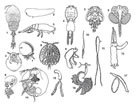
Ref.: Boxshall & Halsey, 2004 (p.706 & seq.)
Body of podoplean type, with articulation between pedigerous somites "4" and "5".
Prosome incorporating the first pedigerous somite and 3 free pedigerous somites; urosome with 6 segments in both sexes.
Female antennules with 21 segments, male with 19 segments with geniculation, often reduced by fusion.
Antennae biramous, but with loss of the exopodite in many families, often terminating in a strong hook.
Mouth with labrum and labium prolonged into a siphon, but without fusion at the base, allowing the stylet-bearing gnathobase of the mandible to penetrate it.
Maxillules and maxillipeds subcheliform.
Swimming legs in the adult of the classical type or variously modified and reduced. P5 reduced when present.
Remarks: ecto- or endoparasitic forms on marine or freshwater fishes and on various invertebrates. The success of the parasitic lifestyle of this order is demonstrated by the variety of morphological and biological adaptations. Of the fifteen hundred species of copepods parasitic on fishes, nearly 75 per cent belong to this order. Males are often commensal on females. Three families are pelagic and free-living, at least as adults: Rataniidae, Pontoeciellidae and Megapontiidae, all monogeneric.
Ref.: Boxshall & Halsey, 2004 (p.834 & seq.)
Body of podoplean type, with articulation between pedigerous somites "4" and "5".
Prosome incorporating the first pedigerous somite and 3 free pedigerous somites; urosome with 4 segments in the female and 5 in the male.
Antennules directed anteriorly, with 4 indistinct segments in the female, 5 in the male with geniculation. Cephalic appendages absent. Mouth closed or with a median process open at the centre of the ventral surface of the cephalosome.
Swimming legs built on the primitive plan: biramous with 3 segments each; P4 and P5, or P5 alone, reduced.
Presence of 2 long spines on the genital segment of the female serving as support for the eggs (possibly P6 or a new structure); in the male a bifid protrusion.
Remarks: Free-living planktonic marine forms only as adults, endoparasitic in polychaete annelids infested by the nauplius (protelan-type parasitism). 1 family: Monstrillidae with the genera Cymbasoma , Monstrilla , Monstrillopsis (possibly), and less certain Haemocera , Strilloma and Thaumatoessia. (fig. G18, C2)