


General features of external morphology of marine planktonic copepods
The antennules
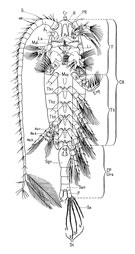
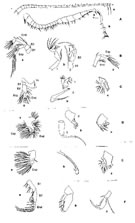
They consist of a single row of segments, more or less cylindrical, decreasing in size towards the distal end (fig. G3, A). The number of segments varies according to the major taxonomic divisions. They may be nearly identical in both sexes, or exhibit in the male a sexual dimorphism more or less pronounced, asymmetric or symmetric, with or without one or two articulations towards the distal part (fig. G3, A, b). Setae and aesthetes occupy particular sites on the segments in a specific sequential pattern that allows a chaetotaxy to be defined (Fleminger, 1985). Segment fusion or reduction is analysed on this basis (Cf. in Huys & Boxshall, 1991, p.20, 362-364). Fundamentally the number of segments is 28: the basal segment bears 3 setae plus 1 aesthete; segments 2 to 21 and 24 to 27 bear 2 setae + 1 aesthete (trithek); segments 22 and 23: 1 seta + 1 aesthete; the distal segment 28: 4 setae + 1 aesthete. In practice (faunal accounts, descriptions), the numbering of segments takes into account only those that are individually recognizable or showing a trace of separation, which is often incomplete.
1 In the group of planktonic copepods (living in the open water), the antennule plays an essential role (though not the only one) in locomotion and buoyancy, owing to its elongation and the presence of numerous plumose setae.
In the Calanoida, at most 27 segments are counted (Erebonectes nesioticus), 25 in Calanus finmarchicus female and 16 in females of Pontellopsis.
The length, independently of segment number, may reach or exceed the distal end of the furca as in Calanus finmarchicus, greatly exceed the furcal setae as in female Haloptilus longicornis, or be shorter than the prosome as in Phaenna or Euchaeta-Paraeuchaeta, or even shorter than the head as in Pseudocyclopia. Mesopelagic species appear to possess the longest antennules, whereas species living close to the bottom have relatively shorter ones.
The relative lengths of segments within the same species may vary (Sewell, 1929, 1932). According to Gaudy (1971a), antennule length in Centropages typicus would be correlated with water density.
Locomotion is achieved by powerful fore-and-aft beats, generally discontinuous. The musculature, stronger in the male than in the female, results in slightly dilated proximal segments as in Calanus finmarchicus.
Male antennules may be symmetric and similar to those of the female as in the tribe Isokerandria, for example Diaixis or Stephos. Symmetric and sexually slightly dimorphic but without articulation, for example Calanus finmarchicus as in the tribe Amphascandria. Asymmetric and sexually more or less strongly modified (most often on the right side, but sometimes on the left) into a prehensile organ involved in mating, as in the tribe Heterarthrandria. These sections established by Giesbrecht (1892), supplemented by Sars (1901-1903), have since been abandoned as having no taxonomic value (Huys & Boxshall, 1991, p.50-51).
The antennules bear receptor organs belonging morphologically and functionally to two categories: setae and aesthetes (or aesthetascs).
Setae are of several morphological types, essentially slender and short, flexible and more rigid, often bearing a single or double row of fine hairs giving them a plumose appearance. They are presumed to be mechanoreceptors, some contributing to lift particularly the longer and more plumose ones, often located on the distal segments.
Aesthetes are also of several morphological types, club-shaped or narrow-lamellate. They are presumed to be chemoreceptors (Cf. in Mauchline, 1998, p.18).
The setae and aesthetes, which occupy particular sites on the segments in a specific sequential pattern, enabled Fleminger (1985) to define a chaetotaxy in the Calanidae.
One function of the antennule is the detection of food, water movements, and predators (Landry, 1980; Poulet et al., 1986; Yen, 1987; Jonnson & Tiselius, 1990; Yen et al., 1992; Yamazaki & Squires, 1996).
Another function is linked to reproduction, principally in the male: chemical detection of pheromones and/or mechanical detection of the female (Fleminger, 1967), followed by capture of the posterior part of the female.
2 In the group of Cyclopoida, the number of segments in the female is highly variable, generally between 6 and 21, sometimes more (26 in Cyclopicina). Antennule length rarely reaches the end of the body, or even the end of the prosome in marine planktonic species such as Oithona, but fusion (or loss) of segments confers an apparent elongation, and they are equipped with long setae. In freshwater or brackish species, whose swimming is most often intermittent, resting on substrates, the antennules barely exceed the cephalosome and their setae are relatively short.
In the male, segments, some of which are dilated, show more fusions than in the female; the maximum number is 17 in Macrocyclops albidus. They are geniculate on both sides, forming towards the distal part a more or less distinct chela whose function, as in the Calanoida, is to hold the female during mating.
It should be noted that in the family Thespesiopsyllidae, included until Huys & Boxshall (1991) among the Monstrilloida, the female and male antennules show respectively 15 and 14 segments.
3 In the group of Harpacticoida, the number of segments is variable, from 3 to 9 at most in the female and 14 in the male.
Length is always reduced, rarely exceeding the cephalosome, in relation to the benthic or meiofaunal habitat.
Male antennules, geniculate on both sides, show increasing complexity: of haplocere type for the least modified (such as Microsetella norvegica), intermediate of the sub-chelicere type (as in Eucanuella spinifera), and finally the chelicere type with the segment anterior to the geniculation thickened and strongly dilated and a single segment posterior to the geniculation (as in Tigriopus brevicornis).
4 In the group of Poecilostomatoida (mainly commensal and parasitic), the number of segments is reduced (from 6 to 8), slightly sexually dimorphic, but showing no geniculation in the male, in which it plays no role during mating.
Although the free-living species are pelagic, the antennules are very short and bear few setae.
5 In the group of Siphonostomatoida (essentially parasitic), the maximum number of segments is 21, often fewer. In the male, they may or may not show a geniculation.
6 In the group of Monstrilloida, the segments are often poorly defined, numbering 4 in the female and 5 in the male, the latter showing a well-marked geniculation. The setae are varied. The antennules are directed forward, nearly parallel.
7 For the order Gelyelloida, represented by species inhabiting the subterranean environments of karstic systems, see in Huys & Boxshall, 1991 (p.185-191).