Introduction | Morphologie générale | Morphologie des diverses parties du corps et des appendices | Dimensions | Formes | Principales modifications structurelles | Les antennules | Les antennes |
Le cadre buccal : Labrum et labium | Les Mandibules | Les Maxillules ou premières maxilles | Les Maxilles (Maxilla) ou secondes maxilles | Les Maxillipèdes | Les pattes natatoires | Variation du nombre des segments corporels | Nomenclature des parties du corps et Métamérie | Structures et organes tégumentaires | Organes visuels |
Variations de la morphologie | Sex-ratio | Gynandromorphisme et intersexualité | Accouplement | Parthénogénèse | Caractéristique de la ponte |
Les formes larvaires | La durée du développement | La croissance | Régénération |
Anomalies | Classification et Phylogénie | Références | Photothèque
 Nomenclature des parties du corps et Métamérie : Nomenclature des parties du corps et Métamérie :
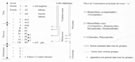
Comme le souligne Vaupel-Klein (1982), historiquement, le corps des Copépodes est divisé en deux parties (ou tagmes) appelées soit céphalothorax et abdomen, soit corps antérieur et postérieur, selon que l'on considère ou non que le corps des Arthropodes est fondamentalement divisé en céphalon, thorax et abdomen comme chez les insectes (in Traité de Zoologie, tome VII, fasc. I, p.9 et suiv.).
Par la suite, ont été introduits les termes de céphalosome (céphalon + somite du maxillipède), métasome et urosome, ces deux derniers représentant une subdivision du tagme abdominal primitif.
En prenant en considération la place de l'articulation principale du corps (in Traité de Zoologie, tome VII, fasc. 1, p.24), Gooding (1957) définit en avant le prosome (céphalosome + métasome) et vers l'arrière l'urosome. La plupart des auteurs admettent que, d'un point de vue fonctionnel, la tête comprend le céphalon plus le premier somite thoracique, et que le septième somite thoracique avec le premier abdominal appartiennent à l'urosome, la région intermédiaire comprenant les somites thoraciques restants.
On admet généralement l'existence de 16 ou 17 segments (fig. G13). Le plan général comprend, outre l'acron, 5 céphaliques (ou 6 si l'on considère le labre comme un appendice transformé), 7 thoraciques et 4 abdominaux, ce qui, avec la structure des mandibules, maxillules et maxilles, inclut les Copépodes dans un taxon d'ordre supérieur. Dahl (1956, 1963) le définit sous le terme de Maxillopodes, considérés comme une classe des Diantennates ou Crustacés (in Traité de Zoologie, tome VII, fasc.1, p.4, 5, 8, 19, 293). G13). Le plan général comprend, outre l'acron, 5 céphaliques (ou 6 si l'on considère le labre comme un appendice transformé), 7 thoraciques et 4 abdominaux, ce qui, avec la structure des mandibules, maxillules et maxilles, inclut les Copépodes dans un taxon d'ordre supérieur. Dahl (1956, 1963) le définit sous le terme de Maxillopodes, considérés comme une classe des Diantennates ou Crustacés (in Traité de Zoologie, tome VII, fasc.1, p.4, 5, 8, 19, 293).
La présence d'une septième paire d'appendices (P6 dans la numérotation courante) sur le tronc de divers Harpacticoïdes ainsi que d'autres caractères analysés par Hessler (1982) et Boxshall (1983) n'autorisent guère le maintien de ce taxon.
Dans ces conditions, l'origine des Copépodes (considérés alors comme une classe) est monophylétique. A partir d'un type ancestral, diverses adaptations plus ou moins étendues ont induit des modifications du plan de base initial qui sont à l'origine des divers groupes ou ordres.
Pour Marcotte (1983) le plan est de type: Acron + 4 segments pour la tête, 7 thoraciques, 4 abdominaux + telson (avec anus dorsal) + rames caudales.
Il convient de souligner la distinction entre la segmentation apparente du corps de l'adulte dont la nomenclature est différente de celle utilisée pour les somites dérivés au cours du développement embryonnaire. Les terminologies varient souvent selon les auteurs, mais tendent actuellement à s'unifier.
Remarques :
1 - On admet que le céphalon originel des Arthropodes comprend six somites primaires qui portent successivement: les yeux pédonculés (non développés chez les Copépodes), les antennules (A1), les antennes (A2), les mandibules (Md), les maxilles antérieures (Mx1), les maxilles postérieures (Mx2).
La question de savoir si l'acron présomitique comprend ou non des structures homologues, et s'il inclut ou non le somite antennulaire, n'est pas encore résolue. De même, on ne sait encore si le labrum correspond à une structure sternale ou à une paire d'appendices fusionnés et fait partie de l'acron ou d'un somite intercalaire.
Vaupel-Klein (1982) suggère que la paire de tubercules frontaux qui portent les fils rostraux (issus des organes frontaux sous-jacents) pourrait traduire l'existence d'un premier somite embryonnaire pré-antennulaire, du fait de leur position antérieure extrême et de leur innervation par un rameau primaire du nerf optique.
Le cas de l'antennule, uniramée, et de son homologie avec les appendices biramés des somites suivants est encore en discussion.
La ressemblance souvent frappante entre les derniers appendices céphaliques (Mx2) et les maxillipèdes (non réunis entre eux par une plaque intercoxale, sauf cas particuliers, au contraire des pattes natatoires) est interprétée comme une convergence fonctionnelle.
2 - La nature thoracique du premier somite de l'urosome est déduite par référence aux segments thoraciques 6 et 8 qui portent les gonopores chez la femelle et le mâle des Malacostracés, ainsi que par la présence chez certains Copépodes podopléens d'une sixième paire de pattes vestigiales.
On admet généralement que le septième somite thoracique (communément noté Th6 ou Abd1dans la littérature) est un somite génital mâle chez les Calanoïdes, qui comptent un segment de plus à l'urosome que la femelle. Chez celle-ci, ce segment est composite, incluant aussi le premier somite originel abdominal, l'ensemble constituant ce qu'il convient d'appeler le complexe génital ou somite génital double (et non comme on le trouve souvent dans la littérature le segment génital ou le premier segment abdominal). Gurney (1931) considère toutefois que le complexe génital est formé par deux somites thoraciques (Th7+Th8)
3 - Le complexe formé par le somite anal, l'opercule anal et la furca est diversement interprété.
Bowman (1971) considère le métamère anal comme le véritable somite terminal portant un telson, réduit sous la forme de l'opercule anal, et les rames furcales qui sont considérées homologues à la paire d'uropodes des Malacostracés, suivi par Kabata (1979) et Vaupel Klein (1982). Huys et Boxshall (1991, p.315) contestent cette interprétation, pour ceux-ci le développement ontogénique montre que le "somite" anal est un telson (non un vrai somite), de plus on note l'absence d'opercule anal dans le groupe primitif des Platycopioida comme dans la famille la plus primitive des Pseudocyclopidae (Calanoida)
Les discussions actuelles sur l'origine probablement polyphylétique des divers groupes de Crustacés (Lang, 1948; Dahl, 1963; Manton, 1977; Yager, 1981) Vaupel-Klein (1982) soulignent qu'il convient de mettre en question la différence fondamentale entre les somites thoraciques et abdominaux, ainsi que la nature secondaire de la tagmose des Crustacés, y compris des Copépodes.
La correspondance des segments et de la tagmose entre les divers auteurs, ainsi que les homologies avec les Malacostracés et au cours du développement entre les Gymnopléens et les Podopléens, ont été résumées par Dudley (1986).
|





 Any use of this site for a publication will be mentioned with the following reference :