


General Features of the External Morphology of Marine Planktonic Copepods
Main structural modifications
The apparent segmentation of the body, through fusion of anterior and/or posterior segments, is often more variable within a taxonomic group at the order level than between orders themselves. The most extreme cases of segmentation modification are naturally found in parasitic forms, which will not be considered here (cf. Raibaut, 1996 in Traité de Zoologie, Crustacés, VII, fasc.2:)
Since the somitic origin of segments is not taken into account in the naming and numbering of segments, the terminologies used by different authors may differ.
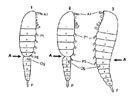 A maximum of eleven segments are counted, grouped into two parts: the anterior or prosome and the posterior or urosome, with a more or less equal number of segments in each. An articulation (fig. G6, A) of variable degree distinguishes the two body parts.
The evolution of segment number, and the number and structure of appendages, are closely linked to mode of locomotion, feeding modes, and sexual behaviour.